

environment of Daisyworld is solely specified by temperature, the best way to test
the Gaia Hypothesis is to affect Daisyworld in such a way that temperature is the
independent variable. Note, however, that most of the graphs presented here have
time as the independent variable. This is somewhat misleading since time is not
significant to Daisyworld; instead the luminosity of the sun is the independent
variable used in this investigation. But SUN LUMINOSITY is varied linearly with
respect to time, so the time axes in the graphs can easily be translated to a SUN
LUMINOSITY axis.
First, let us consider what is expected of a Daisyworld unaffected by biology. In
this case, the albedo of the planet surface is constant and equal to 0.5. As the solar
luminosity increases, the temperature of the planet surface increases (almost)
linearly by the Stefan-Boltzmann rule. There is only a small range of luminosities
where the planet surface temperature is suitable for daisy growth, so we expect few
daisies to appear. This is clearly not a situation where life that requires a certain
temperature to grow would thrive. It is this type of environment that life without
Gaia faces. Whatever biota are present must be able to survive in the given
environmental conditions. As we see in the graphs of Figs. 44.5 and 44.6, daisies
are only present during the short interval in which the planet’s surface temperature
is appropriate for their growth. Daisies are entirely subject to their environment.
How should a Gaian Daisyworld respond to changing solar flux? Lovelock
asserts that the daisies should regulate the temperature of Daisyworld at the
optimum growth temperature, 25
C, over a range of solar luminosities. Furthermore, perturbations that are not too large should be accommodated by Daisyworld.
The most important characteristic of Gaia is that Gaian feedbacks are homeostatic
and should increase stability of the system. Indeed, Lovelock claims the model
always shows greater stability with daisies than it does without them. Thus, if we
find that Daisyworld is not more stable with daisies than without, then we can safely
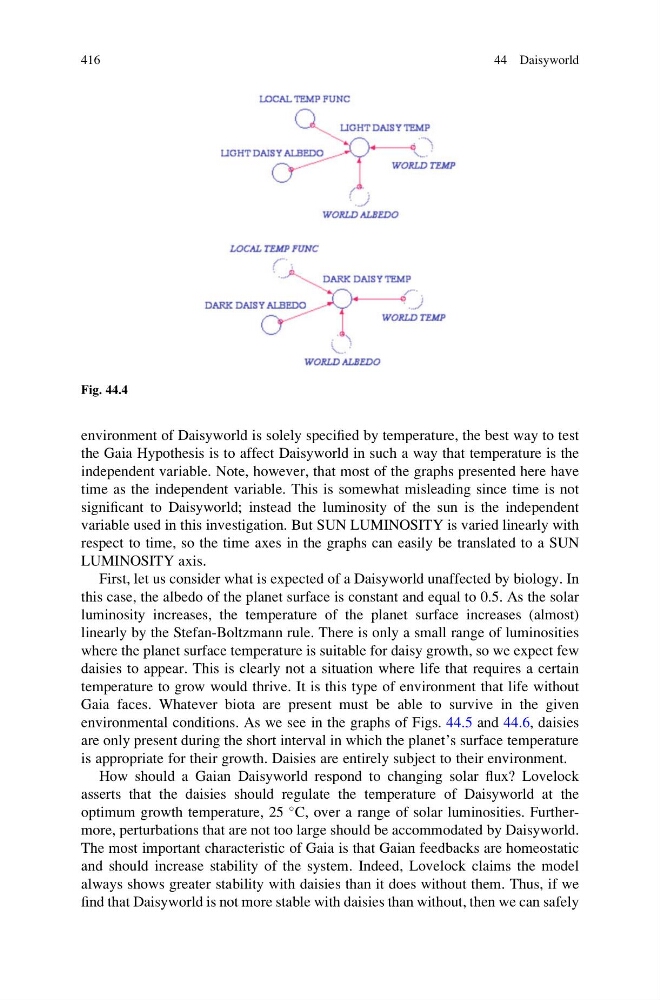
Fig. 44.4
416
44 Daisyworld
the Gaia Hypothesis is to affect Daisyworld in such a way that temperature is the
independent variable. Note, however, that most of the graphs presented here have
time as the independent variable. This is somewhat misleading since time is not
significant to Daisyworld; instead the luminosity of the sun is the independent
variable used in this investigation. But SUN LUMINOSITY is varied linearly with
respect to time, so the time axes in the graphs can easily be translated to a SUN
LUMINOSITY axis.
First, let us consider what is expected of a Daisyworld unaffected by biology. In
this case, the albedo of the planet surface is constant and equal to 0.5. As the solar
luminosity increases, the temperature of the planet surface increases (almost)
linearly by the Stefan-Boltzmann rule. There is only a small range of luminosities
where the planet surface temperature is suitable for daisy growth, so we expect few
daisies to appear. This is clearly not a situation where life that requires a certain
temperature to grow would thrive. It is this type of environment that life without
Gaia faces. Whatever biota are present must be able to survive in the given
environmental conditions. As we see in the graphs of Figs. 44.5 and 44.6, daisies
are only present during the short interval in which the planet’s surface temperature
is appropriate for their growth. Daisies are entirely subject to their environment.
How should a Gaian Daisyworld respond to changing solar flux? Lovelock
asserts that the daisies should regulate the temperature of Daisyworld at the
optimum growth temperature, 25
C, over a range of solar luminosities. Furthermore, perturbations that are not too large should be accommodated by Daisyworld.
The most important characteristic of Gaia is that Gaian feedbacks are homeostatic
and should increase stability of the system. Indeed, Lovelock claims the model
always shows greater stability with daisies than it does without them. Thus, if we
find that Daisyworld is not more stable with daisies than without, then we can safely
Fig. 44.4
416
44 Daisyworld