

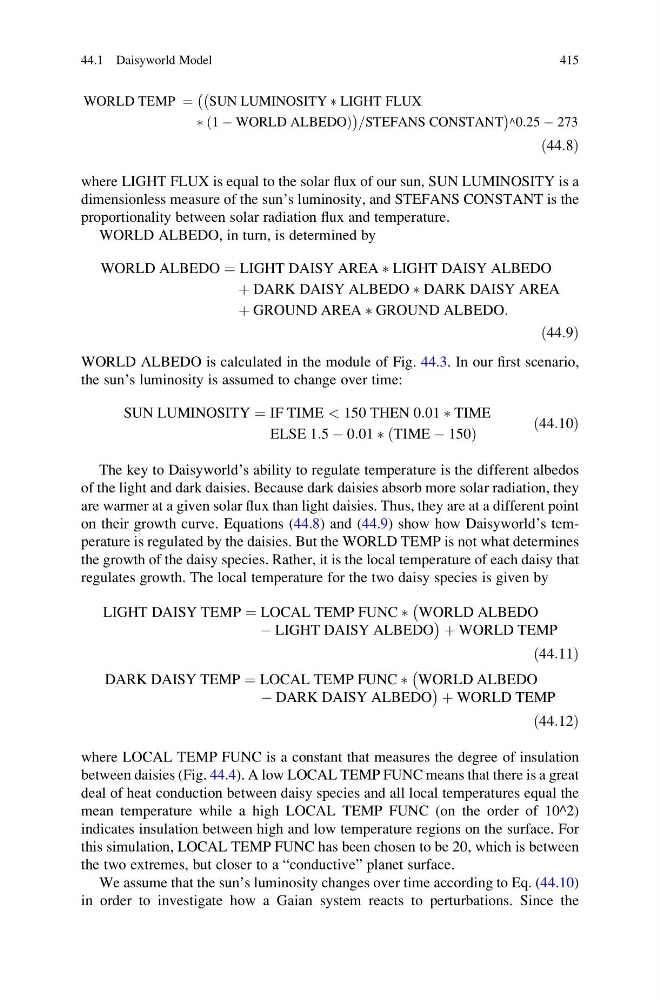
WORLD TEMP ¼
ÀÀ
SUN LUMINOSITY Ã LIGHT FLUX
à 1 À WORLD ALBEDO
ð
Þ
Á
=STEFANS CONSTANT
Á ⋀ 0:25 À 273
ð44:8Þ
where LIGHT FLUX is equal to the solar flux of our sun, SUN LUMINOSITY is a
dimensionless measure of the sun’s luminosity, and STEFANS CONSTANT is the
proportionality between solar radiation flux and temperature.
WORLD ALBEDO, in turn, is determined by
WORLD ALBEDO ¼ LIGHT DAISY AREA Ã LIGHT DAISY ALBEDO
þ DARK DAISY ALBEDO Ã DARK DAISY AREA
þ GROUND AREA Ã GROUND ALBEDO:
ð44:9Þ
WORLD ALBEDO is calculated in the module of Fig. 44.3. In our first scenario,
the sun’s luminosity is assumed to change over time:
SUN LUMINOSITY ¼ IF TIME < 150 THEN 0:01 Ã TIME
ELSE 1:5 À 0:01 Ã TIME À 150
ð
Þ
ð44:10Þ
The key to Daisyworld’s ability to regulate temperature is the different albedos
of the light and dark daisies. Because dark daisies absorb more solar radiation, they
are warmer at a given solar flux than light daisies. Thus, they are at a different point
on their growth curve. Equations (44.8) and (44.9) show how Daisyworld’s temperature is regulated by the daisies. But the WORLD TEMP is not what determines
the growth of the daisy species. Rather, it is the local temperature of each daisy that
regulates growth. The local temperature for the two daisy species is given by
LIGHT DAISY TEMP ¼ LOCAL TEMP FUNC Ã
À
WORLD ALBEDO
À LIGHT DAISY ALBEDO
Á þ WORLD TEMP
ð44:11Þ
DARK DAISY TEMP ¼ LOCAL TEMP FUNC Ã
À
WORLD ALBEDO
À DARK DAISY ALBEDO
Á þ WORLD TEMP
ð44:12Þ
where LOCAL TEMP FUNC is a constant that measures the degree of insulation
between daisies (Fig. 44.4). A low LOCAL TEMP FUNC means that there is a great
deal of heat conduction between daisy species and all local temperatures equal the
mean temperature while a high LOCAL TEMP FUNC (on the order of 10^2)
indicates insulation between high and low temperature regions on the surface. For
this simulation, LOCAL TEMP FUNC has been chosen to be 20, which is between
the two extremes, but closer to a “conductive” planet surface.
We assume that the sun’s luminosity changes over time according to Eq. (44.10)
in order to investigate how a Gaian system reacts to perturbations. Since the
44.1 Daisyworld Model
415
ÀÀ
SUN LUMINOSITY Ã LIGHT FLUX
à 1 À WORLD ALBEDO
ð
Þ
Á
=STEFANS CONSTANT
Á ⋀ 0:25 À 273
ð44:8Þ
where LIGHT FLUX is equal to the solar flux of our sun, SUN LUMINOSITY is a
dimensionless measure of the sun’s luminosity, and STEFANS CONSTANT is the
proportionality between solar radiation flux and temperature.
WORLD ALBEDO, in turn, is determined by
WORLD ALBEDO ¼ LIGHT DAISY AREA Ã LIGHT DAISY ALBEDO
þ DARK DAISY ALBEDO Ã DARK DAISY AREA
þ GROUND AREA Ã GROUND ALBEDO:
ð44:9Þ
WORLD ALBEDO is calculated in the module of Fig. 44.3. In our first scenario,
the sun’s luminosity is assumed to change over time:
SUN LUMINOSITY ¼ IF TIME < 150 THEN 0:01 Ã TIME
ELSE 1:5 À 0:01 Ã TIME À 150
ð
Þ
ð44:10Þ
The key to Daisyworld’s ability to regulate temperature is the different albedos
of the light and dark daisies. Because dark daisies absorb more solar radiation, they
are warmer at a given solar flux than light daisies. Thus, they are at a different point
on their growth curve. Equations (44.8) and (44.9) show how Daisyworld’s temperature is regulated by the daisies. But the WORLD TEMP is not what determines
the growth of the daisy species. Rather, it is the local temperature of each daisy that
regulates growth. The local temperature for the two daisy species is given by
LIGHT DAISY TEMP ¼ LOCAL TEMP FUNC Ã
À
WORLD ALBEDO
À LIGHT DAISY ALBEDO
Á þ WORLD TEMP
ð44:11Þ
DARK DAISY TEMP ¼ LOCAL TEMP FUNC Ã
À
WORLD ALBEDO
À DARK DAISY ALBEDO
Á þ WORLD TEMP
ð44:12Þ
where LOCAL TEMP FUNC is a constant that measures the degree of insulation
between daisies (Fig. 44.4). A low LOCAL TEMP FUNC means that there is a great
deal of heat conduction between daisy species and all local temperatures equal the
mean temperature while a high LOCAL TEMP FUNC (on the order of 10^2)
indicates insulation between high and low temperature regions on the surface. For
this simulation, LOCAL TEMP FUNC has been chosen to be 20, which is between
the two extremes, but closer to a “conductive” planet surface.
We assume that the sun’s luminosity changes over time according to Eq. (44.10)
in order to investigate how a Gaian system reacts to perturbations. Since the
44.1 Daisyworld Model
415