

MIG PRED 1 ¼ MIN
À
PRED 1 À DEATH PRED 1, MIG RATE PRED
ÃDEATH PRED 1
ð40:10Þ
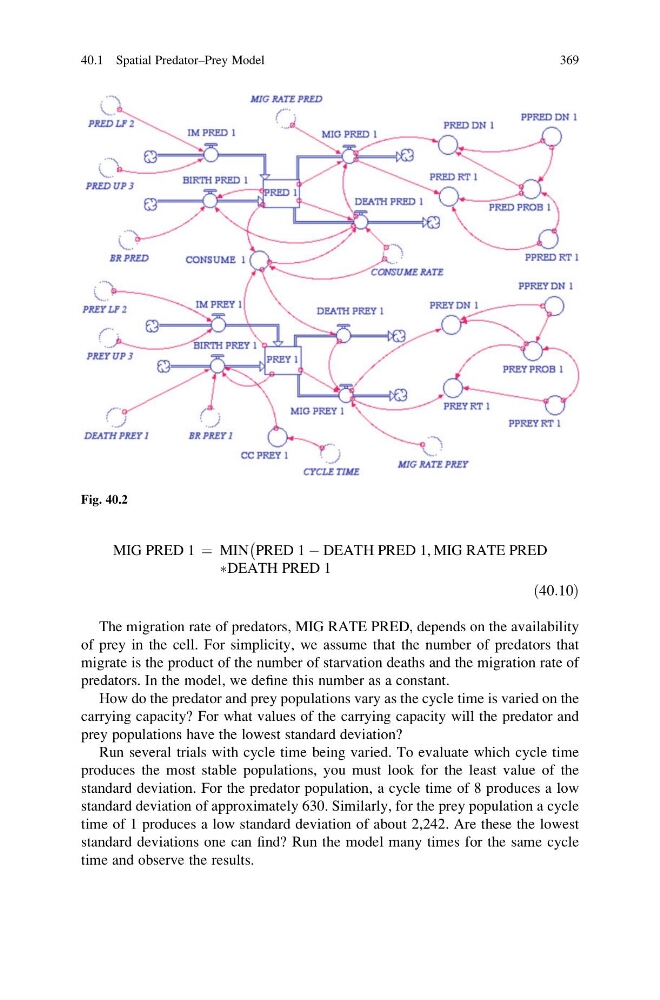
The migration rate of predators, MIG RATE PRED, depends on the availability
of prey in the cell. For simplicity, we assume that the number of predators that
migrate is the product of the number of starvation deaths and the migration rate of
predators. In the model, we define this number as a constant.
How do the predator and prey populations vary as the cycle time is varied on the
carrying capacity? For what values of the carrying capacity will the predator and
prey populations have the lowest standard deviation?
Run several trials with cycle time being varied. To evaluate which cycle time
produces the most stable populations, you must look for the least value of the
standard deviation. For the predator population, a cycle time of 8 produces a low
standard deviation of approximately 630. Similarly, for the prey population a cycle
time of 1 produces a low standard deviation of about 2,242. Are these the lowest
standard deviations one can find? Run the model many times for the same cycle
time and observe the results.
Fig. 40.2
40.1 Spatial Predator–Prey Model
369
À
PRED 1 À DEATH PRED 1, MIG RATE PRED
ÃDEATH PRED 1
ð40:10Þ
The migration rate of predators, MIG RATE PRED, depends on the availability
of prey in the cell. For simplicity, we assume that the number of predators that
migrate is the product of the number of starvation deaths and the migration rate of
predators. In the model, we define this number as a constant.
How do the predator and prey populations vary as the cycle time is varied on the
carrying capacity? For what values of the carrying capacity will the predator and
prey populations have the lowest standard deviation?
Run several trials with cycle time being varied. To evaluate which cycle time
produces the most stable populations, you must look for the least value of the
standard deviation. For the predator population, a cycle time of 8 produces a low
standard deviation of approximately 630. Similarly, for the prey population a cycle
time of 1 produces a low standard deviation of about 2,242. Are these the lowest
standard deviations one can find? Run the model many times for the same cycle
time and observe the results.
Fig. 40.2
40.1 Spatial Predator–Prey Model
369