

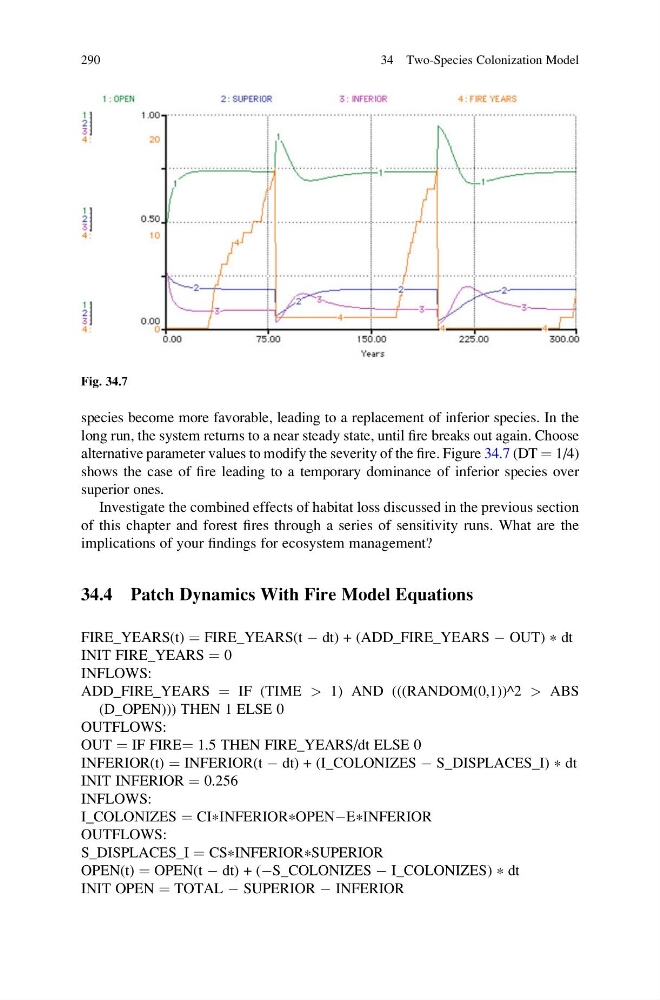
species become more favorable, leading to a replacement of inferior species. In the
long run, the system returns to a near steady state, until fire breaks out again. Choose
alternative parameter values to modify the severity of the fire. Figure 34.7 (DT ¼ 1/4)
shows the case of fire leading to a temporary dominance of inferior species over
superior ones.
Investigate the combined effects of habitat loss discussed in the previous section
of this chapter and forest fires through a series of sensitivity runs. What are the
implications of your findings for ecosystem management?
34.4 Patch Dynamics With Fire Model Equations
FIRE_YEARS(t) ¼ FIRE_YEARS(t À dt) + (ADD_FIRE_YEARS À OUT) * dt
INIT FIRE_YEARS ¼ 0
INFLOWS:
ADD_FIRE_YEARS ¼ IF (TIME > 1) AND (((RANDOM(0,1))^2 > ABS
(D_OPEN))) THEN 1 ELSE 0
OUTFLOWS:
OUT ¼ IF FIRE¼ 1.5 THEN FIRE_YEARS/dt ELSE 0
INFERIOR(t) ¼ INFERIOR(t À dt) + (I_COLONIZES À S_DISPLACES_I) * dt
INIT INFERIOR ¼ 0.256
INFLOWS:
I_COLONIZES ¼ CI * INFERIOR * OPENÀE * INFERIOR
OUTFLOWS:
S_DISPLACES_I ¼ CS * INFERIOR * SUPERIOR
OPEN(t) ¼ OPEN(t À dt) + (ÀS_COLONIZES À I_COLONIZES) * dt
INIT OPEN ¼ TOTAL À SUPERIOR À INFERIOR
Fig. 34.7
290
34 Two-Species Colonization Model
long run, the system returns to a near steady state, until fire breaks out again. Choose
alternative parameter values to modify the severity of the fire. Figure 34.7 (DT ¼ 1/4)
shows the case of fire leading to a temporary dominance of inferior species over
superior ones.
Investigate the combined effects of habitat loss discussed in the previous section
of this chapter and forest fires through a series of sensitivity runs. What are the
implications of your findings for ecosystem management?
34.4 Patch Dynamics With Fire Model Equations
FIRE_YEARS(t) ¼ FIRE_YEARS(t À dt) + (ADD_FIRE_YEARS À OUT) * dt
INIT FIRE_YEARS ¼ 0
INFLOWS:
ADD_FIRE_YEARS ¼ IF (TIME > 1) AND (((RANDOM(0,1))^2 > ABS
(D_OPEN))) THEN 1 ELSE 0
OUTFLOWS:
OUT ¼ IF FIRE¼ 1.5 THEN FIRE_YEARS/dt ELSE 0
INFERIOR(t) ¼ INFERIOR(t À dt) + (I_COLONIZES À S_DISPLACES_I) * dt
INIT INFERIOR ¼ 0.256
INFLOWS:
I_COLONIZES ¼ CI * INFERIOR * OPENÀE * INFERIOR
OUTFLOWS:
S_DISPLACES_I ¼ CS * INFERIOR * SUPERIOR
OPEN(t) ¼ OPEN(t À dt) + (ÀS_COLONIZES À I_COLONIZES) * dt
INIT OPEN ¼ TOTAL À SUPERIOR À INFERIOR
Fig. 34.7
290
34 Two-Species Colonization Model