

Once fifteen such fire years accumulated, we assume a fire occurs that is large
enough to affect the extinction rates of species from their colonized patches. We
calculate a variable FIRE as
FIRE ¼ IF FIRE YEARS ¼ 15 THEN 1:5 ELSE 0
ð34:8Þ
and capture its impacts on the extinction of the species from a particular forest
patch, by modifying the extinction rate to
E ¼ 0:4 þ RANDOM :45; :65
ð
ÞÃFIRE=DT
ð34:9Þ
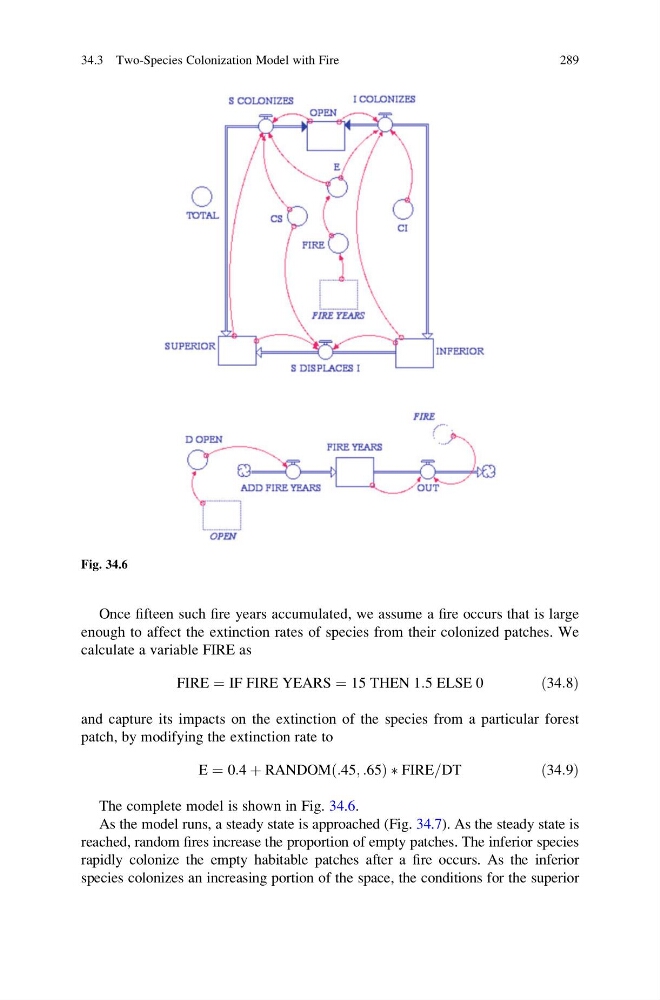
The complete model is shown in Fig. 34.6.
As the model runs, a steady state is approached (Fig. 34.7). As the steady state is
reached, random fires increase the proportion of empty patches. The inferior species
rapidly colonize the empty habitable patches after a fire occurs. As the inferior
species colonizes an increasing portion of the space, the conditions for the superior
Fig. 34.6
34.3 Two-Species Colonization Model with Fire
289
enough to affect the extinction rates of species from their colonized patches. We
calculate a variable FIRE as
FIRE ¼ IF FIRE YEARS ¼ 15 THEN 1:5 ELSE 0
ð34:8Þ
and capture its impacts on the extinction of the species from a particular forest
patch, by modifying the extinction rate to
E ¼ 0:4 þ RANDOM :45; :65
ð
ÞÃFIRE=DT
ð34:9Þ
The complete model is shown in Fig. 34.6.
As the model runs, a steady state is approached (Fig. 34.7). As the steady state is
reached, random fires increase the proportion of empty patches. The inferior species
rapidly colonize the empty habitable patches after a fire occurs. As the inferior
species colonizes an increasing portion of the space, the conditions for the superior
Fig. 34.6
34.3 Two-Species Colonization Model with Fire
289