

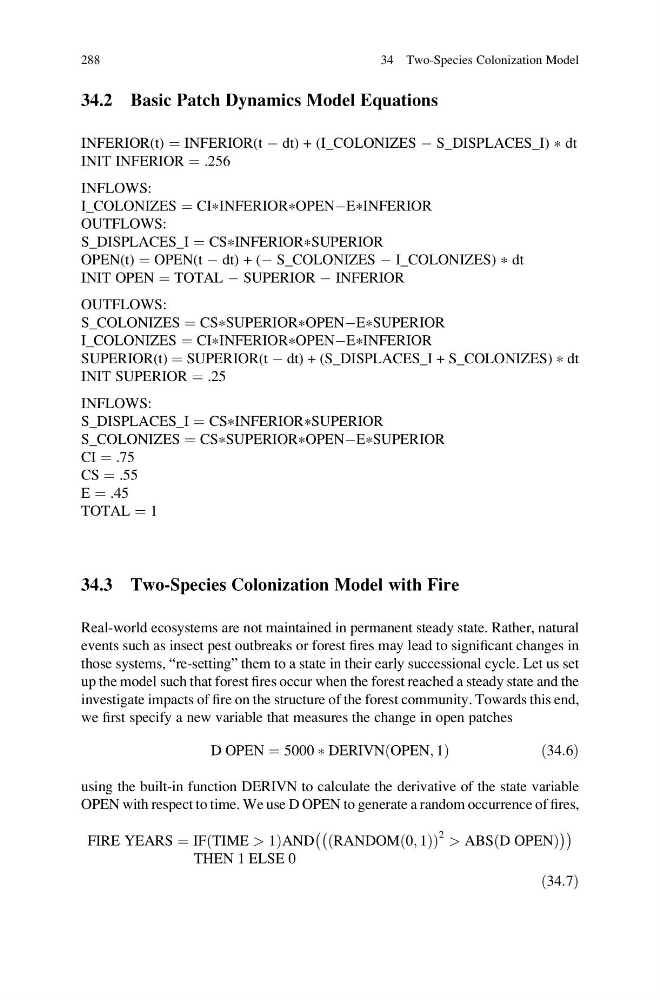
34.2 Basic Patch Dynamics Model Equations
INFERIOR(t) ¼ INFERIOR(t À dt) + (I_COLONIZES À S_DISPLACES_I) * dt
INIT INFERIOR ¼ .256
INFLOWS:
I_COLONIZES ¼ CI * INFERIOR * OPENÀE * INFERIOR
OUTFLOWS:
S_DISPLACES_I ¼ CS * INFERIOR * SUPERIOR
OPEN(t) ¼ OPEN(t À dt) + (À S_COLONIZES À I_COLONIZES) * dt
INIT OPEN ¼ TOTAL À SUPERIOR À INFERIOR
OUTFLOWS:
S_COLONIZES ¼ CS * SUPERIOR * OPENÀE * SUPERIOR
I_COLONIZES ¼ CI * INFERIOR * OPENÀE * INFERIOR
SUPERIOR(t) ¼ SUPERIOR(t À dt) + (S_DISPLACES_I + S_COLONIZES) * dt
INIT SUPERIOR ¼ .25
INFLOWS:
S_DISPLACES_I ¼ CS * INFERIOR * SUPERIOR
S_COLONIZES ¼ CS * SUPERIOR * OPENÀE * SUPERIOR
CI ¼ .75
CS ¼ .55
E ¼ .45
TOTAL ¼ 1
34.3 Two-Species Colonization Model with Fire
Real-world ecosystems are not maintained in permanent steady state. Rather, natural
events such as insect pest outbreaks or forest fires may lead to significant changes in
those systems, “re-setting” them to a state in their early successional cycle. Let us set
up the model such that forest fires occur when the forest reached a steady state and the
investigate impacts of fire on the structure of the forest community. Towards this end,
we first specify a new variable that measures the change in open patches
D OPEN ¼ 5000 Ã DERIVN OPEN; 1
ð
Þ
ð 34:6Þ
using the built-in function DERIVN to calculate the derivative of the state variable
OPEN with respect to time. We use D OPEN to generate a random occurrence of fires,
FIRE YEARS ¼ IF TIME > 1
ð
Þ AND
ÀÀ
RANDOM 0; 1
ð Þ
ð
Þ
2 > ABS D OPEN
ð
Þ
ÁÁ
THEN 1 ELSE 0
ð34:7Þ
288
34 Two-Species Colonization Model
INFERIOR(t) ¼ INFERIOR(t À dt) + (I_COLONIZES À S_DISPLACES_I) * dt
INIT INFERIOR ¼ .256
INFLOWS:
I_COLONIZES ¼ CI * INFERIOR * OPENÀE * INFERIOR
OUTFLOWS:
S_DISPLACES_I ¼ CS * INFERIOR * SUPERIOR
OPEN(t) ¼ OPEN(t À dt) + (À S_COLONIZES À I_COLONIZES) * dt
INIT OPEN ¼ TOTAL À SUPERIOR À INFERIOR
OUTFLOWS:
S_COLONIZES ¼ CS * SUPERIOR * OPENÀE * SUPERIOR
I_COLONIZES ¼ CI * INFERIOR * OPENÀE * INFERIOR
SUPERIOR(t) ¼ SUPERIOR(t À dt) + (S_DISPLACES_I + S_COLONIZES) * dt
INIT SUPERIOR ¼ .25
INFLOWS:
S_DISPLACES_I ¼ CS * INFERIOR * SUPERIOR
S_COLONIZES ¼ CS * SUPERIOR * OPENÀE * SUPERIOR
CI ¼ .75
CS ¼ .55
E ¼ .45
TOTAL ¼ 1
34.3 Two-Species Colonization Model with Fire
Real-world ecosystems are not maintained in permanent steady state. Rather, natural
events such as insect pest outbreaks or forest fires may lead to significant changes in
those systems, “re-setting” them to a state in their early successional cycle. Let us set
up the model such that forest fires occur when the forest reached a steady state and the
investigate impacts of fire on the structure of the forest community. Towards this end,
we first specify a new variable that measures the change in open patches
D OPEN ¼ 5000 Ã DERIVN OPEN; 1
ð
Þ
ð 34:6Þ
using the built-in function DERIVN to calculate the derivative of the state variable
OPEN with respect to time. We use D OPEN to generate a random occurrence of fires,
FIRE YEARS ¼ IF TIME > 1
ð
Þ AND
ÀÀ
RANDOM 0; 1
ð Þ
ð
Þ
2 > ABS D OPEN
ð
Þ
ÁÁ
THEN 1 ELSE 0
ð34:7Þ
288
34 Two-Species Colonization Model