

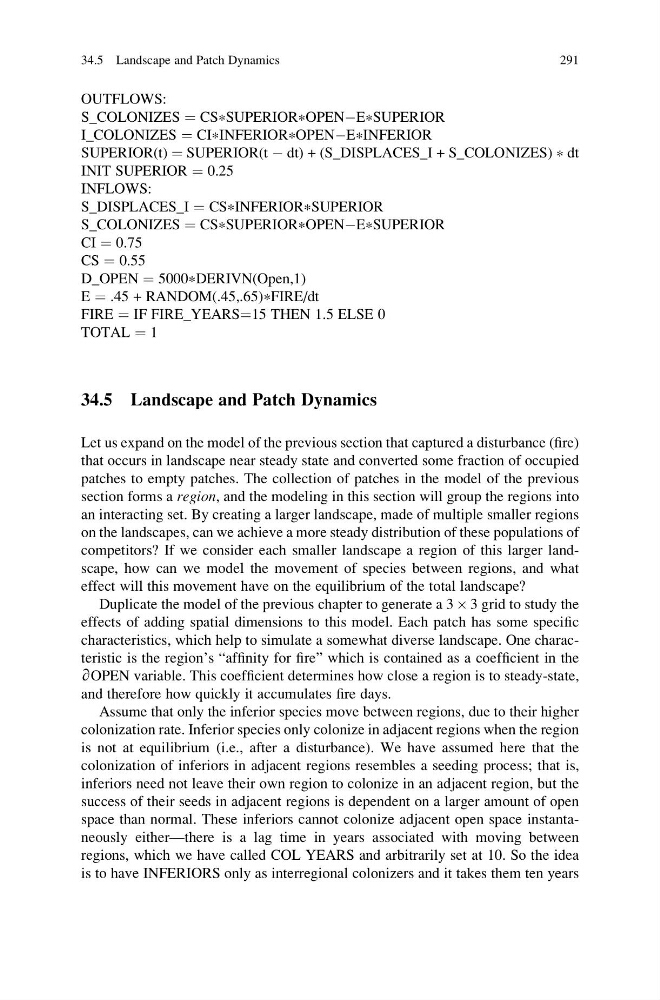
OUTFLOWS:
S_COLONIZES ¼ CS * SUPERIOR * OPENÀE * SUPERIOR
I_COLONIZES ¼ CI * INFERIOR * OPENÀE * INFERIOR
SUPERIOR(t) ¼ SUPERIOR(t À dt) + (S_DISPLACES_I + S_COLONIZES) * dt
INIT SUPERIOR ¼ 0.25
INFLOWS:
S_DISPLACES_I ¼ CS * INFERIOR * SUPERIOR
S_COLONIZES ¼ CS * SUPERIOR * OPENÀE * SUPERIOR
CI ¼ 0.75
CS ¼ 0.55
D_OPEN ¼ 5000 * DERIVN(Open,1)
E ¼ .45 + RANDOM(.45,.65) * FIRE/dt
FIRE ¼ IF FIRE_YEARS¼15 THEN 1.5 ELSE 0
TOTAL ¼ 1
34.5 Landscape and Patch Dynamics
Let us expand on the model of the previous section that captured a disturbance (fire)
that occurs in landscape near steady state and converted some fraction of occupied
patches to empty patches. The collection of patches in the model of the previous
section forms a region, and the modeling in this section will group the regions into
an interacting set. By creating a larger landscape, made of multiple smaller regions
on the landscapes, can we achieve a more steady distribution of these populations of
competitors? If we consider each smaller landscape a region of this larger landscape, how can we model the movement of species between regions, and what
effect will this movement have on the equilibrium of the total landscape?
Duplicate the model of the previous chapter to generate a 3 Â 3 grid to study the
effects of adding spatial dimensions to this model. Each patch has some specific
characteristics, which help to simulate a somewhat diverse landscape. One characteristic is the region’s “affinity for fire” which is contained as a coefficient in the
∂OPEN variable. This coefficient determines how close a region is to steady-state,
and therefore how quickly it accumulates fire days.
Assume that only the inferior species move between regions, due to their higher
colonization rate. Inferior species only colonize in adjacent regions when the region
is not at equilibrium (i.e., after a disturbance). We have assumed here that the
colonization of inferiors in adjacent regions resembles a seeding process; that is,
inferiors need not leave their own region to colonize in an adjacent region, but the
success of their seeds in adjacent regions is dependent on a larger amount of open
space than normal. These inferiors cannot colonize adjacent open space instantaneously either—there is a lag time in years associated with moving between
regions, which we have called COL YEARS and arbitrarily set at 10. So the idea
is to have INFERIORS only as interregional colonizers and it takes them ten years
34.5 Landscape and Patch Dynamics
291
S_COLONIZES ¼ CS * SUPERIOR * OPENÀE * SUPERIOR
I_COLONIZES ¼ CI * INFERIOR * OPENÀE * INFERIOR
SUPERIOR(t) ¼ SUPERIOR(t À dt) + (S_DISPLACES_I + S_COLONIZES) * dt
INIT SUPERIOR ¼ 0.25
INFLOWS:
S_DISPLACES_I ¼ CS * INFERIOR * SUPERIOR
S_COLONIZES ¼ CS * SUPERIOR * OPENÀE * SUPERIOR
CI ¼ 0.75
CS ¼ 0.55
D_OPEN ¼ 5000 * DERIVN(Open,1)
E ¼ .45 + RANDOM(.45,.65) * FIRE/dt
FIRE ¼ IF FIRE_YEARS¼15 THEN 1.5 ELSE 0
TOTAL ¼ 1
34.5 Landscape and Patch Dynamics
Let us expand on the model of the previous section that captured a disturbance (fire)
that occurs in landscape near steady state and converted some fraction of occupied
patches to empty patches. The collection of patches in the model of the previous
section forms a region, and the modeling in this section will group the regions into
an interacting set. By creating a larger landscape, made of multiple smaller regions
on the landscapes, can we achieve a more steady distribution of these populations of
competitors? If we consider each smaller landscape a region of this larger landscape, how can we model the movement of species between regions, and what
effect will this movement have on the equilibrium of the total landscape?
Duplicate the model of the previous chapter to generate a 3 Â 3 grid to study the
effects of adding spatial dimensions to this model. Each patch has some specific
characteristics, which help to simulate a somewhat diverse landscape. One characteristic is the region’s “affinity for fire” which is contained as a coefficient in the
∂OPEN variable. This coefficient determines how close a region is to steady-state,
and therefore how quickly it accumulates fire days.
Assume that only the inferior species move between regions, due to their higher
colonization rate. Inferior species only colonize in adjacent regions when the region
is not at equilibrium (i.e., after a disturbance). We have assumed here that the
colonization of inferiors in adjacent regions resembles a seeding process; that is,
inferiors need not leave their own region to colonize in an adjacent region, but the
success of their seeds in adjacent regions is dependent on a larger amount of open
space than normal. These inferiors cannot colonize adjacent open space instantaneously either—there is a lag time in years associated with moving between
regions, which we have called COL YEARS and arbitrarily set at 10. So the idea
is to have INFERIORS only as interregional colonizers and it takes them ten years
34.5 Landscape and Patch Dynamics
291