

Let us also assume that without parasitoids, the hosts will grow toward a carrying
capacity K set by the environment. To capture growth of the host population up to a
density H(t) ¼ K and decline of the host population for H(t) > K, we replace in
Eq. (32.7) the growth rate λ(H(t)) with
λ ¼ EXP R Ã 1 À
H t
ð Þ
K
ð32:9Þ
where R is the maximum host growth rate. Thus, the equation governing the size of
the host population in time t + 1 becomes
H t þ 1
ð
Þ¼H t
ð Þ Ã EXP R Ã 1 À
H t
ð Þ
K
À A Ã P t
ð Þ
ð32:10Þ
and after subtracting the respective state variables in time period t from Eqs. (32.8)
and (32.10), we have a set of differential equations that capture the change of
host and parasitoid densities from time period t to t + 1:
ΔH t
ð Þ ¼ H t
ð Þ Ã EXP R Ã 1 À
H t
ð Þ
K
À A Ã P t
ð Þ
À H t
ð Þ
ð32:11Þ
ΔP t
ð Þ ¼ C Ã H t
ð Þ Ã 1 À EXP ÀA Ã P t
ð Þ
ð
Þ
½
À P t
ð Þ
ð32:12Þ
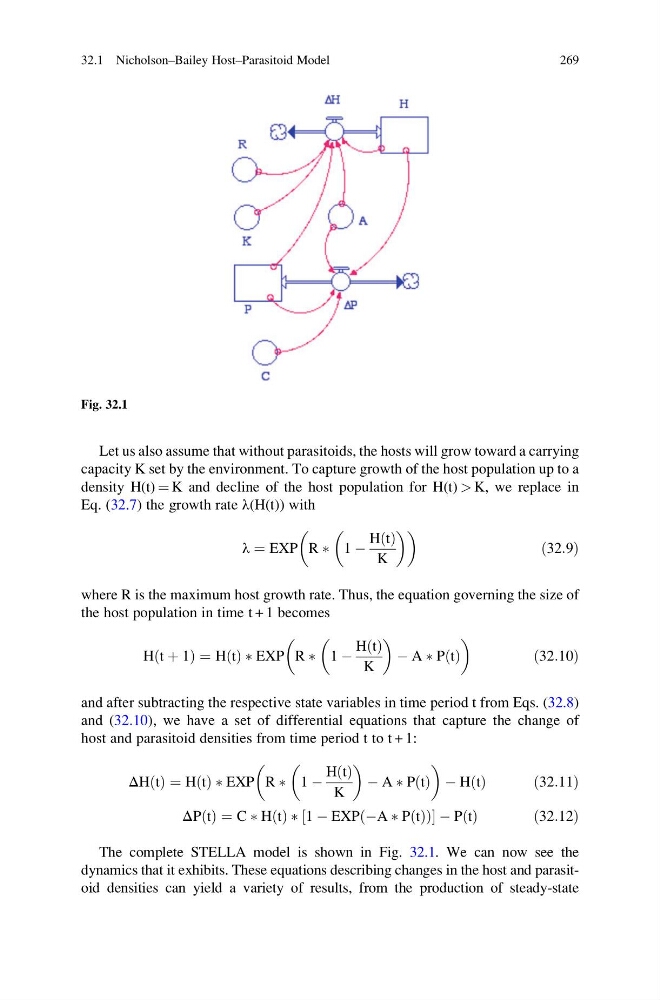
The complete STELLA model is shown in Fig. 32.1. We can now see the
dynamics that it exhibits. These equations describing changes in the host and parasitoid densities can yield a variety of results, from the production of steady-state
Fig. 32.1
32.1 Nicholson–Bailey Host–Parasitoid Model
269
capacity K set by the environment. To capture growth of the host population up to a
density H(t) ¼ K and decline of the host population for H(t) > K, we replace in
Eq. (32.7) the growth rate λ(H(t)) with
λ ¼ EXP R Ã 1 À
H t
ð Þ
K
ð32:9Þ
where R is the maximum host growth rate. Thus, the equation governing the size of
the host population in time t + 1 becomes
H t þ 1
ð
Þ¼H t
ð Þ Ã EXP R Ã 1 À
H t
ð Þ
K
À A Ã P t
ð Þ
ð32:10Þ
and after subtracting the respective state variables in time period t from Eqs. (32.8)
and (32.10), we have a set of differential equations that capture the change of
host and parasitoid densities from time period t to t + 1:
ΔH t
ð Þ ¼ H t
ð Þ Ã EXP R Ã 1 À
H t
ð Þ
K
À A Ã P t
ð Þ
À H t
ð Þ
ð32:11Þ
ΔP t
ð Þ ¼ C Ã H t
ð Þ Ã 1 À EXP ÀA Ã P t
ð Þ
ð
Þ
½
À P t
ð Þ
ð32:12Þ
The complete STELLA model is shown in Fig. 32.1. We can now see the
dynamics that it exhibits. These equations describing changes in the host and parasitoid densities can yield a variety of results, from the production of steady-state
Fig. 32.1
32.1 Nicholson–Bailey Host–Parasitoid Model
269