

P t þ 1
ð
Þ¼C Ã H t
ð Þ Ã 1 À F H t
ð Þ, P t
ð Þ
ð
Þ
½
ð 32:2Þ
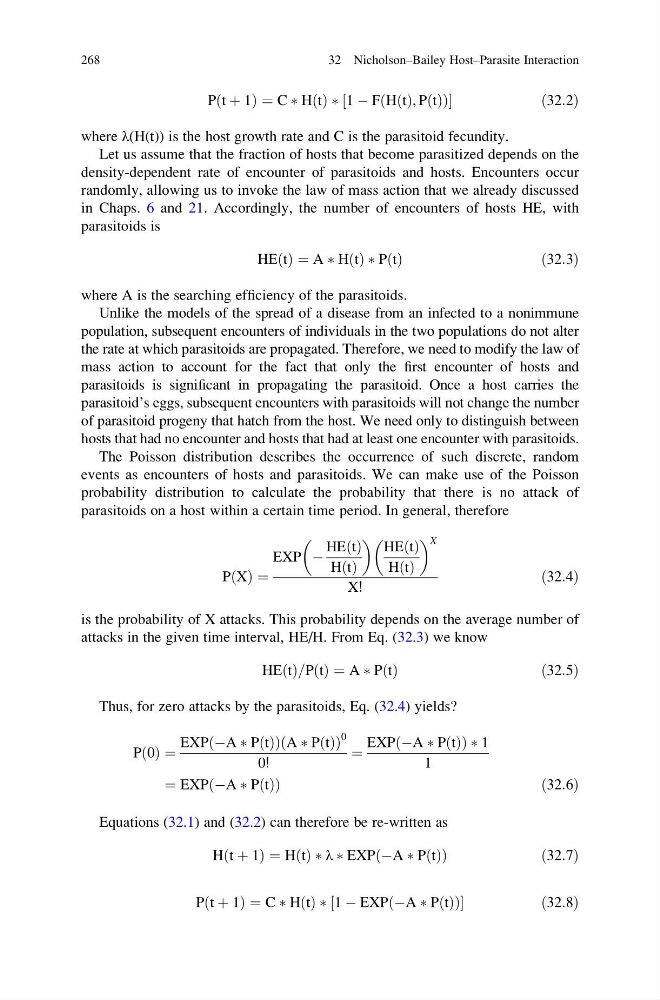
where λ(H(t)) is the host growth rate and C is the parasitoid fecundity.
Let us assume that the fraction of hosts that become parasitized depends on the
density-dependent rate of encounter of parasitoids and hosts. Encounters occur
randomly, allowing us to invoke the law of mass action that we already discussed
in Chaps. 6 and 21. Accordingly, the number of encounters of hosts HE, with
parasitoids is
HE t
ð Þ ¼ A Ã H t
ð Þ Ã P t
ð Þ
ð32:3Þ
where A is the searching efficiency of the parasitoids.
Unlike the models of the spread of a disease from an infected to a nonimmune
population, subsequent encounters of individuals in the two populations do not alter
the rate at which parasitoids are propagated. Therefore, we need to modify the law of
mass action to account for the fact that only the first encounter of hosts and
parasitoids is significant in propagating the parasitoid. Once a host carries the
parasitoid’s eggs, subsequent encounters with parasitoids will not change the number
of parasitoid progeny that hatch from the host. We need only to distinguish between
hosts that had no encounter and hosts that had at least one encounter with parasitoids.
The Poisson distribution describes the occurrence of such discrete, random
events as encounters of hosts and parasitoids. We can make use of the Poisson
probability distribution to calculate the probability that there is no attack of
parasitoids on a host within a certain time period. In general, therefore
P X
ð Þ ¼
EXP À
HE t
ð Þ
H t
ð Þ
HE t
ð Þ
H t
ð Þ
X
X!
ð32:4Þ
is the probability of X attacks. This probability depends on the average number of
attacks in the given time interval, HE/H. From Eq. (32.3) we know
HE t
ð Þ=P t
ð Þ ¼ A Ã P t
ð Þ
ð32:5Þ
Thus, for zero attacks by the parasitoids, Eq. (32.4) yields?
P 0
ð Þ ¼
EXP ÀA Ã P t
ð Þ
ð
ÞA Ã P t
ð Þ
ð
Þ
0
0!
¼
EXP ÀA Ã P t
ð Þ
ð
ÞÃ1
1
¼ EXP ÀA Ã P t
ð Þ
ð
Þ
ð 32:6Þ
Equations (32.1) and (32.2) can therefore be re-written as
H t þ 1
ð
Þ¼H t
ð Þ Ã λ Ã EXP ÀA Ã P t
ð Þ
ð
Þ
ð 32:7Þ
P t þ 1
ð
Þ¼C Ã H t
ð Þ Ã 1 À EXP ÀA Ã P t
ð Þ
ð
Þ
½
ð 32:8Þ
268
32 Nicholson–Bailey Host–Parasite Interaction
ð
Þ¼C Ã H t
ð Þ Ã 1 À F H t
ð Þ, P t
ð Þ
ð
Þ
½
ð 32:2Þ
where λ(H(t)) is the host growth rate and C is the parasitoid fecundity.
Let us assume that the fraction of hosts that become parasitized depends on the
density-dependent rate of encounter of parasitoids and hosts. Encounters occur
randomly, allowing us to invoke the law of mass action that we already discussed
in Chaps. 6 and 21. Accordingly, the number of encounters of hosts HE, with
parasitoids is
HE t
ð Þ ¼ A Ã H t
ð Þ Ã P t
ð Þ
ð32:3Þ
where A is the searching efficiency of the parasitoids.
Unlike the models of the spread of a disease from an infected to a nonimmune
population, subsequent encounters of individuals in the two populations do not alter
the rate at which parasitoids are propagated. Therefore, we need to modify the law of
mass action to account for the fact that only the first encounter of hosts and
parasitoids is significant in propagating the parasitoid. Once a host carries the
parasitoid’s eggs, subsequent encounters with parasitoids will not change the number
of parasitoid progeny that hatch from the host. We need only to distinguish between
hosts that had no encounter and hosts that had at least one encounter with parasitoids.
The Poisson distribution describes the occurrence of such discrete, random
events as encounters of hosts and parasitoids. We can make use of the Poisson
probability distribution to calculate the probability that there is no attack of
parasitoids on a host within a certain time period. In general, therefore
P X
ð Þ ¼
EXP À
HE t
ð Þ
H t
ð Þ
HE t
ð Þ
H t
ð Þ
X
X!
ð32:4Þ
is the probability of X attacks. This probability depends on the average number of
attacks in the given time interval, HE/H. From Eq. (32.3) we know
HE t
ð Þ=P t
ð Þ ¼ A Ã P t
ð Þ
ð32:5Þ
Thus, for zero attacks by the parasitoids, Eq. (32.4) yields?
P 0
ð Þ ¼
EXP ÀA Ã P t
ð Þ
ð
ÞA Ã P t
ð Þ
ð
Þ
0
0!
¼
EXP ÀA Ã P t
ð Þ
ð
ÞÃ1
1
¼ EXP ÀA Ã P t
ð Þ
ð
Þ
ð 32:6Þ
Equations (32.1) and (32.2) can therefore be re-written as
H t þ 1
ð
Þ¼H t
ð Þ Ã λ Ã EXP ÀA Ã P t
ð Þ
ð
Þ
ð 32:7Þ
P t þ 1
ð
Þ¼C Ã H t
ð Þ Ã 1 À EXP ÀA Ã P t
ð Þ
ð
Þ
½
ð 32:8Þ
268
32 Nicholson–Bailey Host–Parasite Interaction