

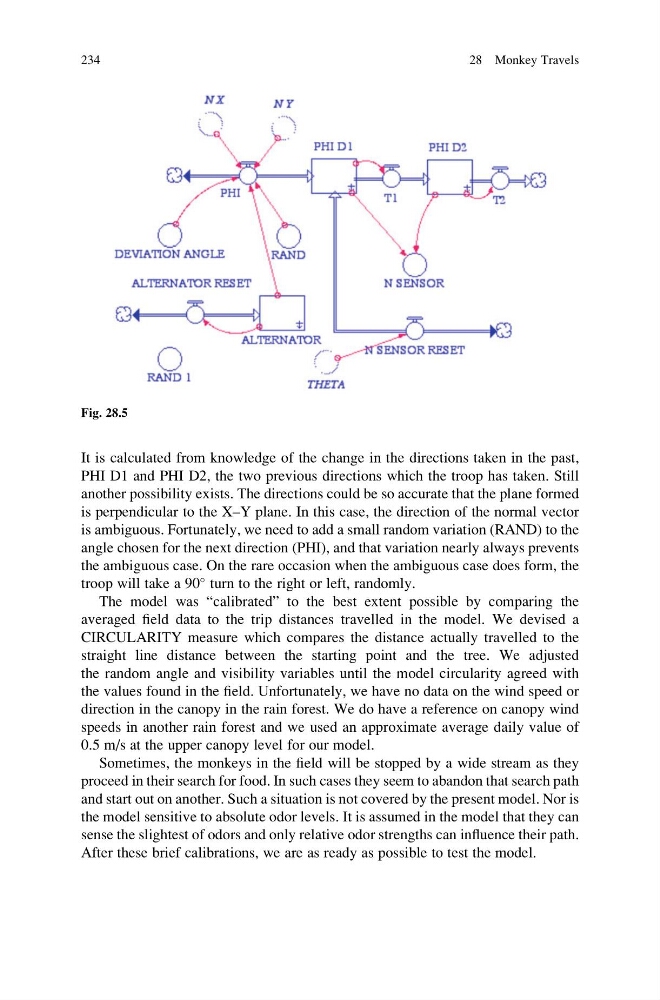
It is calculated from knowledge of the change in the directions taken in the past,
PHI D1 and PHI D2, the two previous directions which the troop has taken. Still
another possibility exists. The directions could be so accurate that the plane formed
is perpendicular to the X–Y plane. In this case, the direction of the normal vector
is ambiguous. Fortunately, we need to add a small random variation (RAND) to the
angle chosen for the next direction (PHI), and that variation nearly always prevents
the ambiguous case. On the rare occasion when the ambiguous case does form, the
troop will take a 90
turn to the right or left, randomly.
The model was “calibrated” to the best extent possible by comparing the
averaged field data to the trip distances travelled in the model. We devised a
CIRCULARITY measure which compares the distance actually travelled to the
straight line distance between the starting point and the tree. We adjusted
the random angle and visibility variables until the model circularity agreed with
the values found in the field. Unfortunately, we have no data on the wind speed or
direction in the canopy in the rain forest. We do have a reference on canopy wind
speeds in another rain forest and we used an approximate average daily value of
0.5 m/s at the upper canopy level for our model.
Sometimes, the monkeys in the field will be stopped by a wide stream as they
proceed in their search for food. In such cases they seem to abandon that search path
and start out on another. Such a situation is not covered by the present model. Nor is
the model sensitive to absolute odor levels. It is assumed in the model that they can
sense the slightest of odors and only relative odor strengths can influence their path.
After these brief calibrations, we are as ready as possible to test the model.
Fig. 28.5
234
28 Monkey Travels
PHI D1 and PHI D2, the two previous directions which the troop has taken. Still
another possibility exists. The directions could be so accurate that the plane formed
is perpendicular to the X–Y plane. In this case, the direction of the normal vector
is ambiguous. Fortunately, we need to add a small random variation (RAND) to the
angle chosen for the next direction (PHI), and that variation nearly always prevents
the ambiguous case. On the rare occasion when the ambiguous case does form, the
troop will take a 90
turn to the right or left, randomly.
The model was “calibrated” to the best extent possible by comparing the
averaged field data to the trip distances travelled in the model. We devised a
CIRCULARITY measure which compares the distance actually travelled to the
straight line distance between the starting point and the tree. We adjusted
the random angle and visibility variables until the model circularity agreed with
the values found in the field. Unfortunately, we have no data on the wind speed or
direction in the canopy in the rain forest. We do have a reference on canopy wind
speeds in another rain forest and we used an approximate average daily value of
0.5 m/s at the upper canopy level for our model.
Sometimes, the monkeys in the field will be stopped by a wide stream as they
proceed in their search for food. In such cases they seem to abandon that search path
and start out on another. Such a situation is not covered by the present model. Nor is
the model sensitive to absolute odor levels. It is assumed in the model that they can
sense the slightest of odors and only relative odor strengths can influence their path.
After these brief calibrations, we are as ready as possible to test the model.
Fig. 28.5
234
28 Monkey Travels