

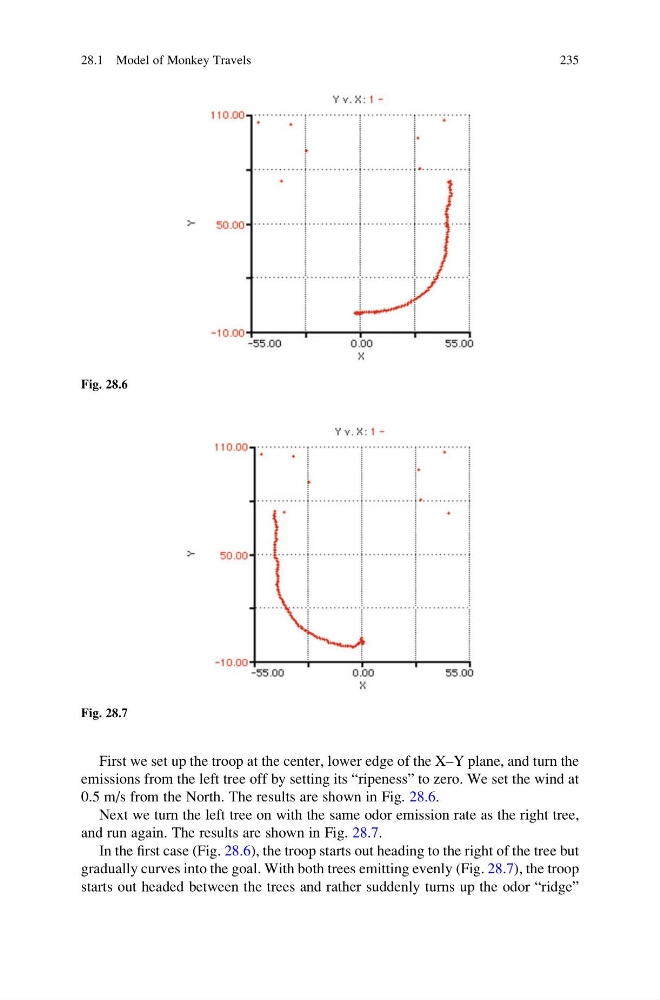
First we set up the troop at the center, lower edge of the X–Y plane, and turn the
emissions from the left tree off by setting its “ripeness” to zero. We set the wind at
0.5 m/s from the North. The results are shown in Fig. 28.6.
Next we turn the left tree on with the same odor emission rate as the right tree,
and run again. The results are shown in Fig. 28.7.
In the first case (Fig. 28.6), the troop starts out heading to the right of the tree but
gradually curves into the goal. With both trees emitting evenly (Fig. 28.7), the troop
starts out headed between the trees and rather suddenly turns up the odor “ridge”
Fig. 28.6
Fig. 28.7
28.1 Model of Monkey Travels
235
emissions from the left tree off by setting its “ripeness” to zero. We set the wind at
0.5 m/s from the North. The results are shown in Fig. 28.6.
Next we turn the left tree on with the same odor emission rate as the right tree,
and run again. The results are shown in Fig. 28.7.
In the first case (Fig. 28.6), the troop starts out heading to the right of the tree but
gradually curves into the goal. With both trees emitting evenly (Fig. 28.7), the troop
starts out headed between the trees and rather suddenly turns up the odor “ridge”
Fig. 28.6
Fig. 28.7
28.1 Model of Monkey Travels
235