

The direction is to be calculated on the minimum necessary information: the
location and odor strength at three points. These three points are the current location
and the last two locations of the troop. The monkeys must remember the locations
and the odor concentrations at the last two points and compare them with their
current situation. They then have the minimum necessary information.
Exactly how the monkeys would figure which direction is the maximum ascent
up the odor mountain is not known of course, nor do we know how we would do it if
we were in the monkeys place. Perhaps each individual has a sort of “stereo”
olfactory system and with their two nostrils can detect odor gradients; perhaps
they sense these gradients by just moving their heads? Here we assume that they
develop a sense of the odor gradient by moving their entire body and refiguring the
gradient periodically. If we were to use odor to find its source, we could ascend the
odor mountain in the direction of steepest ascent but delete and not solve any
computer programs. Yet to mimic the monkey pattern, we assume that they do solve
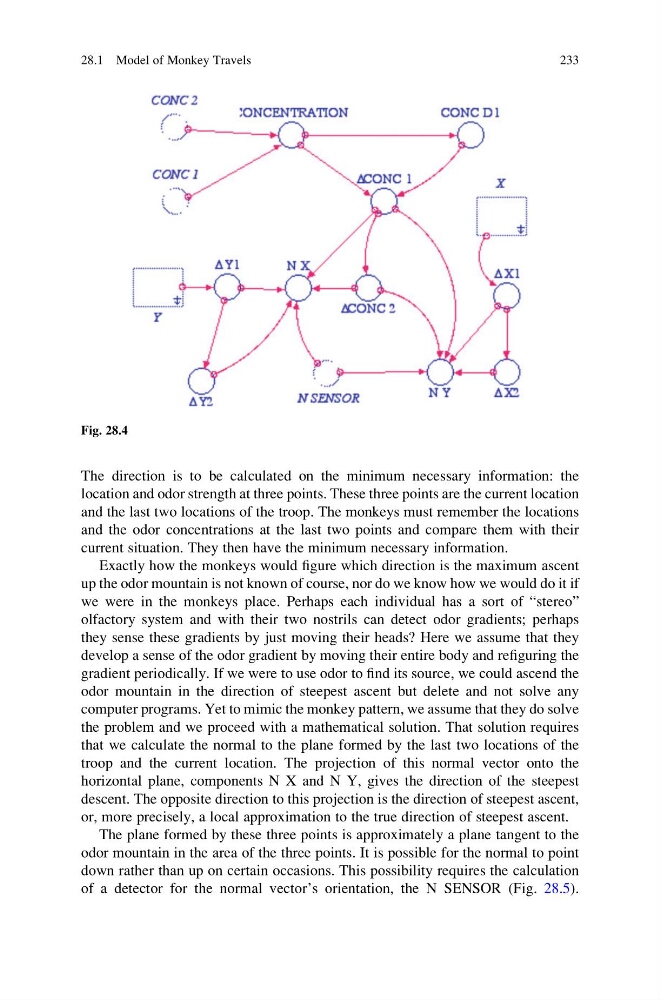
the problem and we proceed with a mathematical solution. That solution requires
that we calculate the normal to the plane formed by the last two locations of the
troop and the current location. The projection of this normal vector onto the
horizontal plane, components N X and N Y, gives the direction of the steepest
descent. The opposite direction to this projection is the direction of steepest ascent,
or, more precisely, a local approximation to the true direction of steepest ascent.
The plane formed by these three points is approximately a plane tangent to the
odor mountain in the area of the three points. It is possible for the normal to point
down rather than up on certain occasions. This possibility requires the calculation
of a detector for the normal vector’s orientation, the N SENSOR (Fig. 28.5).
Fig. 28.4
28.1 Model of Monkey Travels
233
location and odor strength at three points. These three points are the current location
and the last two locations of the troop. The monkeys must remember the locations
and the odor concentrations at the last two points and compare them with their
current situation. They then have the minimum necessary information.
Exactly how the monkeys would figure which direction is the maximum ascent
up the odor mountain is not known of course, nor do we know how we would do it if
we were in the monkeys place. Perhaps each individual has a sort of “stereo”
olfactory system and with their two nostrils can detect odor gradients; perhaps
they sense these gradients by just moving their heads? Here we assume that they
develop a sense of the odor gradient by moving their entire body and refiguring the
gradient periodically. If we were to use odor to find its source, we could ascend the
odor mountain in the direction of steepest ascent but delete and not solve any
computer programs. Yet to mimic the monkey pattern, we assume that they do solve
the problem and we proceed with a mathematical solution. That solution requires
that we calculate the normal to the plane formed by the last two locations of the
troop and the current location. The projection of this normal vector onto the
horizontal plane, components N X and N Y, gives the direction of the steepest
descent. The opposite direction to this projection is the direction of steepest ascent,
or, more precisely, a local approximation to the true direction of steepest ascent.
The plane formed by these three points is approximately a plane tangent to the
odor mountain in the area of the three points. It is possible for the normal to point
down rather than up on certain occasions. This possibility requires the calculation
of a detector for the normal vector’s orientation, the N SENSOR (Fig. 28.5).
Fig. 28.4
28.1 Model of Monkey Travels
233