

Of course part of the initial fluctuations in population sizes is due to the fact that
there is no initial history of the birth rates in this population. To this extent the
model might be thought unrealistic. Yet suppose that we had a population that was
initially stabilized at for many years, and then due to a technological change or a
conquest of new lands, was suddenly exposed to the given amounts of land. In this
case the model is more realistic. Such a population would have no remembrance of
any adaptation process to sudden new resource availability. But we show that as
long as they are trying to adapt to the available resources (close the GAP), they will
eventually reach a new steady state. In essence, this population is remembering a
process of adaptation, but not the details. A more sophisticated model would allow
them to remember how much social trauma the cycling produced and the next
period of sudden resource increase would be met with less extreme peaks and lows.
In general we are trying to capture here the idea that a population reacts to an
average remembered history of efforts to achieve some goal, in this case, closing the
gap between actual and desired levels of the population. Our approach to the final
steady state might be framed as an optimality problem: What controls (birth rates)
do we use to proceed to the steady state within a certain time, perhaps with
certain constraints such as avoiding population decline while rising to the ultimate
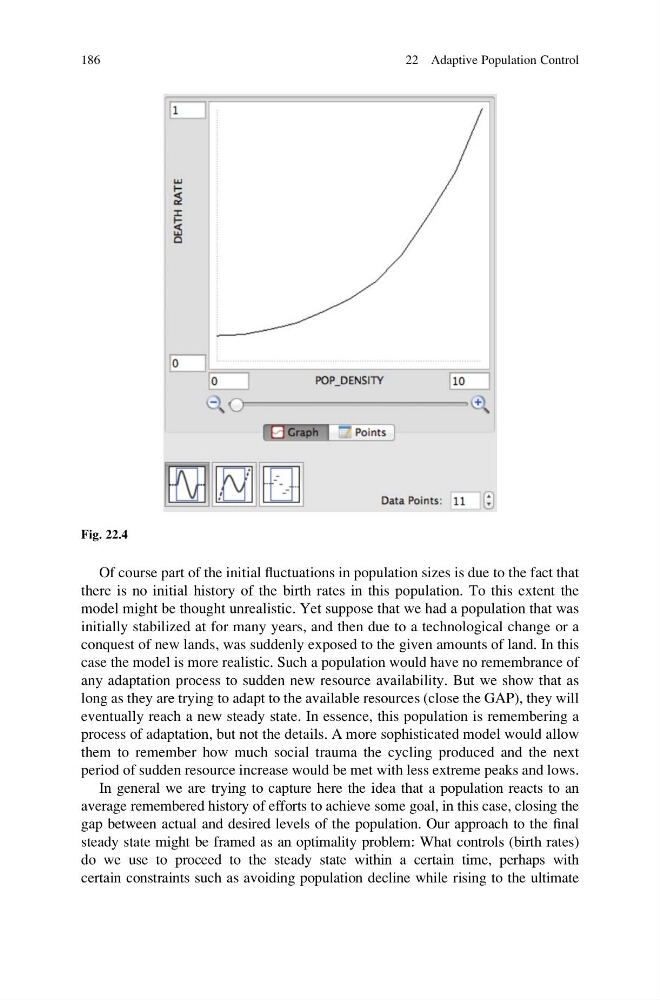
Fig. 22.4
186
22 Adaptive Population Control
there is no initial history of the birth rates in this population. To this extent the
model might be thought unrealistic. Yet suppose that we had a population that was
initially stabilized at for many years, and then due to a technological change or a
conquest of new lands, was suddenly exposed to the given amounts of land. In this
case the model is more realistic. Such a population would have no remembrance of
any adaptation process to sudden new resource availability. But we show that as
long as they are trying to adapt to the available resources (close the GAP), they will
eventually reach a new steady state. In essence, this population is remembering a
process of adaptation, but not the details. A more sophisticated model would allow
them to remember how much social trauma the cycling produced and the next
period of sudden resource increase would be met with less extreme peaks and lows.
In general we are trying to capture here the idea that a population reacts to an
average remembered history of efforts to achieve some goal, in this case, closing the
gap between actual and desired levels of the population. Our approach to the final
steady state might be framed as an optimality problem: What controls (birth rates)
do we use to proceed to the steady state within a certain time, perhaps with
certain constraints such as avoiding population decline while rising to the ultimate
Fig. 22.4
186
22 Adaptive Population Control