

steady-state level? This constraint may be appropriate given the trauma of reducing
populations. The problem with the optimality proposal above though is that we don’t
know a priori, what the final steady state is going to be, given all these parameters.
The final steady-state population is a function of the very parameters that we wish to
change in order to control the ascent to the steady state. We could use as an optimality
goal, the rise (only) in a prescribed time to a steady state and not be partial to the
actual value of that steady state. In that case we would want to know which of the
controllable parameters are accessible—in our case here, only the forgetting rate, the
number of years of recall, and perhaps the reaction sensitivity. Then we wish to know
which of these causes a damping in the system. We would next set those that cause
damping such that there is no oscillation in the population. This slope constraint is
probably the best goal to use: when that value gets sufficiently low, we have reached
the goal—we are sufficiently close to the steady state. Try out this idea and ones of
your own to achieve the “no oscillation” goal.
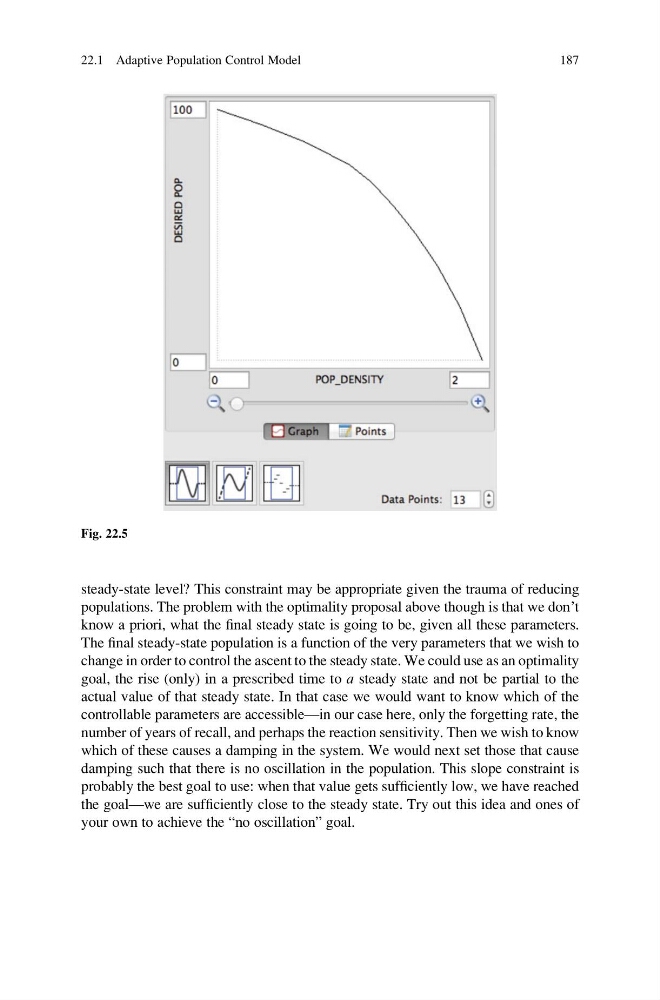
Fig. 22.5
22.1 Adaptive Population Control Model
187
populations. The problem with the optimality proposal above though is that we don’t
know a priori, what the final steady state is going to be, given all these parameters.
The final steady-state population is a function of the very parameters that we wish to
change in order to control the ascent to the steady state. We could use as an optimality
goal, the rise (only) in a prescribed time to a steady state and not be partial to the
actual value of that steady state. In that case we would want to know which of the
controllable parameters are accessible—in our case here, only the forgetting rate, the
number of years of recall, and perhaps the reaction sensitivity. Then we wish to know
which of these causes a damping in the system. We would next set those that cause
damping such that there is no oscillation in the population. This slope constraint is
probably the best goal to use: when that value gets sufficiently low, we have reached
the goal—we are sufficiently close to the steady state. Try out this idea and ones of
your own to achieve the “no oscillation” goal.
Fig. 22.5
22.1 Adaptive Population Control Model
187