

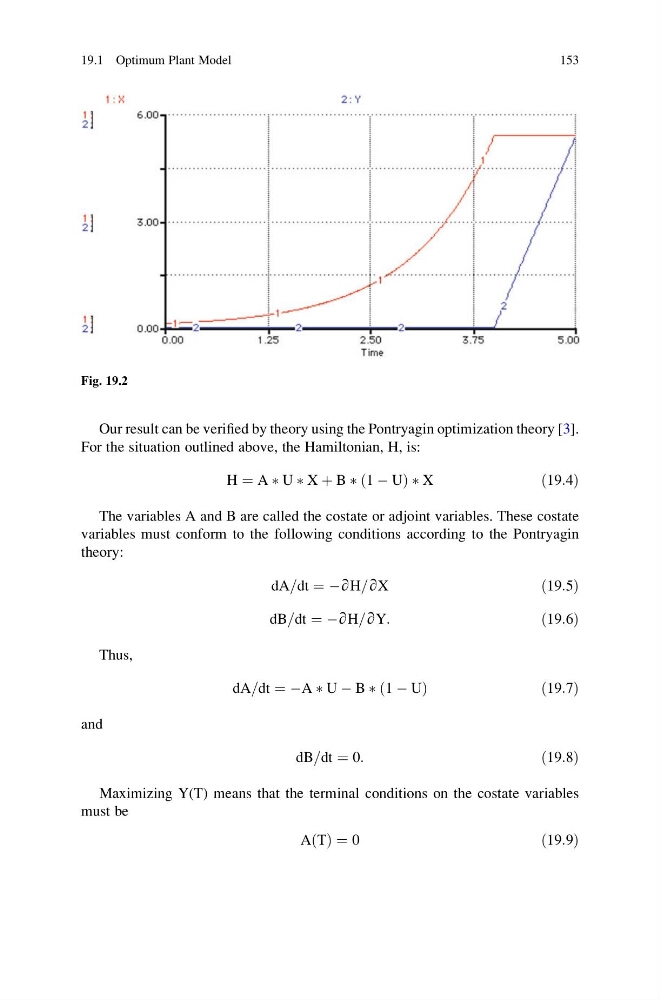
Our result can be verified by theory using the Pontryagin optimization theory [3].
For the situation outlined above, the Hamiltonian, H, is:
H ¼ A Ã U Ã X þ B Ã 1 À U
ð
ÞÃX
ð19:4Þ
The variables A and B are called the costate or adjoint variables. These costate
variables must conform to the following conditions according to the Pontryagin
theory:
dA=dt ¼ À∂H=∂X
ð19:5Þ
dB=dt ¼ À∂H=∂Y:
ð19:6Þ
Thus,
dA=dt ¼ ÀA Ã U À B Ã 1 À U
ð
Þ
ð19:7Þ
and
dB=dt ¼ 0:
ð19:8Þ
Maximizing Y(T) means that the terminal conditions on the costate variables
must be
A T
ð Þ ¼ 0
ð19:9Þ
Fig. 19.2
19.1 Optimum Plant Model
153
For the situation outlined above, the Hamiltonian, H, is:
H ¼ A Ã U Ã X þ B Ã 1 À U
ð
ÞÃX
ð19:4Þ
The variables A and B are called the costate or adjoint variables. These costate
variables must conform to the following conditions according to the Pontryagin
theory:
dA=dt ¼ À∂H=∂X
ð19:5Þ
dB=dt ¼ À∂H=∂Y:
ð19:6Þ
Thus,
dA=dt ¼ ÀA Ã U À B Ã 1 À U
ð
Þ
ð19:7Þ
and
dB=dt ¼ 0:
ð19:8Þ
Maximizing Y(T) means that the terminal conditions on the costate variables
must be
A T
ð Þ ¼ 0
ð19:9Þ
Fig. 19.2
19.1 Optimum Plant Model
153