

ΔX ¼
dX
dt
¼ U Ã X
ð19:1Þ
and the growth of the reproductive part ΔY in the time DT is
ΔX ¼
dY
dt
¼ 1 À U
ð
ÞÃX
ð19:2Þ
U is the control variable that we use to simulate a plant’s shift of its resources from
vegetative growth to reproductive growth. The control, U, is necessarily 0 U 1.
The optimality problem is one of maximizing Y(T).
For this problem, assume that either the vegetative or reproductive portion is
growing but not both at the same time. In such a case we say that the control
is “bang-bang”—it is either 1 or 0. Under this assumption, the control becomes:
if t < T STAR then U ¼ 1
if t > T STAR then U ¼ 0,
ð19:3Þ
where T STAR is the shift time, the time when the plant’s production shifts from
vegetative to reproductive.
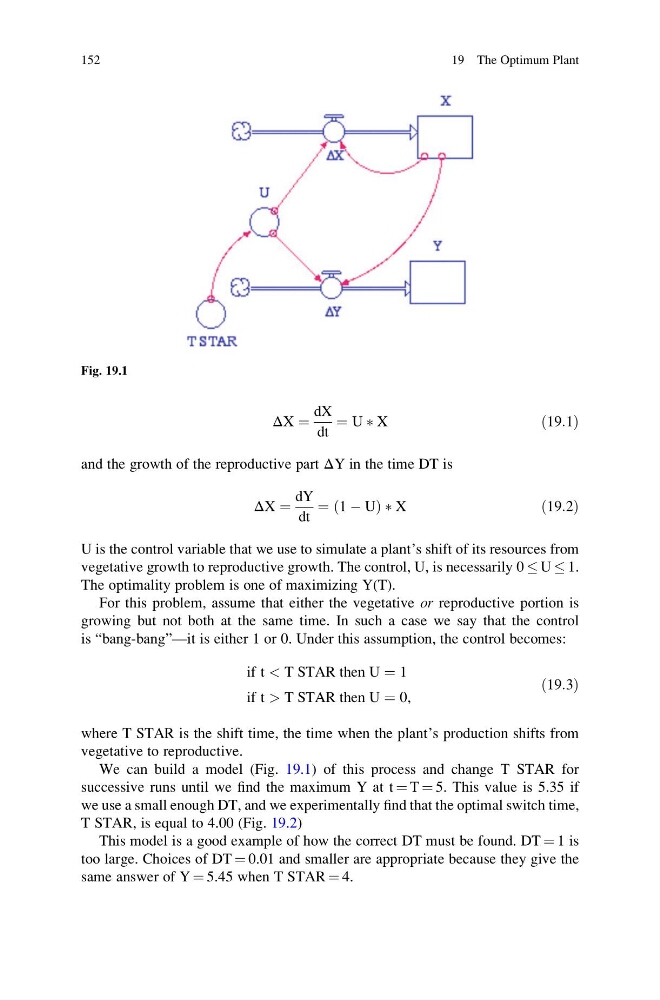
We can build a model (Fig. 19.1) of this process and change T STAR for
successive runs until we find the maximum Y at t ¼ T ¼ 5. This value is 5.35 if
we use a small enough DT, and we experimentally find that the optimal switch time,
T STAR, is equal to 4.00 (Fig. 19.2)
This model is a good example of how the correct DT must be found. DT ¼ 1 is
too large. Choices of DT ¼ 0.01 and smaller are appropriate because they give the
same answer of Y ¼ 5.45 when T STAR ¼ 4.
Fig. 19.1
152
19 The Optimum Plant
dX
dt
¼ U Ã X
ð19:1Þ
and the growth of the reproductive part ΔY in the time DT is
ΔX ¼
dY
dt
¼ 1 À U
ð
ÞÃX
ð19:2Þ
U is the control variable that we use to simulate a plant’s shift of its resources from
vegetative growth to reproductive growth. The control, U, is necessarily 0 U 1.
The optimality problem is one of maximizing Y(T).
For this problem, assume that either the vegetative or reproductive portion is
growing but not both at the same time. In such a case we say that the control
is “bang-bang”—it is either 1 or 0. Under this assumption, the control becomes:
if t < T STAR then U ¼ 1
if t > T STAR then U ¼ 0,
ð19:3Þ
where T STAR is the shift time, the time when the plant’s production shifts from
vegetative to reproductive.
We can build a model (Fig. 19.1) of this process and change T STAR for
successive runs until we find the maximum Y at t ¼ T ¼ 5. This value is 5.35 if
we use a small enough DT, and we experimentally find that the optimal switch time,
T STAR, is equal to 4.00 (Fig. 19.2)
This model is a good example of how the correct DT must be found. DT ¼ 1 is
too large. Choices of DT ¼ 0.01 and smaller are appropriate because they give the
same answer of Y ¼ 5.45 when T STAR ¼ 4.
Fig. 19.1
152
19 The Optimum Plant