

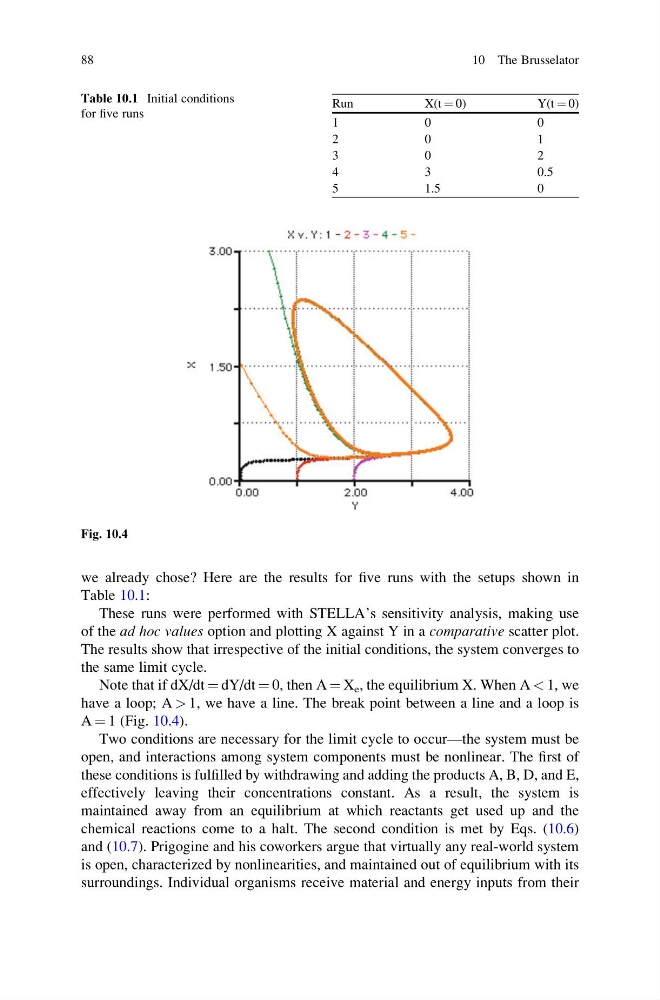
we already chose? Here are the results for five runs with the setups shown in
Table 10.1:
These runs were performed with STELLA’s sensitivity analysis, making use
of the ad hoc values option and plotting X against Y in a comparative scatter plot.
The results show that irrespective of the initial conditions, the system converges to
the same limit cycle.
Note that if dX/dt ¼ dY/dt ¼ 0, then A ¼ X e , the equilibrium X. When A < 1, we
have a loop; A > 1, we have a line. The break point between a line and a loop is
A ¼ 1 (Fig. 10.4).
Two conditions are necessary for the limit cycle to occur—the system must be
open, and interactions among system components must be nonlinear. The first of
these conditions is fulfilled by withdrawing and adding the products A, B, D, and E,
effectively leaving their concentrations constant. As a result, the system is
maintained away from an equilibrium at which reactants get used up and the
chemical reactions come to a halt. The second condition is met by Eqs. (10.6)
and (10.7). Prigogine and his coworkers argue that virtually any real-world system
is open, characterized by nonlinearities, and maintained out of equilibrium with its
surroundings. Individual organisms receive material and energy inputs from their
Table 10.1 Initial conditions
for five runs
Run
X(t ¼ 0)
Y(t ¼ 0)
1
0
0
2
0
1
3
0
2
4
3
0.5
5
1.5
0
Fig. 10.4
88
10 The Brusselator
Table 10.1:
These runs were performed with STELLA’s sensitivity analysis, making use
of the ad hoc values option and plotting X against Y in a comparative scatter plot.
The results show that irrespective of the initial conditions, the system converges to
the same limit cycle.
Note that if dX/dt ¼ dY/dt ¼ 0, then A ¼ X e , the equilibrium X. When A < 1, we
have a loop; A > 1, we have a line. The break point between a line and a loop is
A ¼ 1 (Fig. 10.4).
Two conditions are necessary for the limit cycle to occur—the system must be
open, and interactions among system components must be nonlinear. The first of
these conditions is fulfilled by withdrawing and adding the products A, B, D, and E,
effectively leaving their concentrations constant. As a result, the system is
maintained away from an equilibrium at which reactants get used up and the
chemical reactions come to a halt. The second condition is met by Eqs. (10.6)
and (10.7). Prigogine and his coworkers argue that virtually any real-world system
is open, characterized by nonlinearities, and maintained out of equilibrium with its
surroundings. Individual organisms receive material and energy inputs from their
Table 10.1 Initial conditions
for five runs
Run
X(t ¼ 0)
Y(t ¼ 0)
1
0
0
2
0
1
3
0
2
4
3
0.5
5
1.5
0
Fig. 10.4
88
10 The Brusselator