

3. Identifying the Ecological Correlates of Extinction-Prone Species
35
results indicate the predicted probability that the species will become extinct
under each of the models, given the values for the independent variables for the
species (e.g., body weight, trophic level, endemic status). These values may be
used as an index of extinction proneness for the extant species in setting priorities
for conservation efforts. In this instance, vulnerability is expressed as an index in
which 1 is the most vulnerable to extinction and 0 is the least. Vulnerability
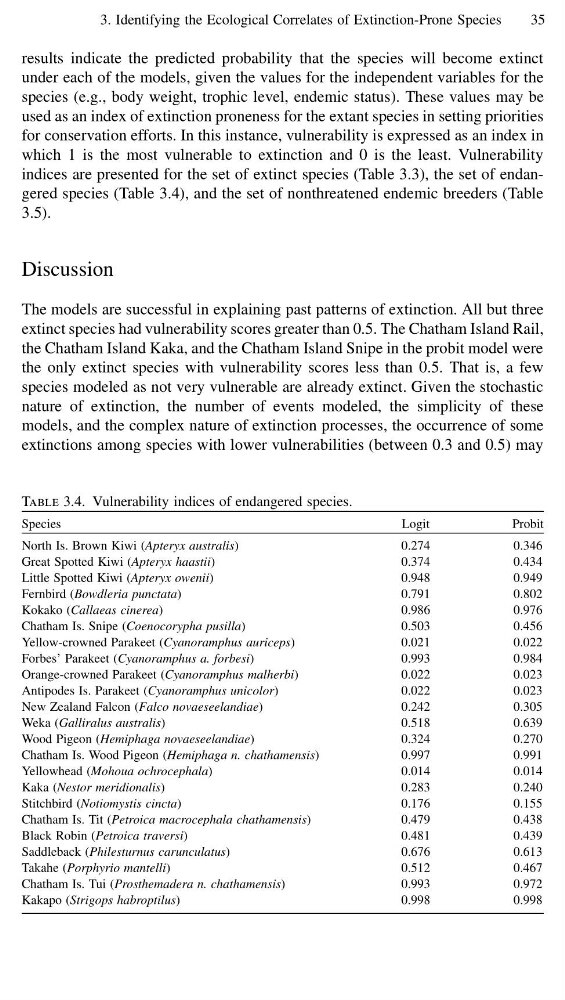
indices are presented for the set of extinct species (Table 3.3), the set of endangered species (Table 3.4), and the set of nonthreatened endemic breeders (Table
3.5).
Discussion
The models are successful in explaining past patterns of extinction. All but three
extinct species had vulnerability scores greater than 0.5. The Chatham Island Rail,
the Chatham Island Kaka, and the Chatham Island Snipe in the probit model were
the only extinct species with vulnerability scores less than 0.5. That is, a few
species modeled as not very vulnerable are already extinct. Given the stochastic
nature of extinction, the number of events modeled, the simplicity of these
models, and the complex nature of extinction processes, the occurrence of some
extinctions among species with lower vulnerabilities (between 0.3 and 0.5) may
Table 3.4. Vulnerability indices of endangered species.
Species
Logit
Probit
North Is. Brown Kiwi (Apteryx australis)
0.274
0.346
Great Spotted Kiwi (Apteryx haastii)
0.374
0.434
Little Spotted Kiwi (Apteryx owenii)
0.948
0.949
Fernbird (Bowdleria punctata)
0.791
0.802
Kokako (Callaeas cinerea)
0.986
0.976
Chatham Is. Snipe (Coenocorypha pusilla)
0.503
0.456
Yellow-crowned Parakeet (Cyanoramphus auriceps)
0.021
0.022
Forbes’ Parakeet (Cyanoramphus a. forbesi)
0.993
0.984
Orange-crowned Parakeet (Cyanoramphus malherbi)
0.022
0.023
Antipodes Is. Parakeet (Cyanoramphus unicolor)
0.022
0.023
New Zealand Falcon (Falco novaeseelandiae)
0.242
0.305
Weka (Galliralus australis)
0.518
0.639
Wood Pigeon (Hemiphaga novaeseelandiae)
0.324
0.270
Chatham Is. Wood Pigeon (Hemiphaga n. chathamensis)
0.997
0.991
Yellowhead (Mohoua ochrocephala)
0.014
0.014
Kaka (Nestor meridionalis)
0.283
0.240
Stitchbird (Notiomystis cincta)
0.176
0.155
Chatham Is. Tit (Petroica macrocephala chathamensis)
0.479
0.438
Black Robin (Petroica traversi)
0.481
0.439
Saddleback (Philesturnus carunculatus)
0.676
0.613
Takahe (Porphyrio mantelli)
0.512
0.467
Chatham Is. Tui (Prosthemadera n. chathamensis)
0.993
0.972
Kakapo (Strigops habroptilus)
0.998
0.998
35
results indicate the predicted probability that the species will become extinct
under each of the models, given the values for the independent variables for the
species (e.g., body weight, trophic level, endemic status). These values may be
used as an index of extinction proneness for the extant species in setting priorities
for conservation efforts. In this instance, vulnerability is expressed as an index in
which 1 is the most vulnerable to extinction and 0 is the least. Vulnerability
indices are presented for the set of extinct species (Table 3.3), the set of endangered species (Table 3.4), and the set of nonthreatened endemic breeders (Table
3.5).
Discussion
The models are successful in explaining past patterns of extinction. All but three
extinct species had vulnerability scores greater than 0.5. The Chatham Island Rail,
the Chatham Island Kaka, and the Chatham Island Snipe in the probit model were
the only extinct species with vulnerability scores less than 0.5. That is, a few
species modeled as not very vulnerable are already extinct. Given the stochastic
nature of extinction, the number of events modeled, the simplicity of these
models, and the complex nature of extinction processes, the occurrence of some
extinctions among species with lower vulnerabilities (between 0.3 and 0.5) may
Table 3.4. Vulnerability indices of endangered species.
Species
Logit
Probit
North Is. Brown Kiwi (Apteryx australis)
0.274
0.346
Great Spotted Kiwi (Apteryx haastii)
0.374
0.434
Little Spotted Kiwi (Apteryx owenii)
0.948
0.949
Fernbird (Bowdleria punctata)
0.791
0.802
Kokako (Callaeas cinerea)
0.986
0.976
Chatham Is. Snipe (Coenocorypha pusilla)
0.503
0.456
Yellow-crowned Parakeet (Cyanoramphus auriceps)
0.021
0.022
Forbes’ Parakeet (Cyanoramphus a. forbesi)
0.993
0.984
Orange-crowned Parakeet (Cyanoramphus malherbi)
0.022
0.023
Antipodes Is. Parakeet (Cyanoramphus unicolor)
0.022
0.023
New Zealand Falcon (Falco novaeseelandiae)
0.242
0.305
Weka (Galliralus australis)
0.518
0.639
Wood Pigeon (Hemiphaga novaeseelandiae)
0.324
0.270
Chatham Is. Wood Pigeon (Hemiphaga n. chathamensis)
0.997
0.991
Yellowhead (Mohoua ochrocephala)
0.014
0.014
Kaka (Nestor meridionalis)
0.283
0.240
Stitchbird (Notiomystis cincta)
0.176
0.155
Chatham Is. Tit (Petroica macrocephala chathamensis)
0.479
0.438
Black Robin (Petroica traversi)
0.481
0.439
Saddleback (Philesturnus carunculatus)
0.676
0.613
Takahe (Porphyrio mantelli)
0.512
0.467
Chatham Is. Tui (Prosthemadera n. chathamensis)
0.993
0.972
Kakapo (Strigops habroptilus)
0.998
0.998