

17. Mathematical Methods for Identifying Representative Reserve Networks
301
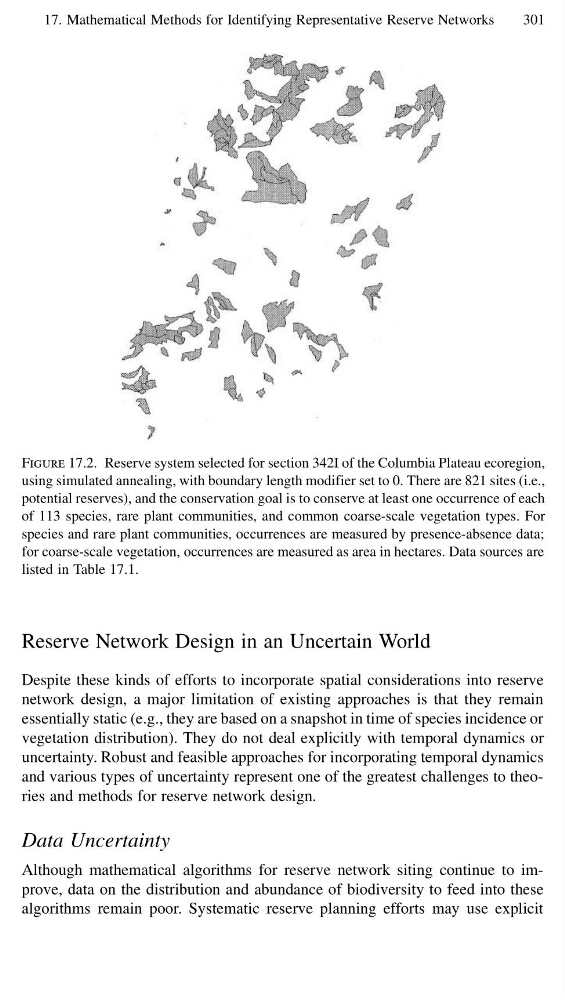
Figure 17.2. Reserve system selected for section 342I of the Columbia Plateau ecoregion,
using simulated annealing, with boundary length modifier set to 0. There are 821 sites (i.e.,
potential reserves), and the conservation goal is to conserve at least one occurrence of each
of 113 species, rare plant communities, and common coarse-scale vegetation types. For
species and rare plant communities, occurrences are measured by presence-absence data;
for coarse-scale vegetation, occurrences are measured as area in hectares. Data sources are
listed in Table 17.1.
Reserve Network Design in an Uncertain World
Despite these kinds of efforts to incorporate spatial considerations into reserve
network design, a major limitation of existing approaches is that they remain
essentially static (e.g., they are based on a snapshot in time of species incidence or
vegetation distribution). They do not deal explicitly with temporal dynamics or
uncertainty. Robust and feasible approaches for incorporating temporal dynamics
and various types of uncertainty represent one of the greatest challenges to theories and methods for reserve network design.
Data Uncertainty
Although mathematical algorithms for reserve network siting continue to improve, data on the distribution and abundance of biodiversity to feed into these
algorithms remain poor. Systematic reserve planning efforts may use explicit
301
Figure 17.2. Reserve system selected for section 342I of the Columbia Plateau ecoregion,
using simulated annealing, with boundary length modifier set to 0. There are 821 sites (i.e.,
potential reserves), and the conservation goal is to conserve at least one occurrence of each
of 113 species, rare plant communities, and common coarse-scale vegetation types. For
species and rare plant communities, occurrences are measured by presence-absence data;
for coarse-scale vegetation, occurrences are measured as area in hectares. Data sources are
listed in Table 17.1.
Reserve Network Design in an Uncertain World
Despite these kinds of efforts to incorporate spatial considerations into reserve
network design, a major limitation of existing approaches is that they remain
essentially static (e.g., they are based on a snapshot in time of species incidence or
vegetation distribution). They do not deal explicitly with temporal dynamics or
uncertainty. Robust and feasible approaches for incorporating temporal dynamics
and various types of uncertainty represent one of the greatest challenges to theories and methods for reserve network design.
Data Uncertainty
Although mathematical algorithms for reserve network siting continue to improve, data on the distribution and abundance of biodiversity to feed into these
algorithms remain poor. Systematic reserve planning efforts may use explicit