

286
Yoshinari Tanaka
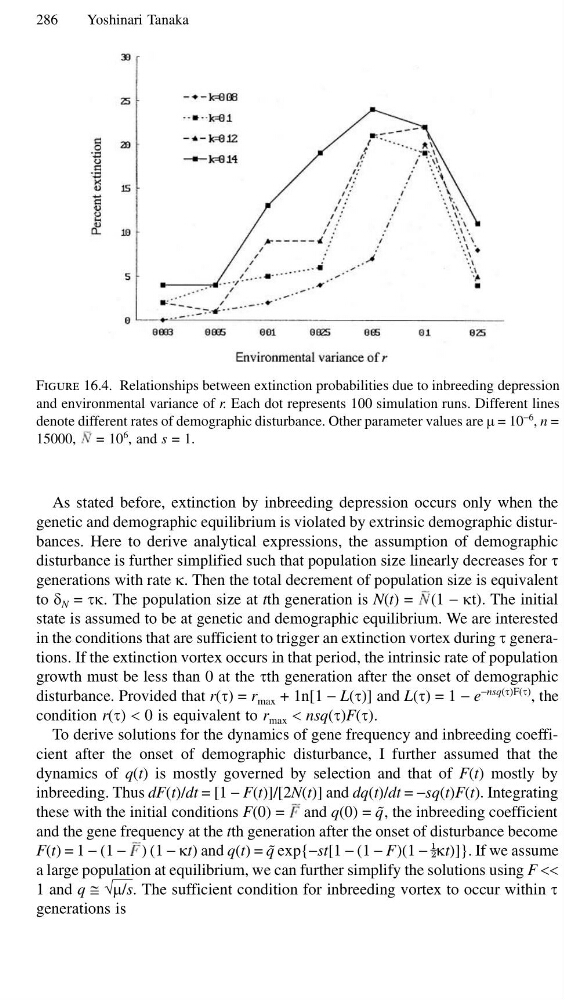
Figure 16.4. Relationships between extinction probabilities due to inbreeding depression
and environmental variance of r. Each dot represents 100 simulation runs. Different lines
denote different rates of demographic disturbance. Other parameter values are µ = 10
−6 , n =
15000, = 10
6 , and s = 1.
As stated before, extinction by inbreeding depression occurs only when the
genetic and demographic equilibrium is violated by extrinsic demographic disturbances. Here to derive analytical expressions, the assumption of demographic
disturbance is further simplified such that population size linearly decreases for τ
generations with rate κ. Then the total decrement of population size is equivalent
to δ N = τκ. The population size at tth generation is N(t) = (1 − κt). The initial
state is assumed to be at genetic and demographic equilibrium. We are interested
in the conditions that are sufficient to trigger an extinction vortex during τ generations. If the extinction vortex occurs in that period, the intrinsic rate of population
growth must be less than 0 at the τth generation after the onset of demographic
disturbance. Provided that r(τ) = r max + 1n[1 − L(τ)] and L(τ) = 1 − e
−nsq(τ)F(τ)
, the
condition r(τ) < 0 is equivalent to r max < nsq(τ)F(τ).
To derive solutions for the dynamics of gene frequency and inbreeding coefficient after the onset of demographic disturbance, I further assumed that the
dynamics of q(t) is mostly governed by selection and that of F(t) mostly by
inbreeding. Thus dF(t)/dt = [1 − F(t)]/[2N(t)] and dq(t)/dt = −sq(t)F(t). Integrating
these with the initial conditions F(0) = and q(0) = ˜
q, the inbreeding coefficient
and the gene frequency at the tth generation after the onset of disturbance become
F(t) = 1 − (1 − ) (1 − κt) and q(t) = ˜
q exp{−st[1 − (1 − F)(1 − κt)]}. If we assume
a large population at equilibrium, we can further simplify the solutions using F <<
1 and q ≅ √µ/s. The sufficient condition for inbreeding vortex to occur within τ
generations is
Yoshinari Tanaka
Figure 16.4. Relationships between extinction probabilities due to inbreeding depression
and environmental variance of r. Each dot represents 100 simulation runs. Different lines
denote different rates of demographic disturbance. Other parameter values are µ = 10
−6 , n =
15000, = 10
6 , and s = 1.
As stated before, extinction by inbreeding depression occurs only when the
genetic and demographic equilibrium is violated by extrinsic demographic disturbances. Here to derive analytical expressions, the assumption of demographic
disturbance is further simplified such that population size linearly decreases for τ
generations with rate κ. Then the total decrement of population size is equivalent
to δ N = τκ. The population size at tth generation is N(t) = (1 − κt). The initial
state is assumed to be at genetic and demographic equilibrium. We are interested
in the conditions that are sufficient to trigger an extinction vortex during τ generations. If the extinction vortex occurs in that period, the intrinsic rate of population
growth must be less than 0 at the τth generation after the onset of demographic
disturbance. Provided that r(τ) = r max + 1n[1 − L(τ)] and L(τ) = 1 − e
−nsq(τ)F(τ)
, the
condition r(τ) < 0 is equivalent to r max < nsq(τ)F(τ).
To derive solutions for the dynamics of gene frequency and inbreeding coefficient after the onset of demographic disturbance, I further assumed that the
dynamics of q(t) is mostly governed by selection and that of F(t) mostly by
inbreeding. Thus dF(t)/dt = [1 − F(t)]/[2N(t)] and dq(t)/dt = −sq(t)F(t). Integrating
these with the initial conditions F(0) = and q(0) = ˜
q, the inbreeding coefficient
and the gene frequency at the tth generation after the onset of disturbance become
F(t) = 1 − (1 − ) (1 − κt) and q(t) = ˜
q exp{−st[1 − (1 − F)(1 − κt)]}. If we assume
a large population at equilibrium, we can further simplify the solutions using F <<
1 and q ≅ √µ/s. The sufficient condition for inbreeding vortex to occur within τ
generations is