

16. Theoretical Properties of Extinction by Inbreeding Depression
287
κ >
sδ
2
N
2 ΄ ln
nδ N √sµ
r max ΅
−1
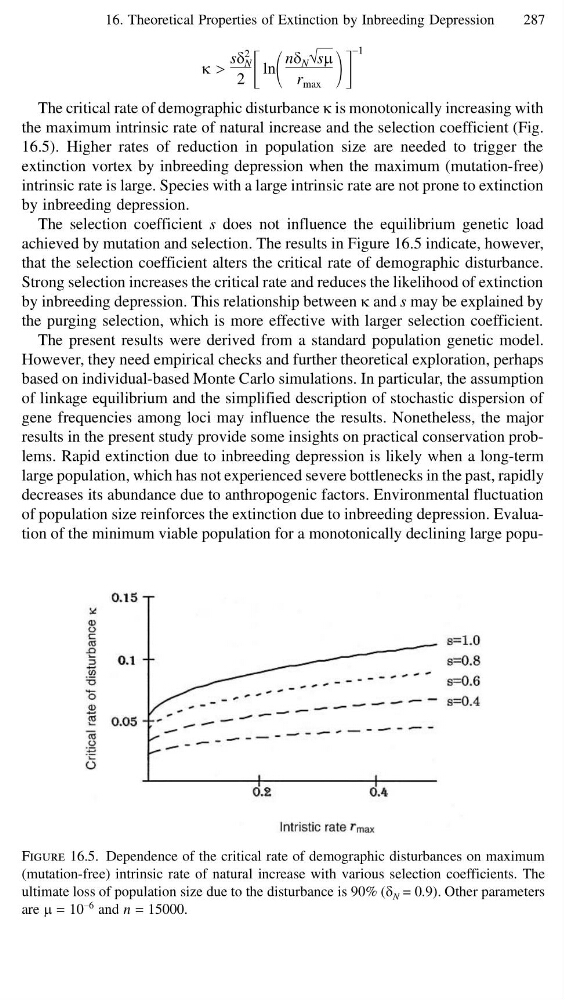
The critical rate of demographic disturbance κ is monotonically increasing with
the maximum intrinsic rate of natural increase and the selection coefficient (Fig.
16.5). Higher rates of reduction in population size are needed to trigger the
extinction vortex by inbreeding depression when the maximum (mutation-free)
intrinsic rate is large. Species with a large intrinsic rate are not prone to extinction
by inbreeding depression.
The selection coefficient s does not influence the equilibrium genetic load
achieved by mutation and selection. The results in Figure 16.5 indicate, however,
that the selection coefficient alters the critical rate of demographic disturbance.
Strong selection increases the critical rate and reduces the likelihood of extinction
by inbreeding depression. This relationship between κ and s may be explained by
the purging selection, which is more effective with larger selection coefficient.
The present results were derived from a standard population genetic model.
However, they need empirical checks and further theoretical exploration, perhaps
based on individual-based Monte Carlo simulations. In particular, the assumption
of linkage equilibrium and the simplified description of stochastic dispersion of
gene frequencies among loci may influence the results. Nonetheless, the major
results in the present study provide some insights on practical conservation problems. Rapid extinction due to inbreeding depression is likely when a long-term
large population, which has not experienced severe bottlenecks in the past, rapidly
decreases its abundance due to anthropogenic factors. Environmental fluctuation
of population size reinforces the extinction due to inbreeding depression. Evaluation of the minimum viable population for a monotonically declining large popuFigure 16.5. Dependence of the critical rate of demographic disturbances on maximum
(mutation-free) intrinsic rate of natural increase with various selection coefficients. The
ultimate loss of population size due to the disturbance is 90% (δ N = 0.9). Other parameters
are µ = 10
−6 and n = 15000.
287
κ >
sδ
2
N
2 ΄ ln
nδ N √sµ
r max ΅
−1
The critical rate of demographic disturbance κ is monotonically increasing with
the maximum intrinsic rate of natural increase and the selection coefficient (Fig.
16.5). Higher rates of reduction in population size are needed to trigger the
extinction vortex by inbreeding depression when the maximum (mutation-free)
intrinsic rate is large. Species with a large intrinsic rate are not prone to extinction
by inbreeding depression.
The selection coefficient s does not influence the equilibrium genetic load
achieved by mutation and selection. The results in Figure 16.5 indicate, however,
that the selection coefficient alters the critical rate of demographic disturbance.
Strong selection increases the critical rate and reduces the likelihood of extinction
by inbreeding depression. This relationship between κ and s may be explained by
the purging selection, which is more effective with larger selection coefficient.
The present results were derived from a standard population genetic model.
However, they need empirical checks and further theoretical exploration, perhaps
based on individual-based Monte Carlo simulations. In particular, the assumption
of linkage equilibrium and the simplified description of stochastic dispersion of
gene frequencies among loci may influence the results. Nonetheless, the major
results in the present study provide some insights on practical conservation problems. Rapid extinction due to inbreeding depression is likely when a long-term
large population, which has not experienced severe bottlenecks in the past, rapidly
decreases its abundance due to anthropogenic factors. Environmental fluctuation
of population size reinforces the extinction due to inbreeding depression. Evaluation of the minimum viable population for a monotonically declining large popuFigure 16.5. Dependence of the critical rate of demographic disturbances on maximum
(mutation-free) intrinsic rate of natural increase with various selection coefficients. The
ultimate loss of population size due to the disturbance is 90% (δ N = 0.9). Other parameters
are µ = 10
−6 and n = 15000.