

16. Theoretical Properties of Extinction by Inbreeding Depression
285
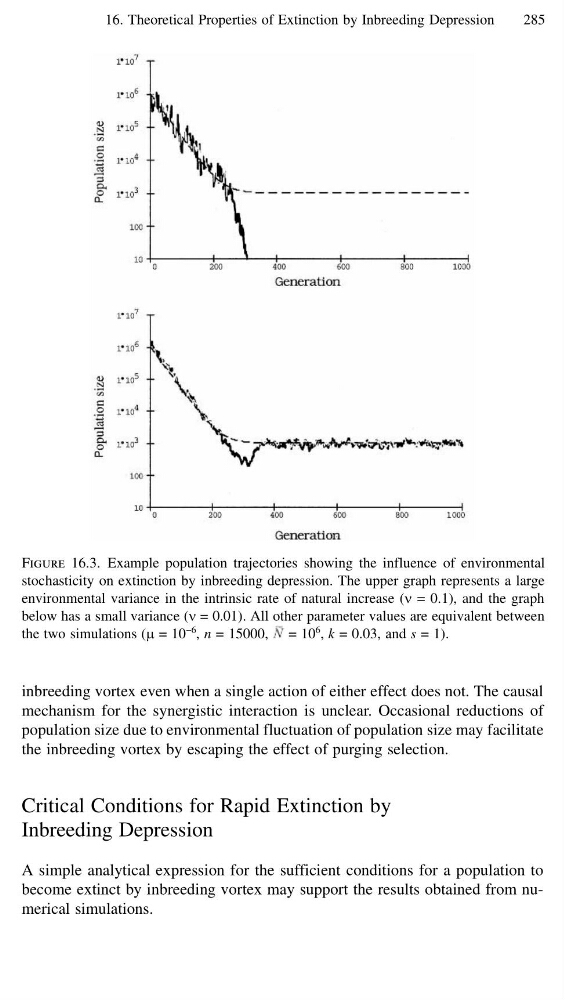
Figure 16.3. Example population trajectories showing the influence of environmental
stochasticity on extinction by inbreeding depression. The upper graph represents a large
environmental variance in the intrinsic rate of natural increase (ν = 0.1), and the graph
below has a small variance (ν = 0.01). All other parameter values are equivalent between
the two simulations (µ = 10
−6 , n = 15000, = 10
6 , k = 0.03, and s = 1).
inbreeding vortex even when a single action of either effect does not. The causal
mechanism for the synergistic interaction is unclear. Occasional reductions of
population size due to environmental fluctuation of population size may facilitate
the inbreeding vortex by escaping the effect of purging selection.
Critical Conditions for Rapid Extinction by
Inbreeding Depression
A simple analytical expression for the sufficient conditions for a population to
become extinct by inbreeding vortex may support the results obtained from numerical simulations.
285
Figure 16.3. Example population trajectories showing the influence of environmental
stochasticity on extinction by inbreeding depression. The upper graph represents a large
environmental variance in the intrinsic rate of natural increase (ν = 0.1), and the graph
below has a small variance (ν = 0.01). All other parameter values are equivalent between
the two simulations (µ = 10
−6 , n = 15000, = 10
6 , k = 0.03, and s = 1).
inbreeding vortex even when a single action of either effect does not. The causal
mechanism for the synergistic interaction is unclear. Occasional reductions of
population size due to environmental fluctuation of population size may facilitate
the inbreeding vortex by escaping the effect of purging selection.
Critical Conditions for Rapid Extinction by
Inbreeding Depression
A simple analytical expression for the sufficient conditions for a population to
become extinct by inbreeding vortex may support the results obtained from numerical simulations.