

13. Potential of Branching Processes as a Modeling Tool
211
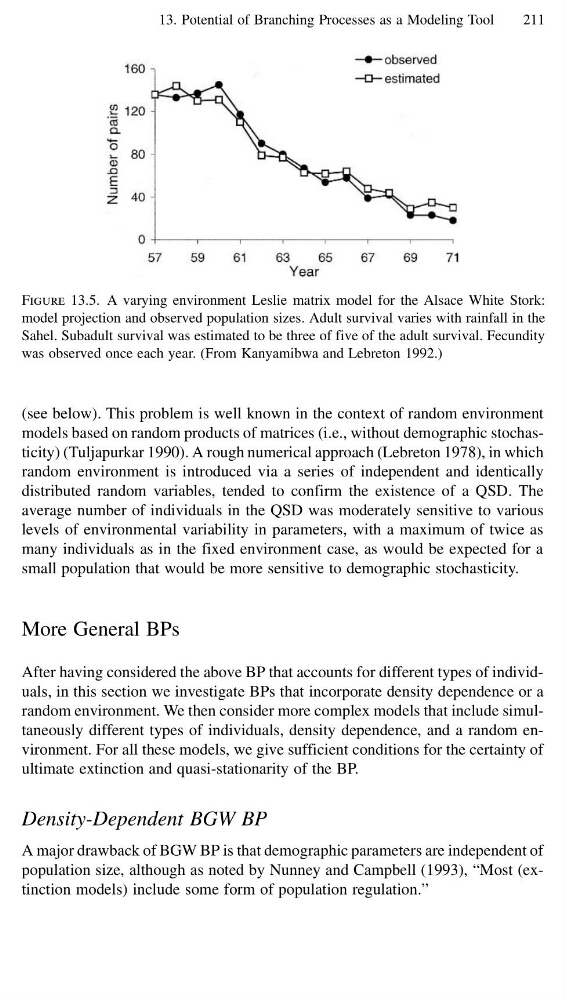
Figure 13.5. A varying environment Leslie matrix model for the Alsace White Stork:
model projection and observed population sizes. Adult survival varies with rainfall in the
Sahel. Subadult survival was estimated to be three of five of the adult survival. Fecundity
was observed once each year. (From Kanyamibwa and Lebreton 1992.)
(see below). This problem is well known in the context of random environment
models based on random products of matrices (i.e., without demographic stochasticity) (Tuljapurkar 1990). A rough numerical approach (Lebreton 1978), in which
random environment is introduced via a series of independent and identically
distributed random variables, tended to confirm the existence of a QSD. The
average number of individuals in the QSD was moderately sensitive to various
levels of environmental variability in parameters, with a maximum of twice as
many individuals as in the fixed environment case, as would be expected for a
small population that would be more sensitive to demographic stochasticity.
More General BPs
After having considered the above BP that accounts for different types of individuals, in this section we investigate BPs that incorporate density dependence or a
random environment. We then consider more complex models that include simultaneously different types of individuals, density dependence, and a random environment. For all these models, we give sufficient conditions for the certainty of
ultimate extinction and quasi-stationarity of the BP.
Density-Dependent BGW BP
A major drawback of BGW BP is that demographic parameters are independent of
population size, although as noted by Nunney and Campbell (1993), “Most (extinction models) include some form of population regulation.”
211
Figure 13.5. A varying environment Leslie matrix model for the Alsace White Stork:
model projection and observed population sizes. Adult survival varies with rainfall in the
Sahel. Subadult survival was estimated to be three of five of the adult survival. Fecundity
was observed once each year. (From Kanyamibwa and Lebreton 1992.)
(see below). This problem is well known in the context of random environment
models based on random products of matrices (i.e., without demographic stochasticity) (Tuljapurkar 1990). A rough numerical approach (Lebreton 1978), in which
random environment is introduced via a series of independent and identically
distributed random variables, tended to confirm the existence of a QSD. The
average number of individuals in the QSD was moderately sensitive to various
levels of environmental variability in parameters, with a maximum of twice as
many individuals as in the fixed environment case, as would be expected for a
small population that would be more sensitive to demographic stochasticity.
More General BPs
After having considered the above BP that accounts for different types of individuals, in this section we investigate BPs that incorporate density dependence or a
random environment. We then consider more complex models that include simultaneously different types of individuals, density dependence, and a random environment. For all these models, we give sufficient conditions for the certainty of
ultimate extinction and quasi-stationarity of the BP.
Density-Dependent BGW BP
A major drawback of BGW BP is that demographic parameters are independent of
population size, although as noted by Nunney and Campbell (1993), “Most (extinction models) include some form of population regulation.”