

212
Fr´ ed´ eric Gosselin and Jean-Dominique Lebreton
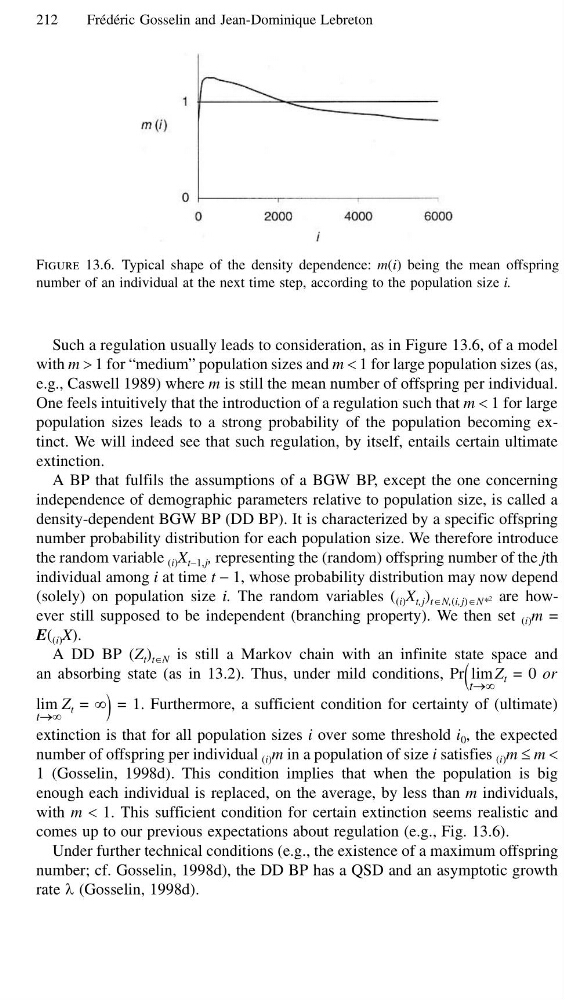
Figure 13.6. Typical shape of the density dependence: m(i) being the mean offspring
number of an individual at the next time step, according to the population size i.
Such a regulation usually leads to consideration, as in Figure 13.6, of a model
with m > 1 for “medium” population sizes and m < 1 for large population sizes (as,
e.g., Caswell 1989) where m is still the mean number of offspring per individual.
One feels intuitively that the introduction of a regulation such that m < 1 for large
population sizes leads to a strong probability of the population becoming extinct. We will indeed see that such regulation, by itself, entails certain ultimate
extinction.
A BP that fulfils the assumptions of a BGW BP, except the one concerning
independence of demographic parameters relative to population size, is called a
density-dependent BGW BP (DD BP). It is characterized by a specific offspring
number probability distribution for each population size. We therefore introduce
the random variable (i) X t−1,j , representing the (random) offspring number of the jth
individual among i at time t − 1, whose probability distribution may now depend
(solely) on population size i. The random variables ( (i) X t,j ) t∈N,(i,j)∈N*
2 are however still supposed to be independent (branching property). We then set (i) m =
E( (i) X).
A DD BP (Z t ) t∈N is still a Markov chain with an infinite state space and
an absorbing state (as in 13.2). Thus, under mild conditions, Pr ( lim
t→∞
Z t = 0 or
lim
t→∞
Z t = ∞ ) = 1. Furthermore, a sufficient condition for certainty of (ultimate)
extinction is that for all population sizes i over some threshold i 0 , the expected
number of offspring per individual (i) m in a population of size i satisfies (i) m ≤ m <
1 (Gosselin, 1998d). This condition implies that when the population is big
enough each individual is replaced, on the average, by less than m individuals,
with m < 1. This sufficient condition for certain extinction seems realistic and
comes up to our previous expectations about regulation (e.g., Fig. 13.6).
Under further technical conditions (e.g., the existence of a maximum offspring
number; cf. Gosselin, 1998d), the DD BP has a QSD and an asymptotic growth
rate λ (Gosselin, 1998d).
Fr´ ed´ eric Gosselin and Jean-Dominique Lebreton
Figure 13.6. Typical shape of the density dependence: m(i) being the mean offspring
number of an individual at the next time step, according to the population size i.
Such a regulation usually leads to consideration, as in Figure 13.6, of a model
with m > 1 for “medium” population sizes and m < 1 for large population sizes (as,
e.g., Caswell 1989) where m is still the mean number of offspring per individual.
One feels intuitively that the introduction of a regulation such that m < 1 for large
population sizes leads to a strong probability of the population becoming extinct. We will indeed see that such regulation, by itself, entails certain ultimate
extinction.
A BP that fulfils the assumptions of a BGW BP, except the one concerning
independence of demographic parameters relative to population size, is called a
density-dependent BGW BP (DD BP). It is characterized by a specific offspring
number probability distribution for each population size. We therefore introduce
the random variable (i) X t−1,j , representing the (random) offspring number of the jth
individual among i at time t − 1, whose probability distribution may now depend
(solely) on population size i. The random variables ( (i) X t,j ) t∈N,(i,j)∈N*
2 are however still supposed to be independent (branching property). We then set (i) m =
E( (i) X).
A DD BP (Z t ) t∈N is still a Markov chain with an infinite state space and
an absorbing state (as in 13.2). Thus, under mild conditions, Pr ( lim
t→∞
Z t = 0 or
lim
t→∞
Z t = ∞ ) = 1. Furthermore, a sufficient condition for certainty of (ultimate)
extinction is that for all population sizes i over some threshold i 0 , the expected
number of offspring per individual (i) m in a population of size i satisfies (i) m ≤ m <
1 (Gosselin, 1998d). This condition implies that when the population is big
enough each individual is replaced, on the average, by less than m individuals,
with m < 1. This sufficient condition for certain extinction seems realistic and
comes up to our previous expectations about regulation (e.g., Fig. 13.6).
Under further technical conditions (e.g., the existence of a maximum offspring
number; cf. Gosselin, 1998d), the DD BP has a QSD and an asymptotic growth
rate λ (Gosselin, 1998d).