

210
Fr´ ed´ eric Gosselin and Jean-Dominique Lebreton
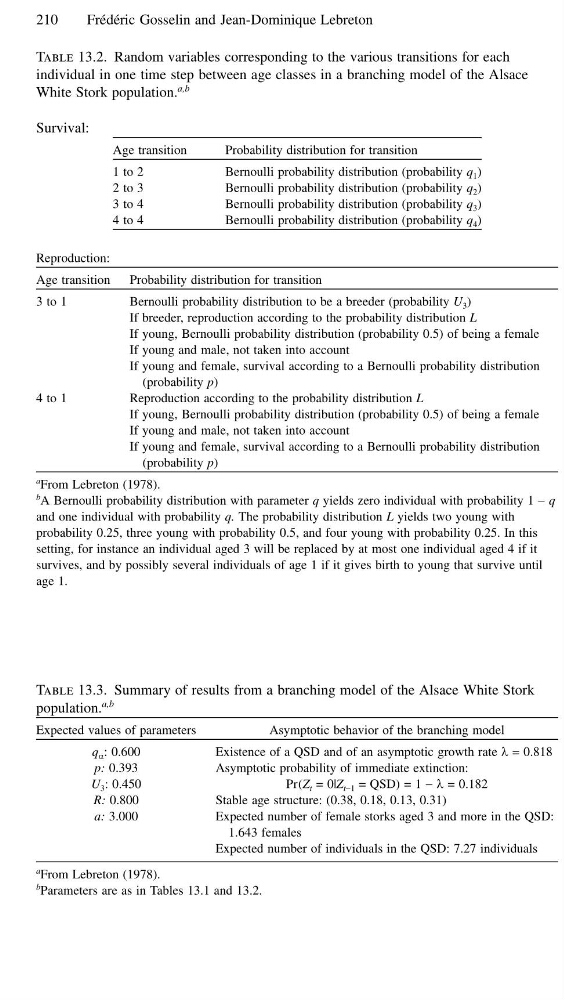
Table 13.2. Random variables corresponding to the various transitions for each
individual in one time step between age classes in a branching model of the Alsace
White Stork population.
a,b
Survival:
Age transition
Probability distribution for transition
1 to 2
Bernoulli probability distribution (probability q 1 )
2 to 3
Bernoulli probability distribution (probability q 2 )
3 to 4
Bernoulli probability distribution (probability q 3 )
4 to 4
Bernoulli probability distribution (probability q 4 )
Reproduction:
Age transition
Probability distribution for transition
3 to 1
Bernoulli probability distribution to be a breeder (probability U 3 )
If breeder, reproduction according to the probability distribution L
If young, Bernoulli probability distribution (probability 0.5) of being a female
If young and male, not taken into account
If young and female, survival according to a Bernoulli probability distribution
(probability p)
4 to 1
Reproduction according to the probability distribution L
If young, Bernoulli probability distribution (probability 0.5) of being a female
If young and male, not taken into account
If young and female, survival according to a Bernoulli probability distribution
(probability p)
a
From Lebreton (1978).
b
A Bernoulli probability distribution with parameter q yields zero individual with probability 1 − q
and one individual with probability q. The probability distribution L yields two young with
probability 0.25, three young with probability 0.5, and four young with probability 0.25. In this
setting, for instance an individual aged 3 will be replaced by at most one individual aged 4 if it
survives, and by possibly several individuals of age 1 if it gives birth to young that survive until
age 1.
Table 13.3. Summary of results from a branching model of the Alsace White Stork
population.
a,b
Expected values of parameters
Asymptotic behavior of the branching model
q α : 0.600
Existence of a QSD and of an asymptotic growth rate λ = 0.818
p: 0.393
Asymptotic probability of immediate extinction:
U 3 : 0.450
Pr(Z t = 0|Z t−1 = QSD) = 1 − λ = 0.182
R: 0.800
Stable age structure: (0.38, 0.18, 0.13, 0.31)
a: 3.000
Expected number of female storks aged 3 and more in the QSD:
1.643 females
Expected number of individuals in the QSD: 7.27 individuals
a
From Lebreton (1978).
b
Parameters are as in Tables 13.1 and 13.2.
Fr´ ed´ eric Gosselin and Jean-Dominique Lebreton
Table 13.2. Random variables corresponding to the various transitions for each
individual in one time step between age classes in a branching model of the Alsace
White Stork population.
a,b
Survival:
Age transition
Probability distribution for transition
1 to 2
Bernoulli probability distribution (probability q 1 )
2 to 3
Bernoulli probability distribution (probability q 2 )
3 to 4
Bernoulli probability distribution (probability q 3 )
4 to 4
Bernoulli probability distribution (probability q 4 )
Reproduction:
Age transition
Probability distribution for transition
3 to 1
Bernoulli probability distribution to be a breeder (probability U 3 )
If breeder, reproduction according to the probability distribution L
If young, Bernoulli probability distribution (probability 0.5) of being a female
If young and male, not taken into account
If young and female, survival according to a Bernoulli probability distribution
(probability p)
4 to 1
Reproduction according to the probability distribution L
If young, Bernoulli probability distribution (probability 0.5) of being a female
If young and male, not taken into account
If young and female, survival according to a Bernoulli probability distribution
(probability p)
a
From Lebreton (1978).
b
A Bernoulli probability distribution with parameter q yields zero individual with probability 1 − q
and one individual with probability q. The probability distribution L yields two young with
probability 0.25, three young with probability 0.5, and four young with probability 0.25. In this
setting, for instance an individual aged 3 will be replaced by at most one individual aged 4 if it
survives, and by possibly several individuals of age 1 if it gives birth to young that survive until
age 1.
Table 13.3. Summary of results from a branching model of the Alsace White Stork
population.
a,b
Expected values of parameters
Asymptotic behavior of the branching model
q α : 0.600
Existence of a QSD and of an asymptotic growth rate λ = 0.818
p: 0.393
Asymptotic probability of immediate extinction:
U 3 : 0.450
Pr(Z t = 0|Z t−1 = QSD) = 1 − λ = 0.182
R: 0.800
Stable age structure: (0.38, 0.18, 0.13, 0.31)
a: 3.000
Expected number of female storks aged 3 and more in the QSD:
1.643 females
Expected number of individuals in the QSD: 7.27 individuals
a
From Lebreton (1978).
b
Parameters are as in Tables 13.1 and 13.2.