

6. Likelihood of Introducing Nonindigenous Organisms
91
Lognormal Distribution
Lognormal distributions have many of the same advantages and disadvantages as
normal distributions: they are representative of many biological phenomena, and
they are not limited by minimum and maximum values, but there is a chance that
values greater than 1 will be chosen for probability estimates. Lognormal distributions have the advantage of not allowing negative values (i.e., 0 is the minimum
value). The problem of sampling values greater than 1 can be managed with many
risk assessment programs by specifying a “truncated lognormal distribution” with
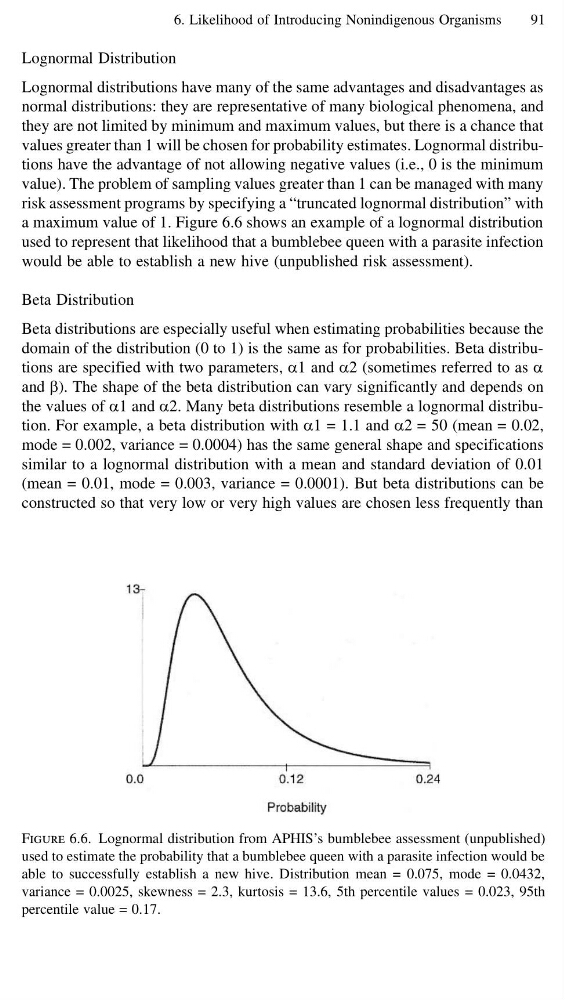
a maximum value of 1. Figure 6.6 shows an example of a lognormal distribution
used to represent that likelihood that a bumblebee queen with a parasite infection
would be able to establish a new hive (unpublished risk assessment).
Beta Distribution
Beta distributions are especially useful when estimating probabilities because the
domain of the distribution (0 to 1) is the same as for probabilities. Beta distributions are specified with two parameters, α1 and α2 (sometimes referred to as α
and β). The shape of the beta distribution can vary significantly and depends on
the values of α1 and α2. Many beta distributions resemble a lognormal distribution. For example, a beta distribution with α1 = 1.1 and α2 = 50 (mean = 0.02,
mode = 0.002, variance = 0.0004) has the same general shape and specifications
similar to a lognormal distribution with a mean and standard deviation of 0.01
(mean = 0.01, mode = 0.003, variance = 0.0001). But beta distributions can be
constructed so that very low or very high values are chosen less frequently than
Figure 6.6. Lognormal distribution from APHIS’s bumblebee assessment (unpublished)
used to estimate the probability that a bumblebee queen with a parasite infection would be
able to successfully establish a new hive. Distribution mean = 0.075, mode = 0.0432,
variance = 0.0025, skewness = 2.3, kurtosis = 13.6, 5th percentile values = 0.023, 95th
percentile value = 0.17.
91
Lognormal Distribution
Lognormal distributions have many of the same advantages and disadvantages as
normal distributions: they are representative of many biological phenomena, and
they are not limited by minimum and maximum values, but there is a chance that
values greater than 1 will be chosen for probability estimates. Lognormal distributions have the advantage of not allowing negative values (i.e., 0 is the minimum
value). The problem of sampling values greater than 1 can be managed with many
risk assessment programs by specifying a “truncated lognormal distribution” with
a maximum value of 1. Figure 6.6 shows an example of a lognormal distribution
used to represent that likelihood that a bumblebee queen with a parasite infection
would be able to establish a new hive (unpublished risk assessment).
Beta Distribution
Beta distributions are especially useful when estimating probabilities because the
domain of the distribution (0 to 1) is the same as for probabilities. Beta distributions are specified with two parameters, α1 and α2 (sometimes referred to as α
and β). The shape of the beta distribution can vary significantly and depends on
the values of α1 and α2. Many beta distributions resemble a lognormal distribution. For example, a beta distribution with α1 = 1.1 and α2 = 50 (mean = 0.02,
mode = 0.002, variance = 0.0004) has the same general shape and specifications
similar to a lognormal distribution with a mean and standard deviation of 0.01
(mean = 0.01, mode = 0.003, variance = 0.0001). But beta distributions can be
constructed so that very low or very high values are chosen less frequently than
Figure 6.6. Lognormal distribution from APHIS’s bumblebee assessment (unpublished)
used to estimate the probability that a bumblebee queen with a parasite infection would be
able to successfully establish a new hive. Distribution mean = 0.075, mode = 0.0432,
variance = 0.0025, skewness = 2.3, kurtosis = 13.6, 5th percentile values = 0.023, 95th
percentile value = 0.17.