

Population Dynamics of Benthic Species and Shorebird Predation
323
o
5
1980
10
15
biomass
o
1985
20
year
0.5
25
1990
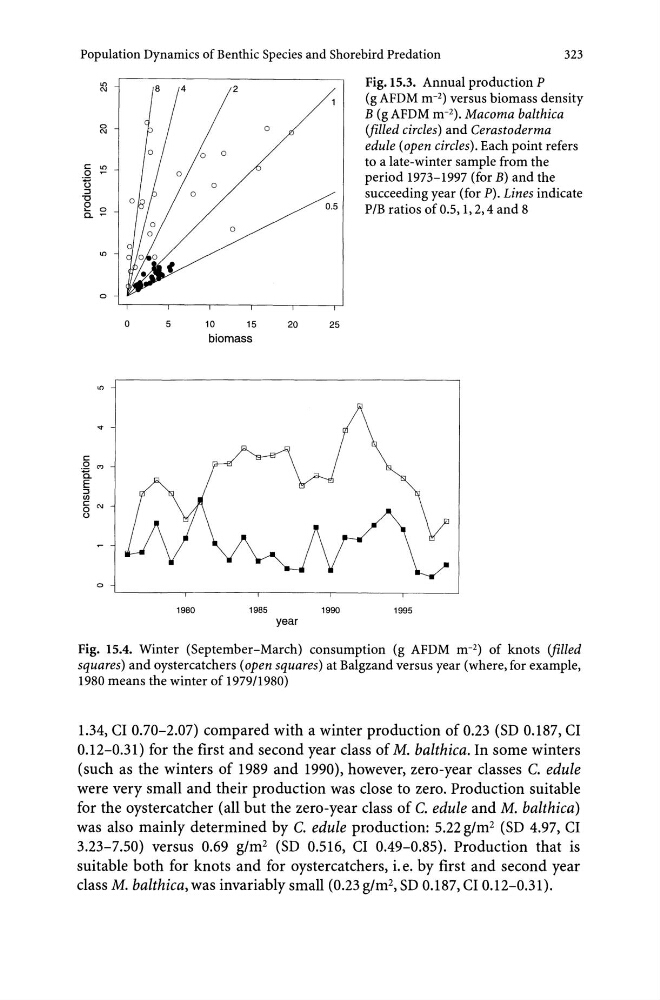
Fig. 15.3. Annual production P
(g AFDM m- 2 ) versus biomass density
B (g AFDM m- 2 ). Macoma balthica
(filled circles) and Cerastoderma
edule (open circles). Each point refers
to a late-winter sample from the
period 1973-1997 (for B) and the
succeeding year (for P). Lines indicate
P /B ratios of 0.5, 1,2,4 and 8
1995
Fig. 15.4. Winter (September-March) consumption (g AFDM m- 2 ) of knots (filled
squares) and oystercatchers (open squares) at Balgzand versus year (where, for example,
1980 means the winter of 1979/1980)
1.34, CI 0.70-2.07) compared with a winter production of 0.23 (SD 0.187, CI
0.12-0.31) for the first and second year class of M. balthica. In some winters
(such as the winters of 1989 and 1990), however, zero-year classes C. edule
were very small and their production was close to zero. Production suitable
for the oystercatcher (all but the zero-year class of C. edule and M. balthica)
was also mainly determined by C. edule production: 5.22 g/m2 (SD 4.97, CI
3.23-7.50) versus 0.69 g/m2 (SD 0.516, CI 0.49-0.85). Production that is
suitable both for knots and for oystercatchers, i. e. by first and second year
class M. balthica, was invariably small (0.23 g/m2, SD 0.187, CI 0.12-0.31).
323
o
5
1980
10
15
biomass
o
1985
20
year
0.5
25
1990
Fig. 15.3. Annual production P
(g AFDM m- 2 ) versus biomass density
B (g AFDM m- 2 ). Macoma balthica
(filled circles) and Cerastoderma
edule (open circles). Each point refers
to a late-winter sample from the
period 1973-1997 (for B) and the
succeeding year (for P). Lines indicate
P /B ratios of 0.5, 1,2,4 and 8
1995
Fig. 15.4. Winter (September-March) consumption (g AFDM m- 2 ) of knots (filled
squares) and oystercatchers (open squares) at Balgzand versus year (where, for example,
1980 means the winter of 1979/1980)
1.34, CI 0.70-2.07) compared with a winter production of 0.23 (SD 0.187, CI
0.12-0.31) for the first and second year class of M. balthica. In some winters
(such as the winters of 1989 and 1990), however, zero-year classes C. edule
were very small and their production was close to zero. Production suitable
for the oystercatcher (all but the zero-year class of C. edule and M. balthica)
was also mainly determined by C. edule production: 5.22 g/m2 (SD 4.97, CI
3.23-7.50) versus 0.69 g/m2 (SD 0.516, CI 0.49-0.85). Production that is
suitable both for knots and for oystercatchers, i. e. by first and second year
class M. balthica, was invariably small (0.23 g/m2, SD 0.187, CI 0.12-0.31).