

Tropical Tidal Flat Benthos Compared Between Australia an Central America
279
J
Pacific OC88n
..... ... ....
180·
..... .
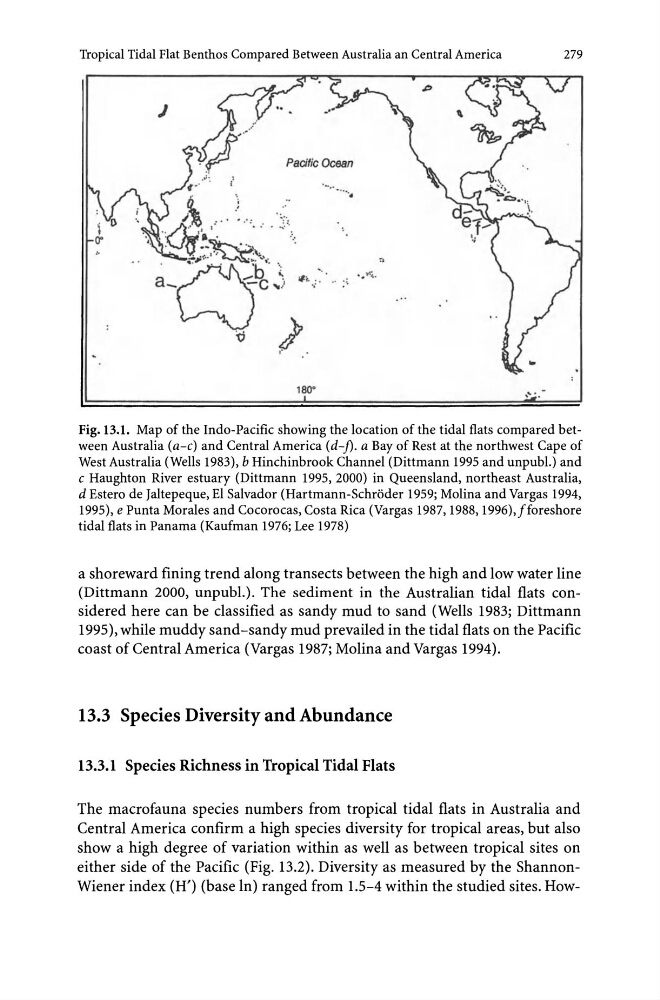
Fig. 13.1. Map of the Indo-Pacific showing the location of the tidal flats compared between Australia (a-c) and Central America (d-j). a Bay of Rest at the northwest Cape of
West Australia (Wells 1983), b Hinchinbrook Channel (Dittmann 1995 and unpub!.) and
c Haughton River estuary (Dittmann 1995, 2000) in Queensland, northeast Australia,
d Estero de Jaltepeque, El Salvador (Hartmann-Schroder 1959; Molina and Vargas 1994,
1995), e Punta Morales and Cocorocas, Costa Rica (Vargas 1987,1988, 1996),Jforeshore
tidal flats in Panama (Kaufman 1976; Lee 1978)
a shoreward fining trend along transects between the high and low water line
(Dittmann 2000, unpubl.). The sediment in the Australian tidal flats considered here can be classified as sandy mud to sand (Wells 1983; Dittmann
1995), while muddy sand-sandy mud prevailed in the tidal flats on the Pacific
coast of Central America (Vargas 1987; Molina and Vargas 1994).
13.3 Species Diversity and Abundance
13.3.1 Species Richness in Tropical Tidal Flats
The macrofauna species numbers from tropical tidal flats in Australia and
Central America confirm a high species diversity for tropical areas, but also
show a high degree of variation within as well as between tropical sites on
either side of the Pacific (Fig. 13.2). Diversity as measured by the ShannonWiener index (H') (base In) ranged from 1.5-4 within the studied sites. How-
279
J
Pacific OC88n
..... ... ....
180·
..... .
Fig. 13.1. Map of the Indo-Pacific showing the location of the tidal flats compared between Australia (a-c) and Central America (d-j). a Bay of Rest at the northwest Cape of
West Australia (Wells 1983), b Hinchinbrook Channel (Dittmann 1995 and unpub!.) and
c Haughton River estuary (Dittmann 1995, 2000) in Queensland, northeast Australia,
d Estero de Jaltepeque, El Salvador (Hartmann-Schroder 1959; Molina and Vargas 1994,
1995), e Punta Morales and Cocorocas, Costa Rica (Vargas 1987,1988, 1996),Jforeshore
tidal flats in Panama (Kaufman 1976; Lee 1978)
a shoreward fining trend along transects between the high and low water line
(Dittmann 2000, unpubl.). The sediment in the Australian tidal flats considered here can be classified as sandy mud to sand (Wells 1983; Dittmann
1995), while muddy sand-sandy mud prevailed in the tidal flats on the Pacific
coast of Central America (Vargas 1987; Molina and Vargas 1994).
13.3 Species Diversity and Abundance
13.3.1 Species Richness in Tropical Tidal Flats
The macrofauna species numbers from tropical tidal flats in Australia and
Central America confirm a high species diversity for tropical areas, but also
show a high degree of variation within as well as between tropical sites on
either side of the Pacific (Fig. 13.2). Diversity as measured by the ShannonWiener index (H') (base In) ranged from 1.5-4 within the studied sites. How-