

278
S. Dittmann and J.A. Vargas
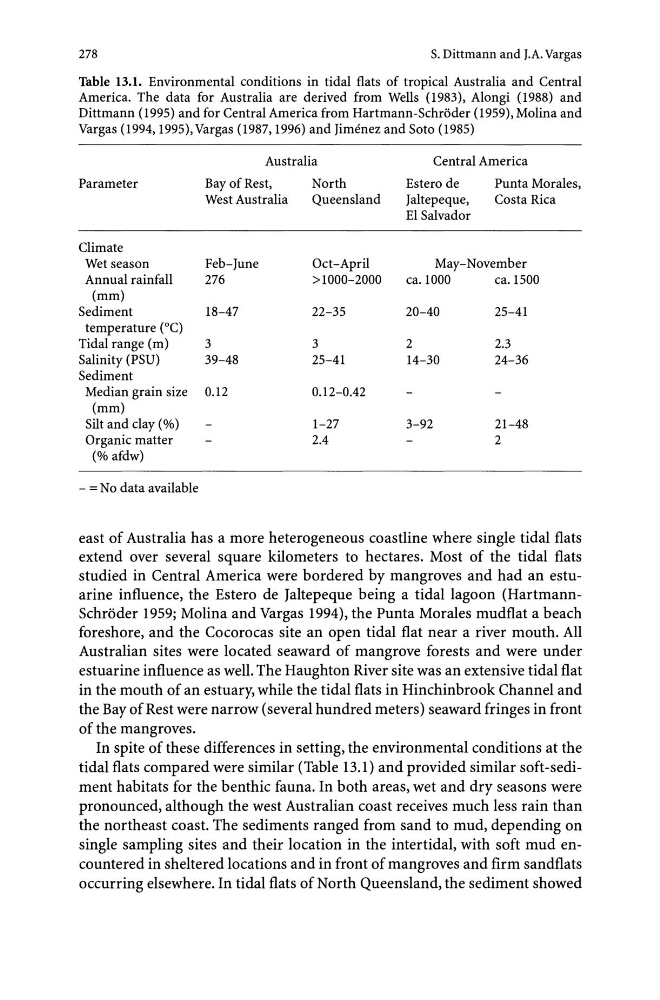
Table 13.1. Environmental conditions in tidal flats of tropical Australia and Central
America. The data for Australia are derived from Wells (1983), Alongi (1988) and
Dittmann (1995) and for Central America from Hartmann-Schroder (1959), Molina and
Vargas (1994, 1995), Vargas (1987, 1996) and Jimenez and Soto (1985)
Parameter
Climate
Wet season
Annual rainfall
(mm)
Sediment
temperature (0C)
Tidal range (m)
Salinity (PSU)
Sediment
Median grain size
(mm)
Silt and clay (%)
Organic matter
(% afdw)
- = No data available
Australia
Bay of Rest,
North
West Australia
Queensland
Feb-June
Oct-April
276
>1000-2000
18-47
22-35
3
3
39-48
25-41
0.12
0.12-0.42
1-27
2.4
Central America
Estero de
Jaltepeque,
El Salvador
Punta Morales,
Costa Rica
May-November
ca. 1000
ca. 1500
20-40
2
14-30
3-92
25-41
2.3
24-36
21-48
2
east of Australia has a more heterogeneous coastline where single tidal flats
extend over several square kilometers to hectares. Most of the tidal flats
studied in Central America were bordered by mangroves and had an estuarine influence, the Estero de Jaltepeque being a tidal lagoon (HartmannSchroder 1959; Molina and Vargas 1994), the Punta Morales mudflat a beach
foreshore, and the Cocorocas site an open tidal flat near a river mouth. All
Australian sites were located seaward of mangrove forests and were under
estuarine influence as well. The Haughton River site was an extensive tidal flat
in the mouth of an estuary, while the tidal flats in Hinchinbrook Channel and
the Bay of Rest were narrow (several hundred meters) seaward fringes in front
of the mangroves.
In spite of these differences in setting, the environmental conditions at the
tidal flats compared were similar (Table 13.1) and provided similar soft-sediment habitats for the benthic fauna. In both areas, wet and dry seasons were
pronounced, although the west Australian coast receives much less rain than
the northeast coast. The sediments ranged from sand to mud, depending on
single sampling sites and their location in the intertidal, with soft mud encountered in sheltered locations and in front of mangroves and firm sandflats
occurring elsewhere. In tidal flats of North Queensland, the sediment showed
S. Dittmann and J.A. Vargas
Table 13.1. Environmental conditions in tidal flats of tropical Australia and Central
America. The data for Australia are derived from Wells (1983), Alongi (1988) and
Dittmann (1995) and for Central America from Hartmann-Schroder (1959), Molina and
Vargas (1994, 1995), Vargas (1987, 1996) and Jimenez and Soto (1985)
Parameter
Climate
Wet season
Annual rainfall
(mm)
Sediment
temperature (0C)
Tidal range (m)
Salinity (PSU)
Sediment
Median grain size
(mm)
Silt and clay (%)
Organic matter
(% afdw)
- = No data available
Australia
Bay of Rest,
North
West Australia
Queensland
Feb-June
Oct-April
276
>1000-2000
18-47
22-35
3
3
39-48
25-41
0.12
0.12-0.42
1-27
2.4
Central America
Estero de
Jaltepeque,
El Salvador
Punta Morales,
Costa Rica
May-November
ca. 1000
ca. 1500
20-40
2
14-30
3-92
25-41
2.3
24-36
21-48
2
east of Australia has a more heterogeneous coastline where single tidal flats
extend over several square kilometers to hectares. Most of the tidal flats
studied in Central America were bordered by mangroves and had an estuarine influence, the Estero de Jaltepeque being a tidal lagoon (HartmannSchroder 1959; Molina and Vargas 1994), the Punta Morales mudflat a beach
foreshore, and the Cocorocas site an open tidal flat near a river mouth. All
Australian sites were located seaward of mangrove forests and were under
estuarine influence as well. The Haughton River site was an extensive tidal flat
in the mouth of an estuary, while the tidal flats in Hinchinbrook Channel and
the Bay of Rest were narrow (several hundred meters) seaward fringes in front
of the mangroves.
In spite of these differences in setting, the environmental conditions at the
tidal flats compared were similar (Table 13.1) and provided similar soft-sediment habitats for the benthic fauna. In both areas, wet and dry seasons were
pronounced, although the west Australian coast receives much less rain than
the northeast coast. The sediments ranged from sand to mud, depending on
single sampling sites and their location in the intertidal, with soft mud encountered in sheltered locations and in front of mangroves and firm sandflats
occurring elsewhere. In tidal flats of North Queensland, the sediment showed