

280
300
Australia
(j)
r-.0 200
E
::J
C
(J)
Q)
'u 100
~
-
-
(J)
0
100
80
60
%
40
20
0
America
r-n
Q) Q)
(J)
mL:
"O::J
Q)
~
0
ei
(ij
.om
(5
~Q)
GlQ.
::Jill
1ii2 ::i! 0
wIG m
..., 'E ::J
Q.
S. Dittmann and J.A. Vargas
•
Polychaeta
~ Crustacea
~ Mollusca
~ Echinoderms
~ others
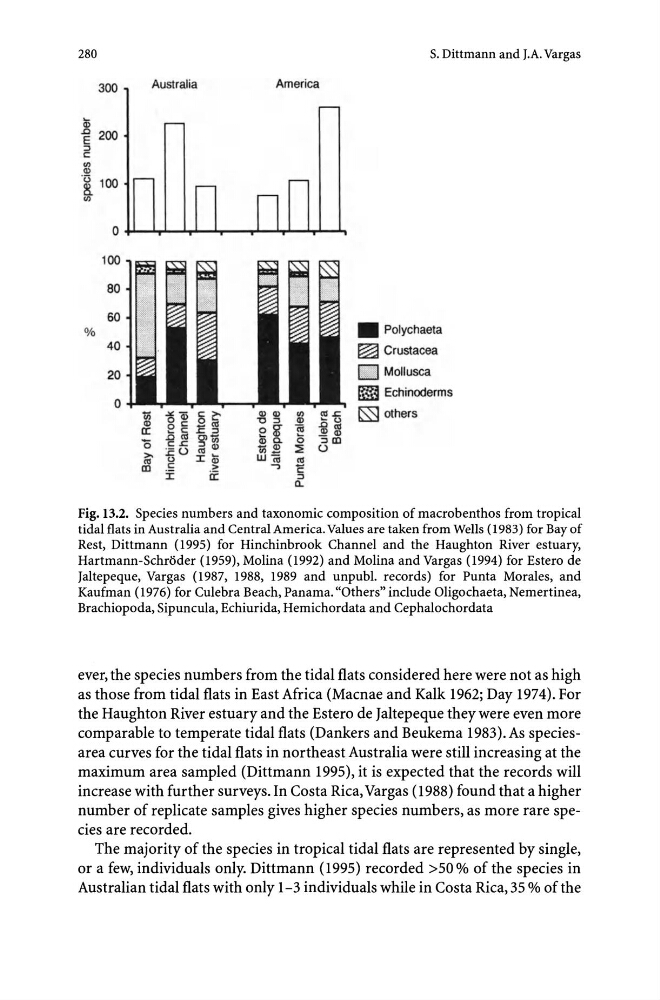
Fig. 13.2. Species numbers and taxonomic composition of macrobenthos from tropical
tidal flats in Australia and Central America. Values are taken from Wells (1983) for Bay of
Rest, Dittmann (1995) for Hinchinbrook Channel and the Haughton River estuary,
Hartmann-Schroder (1959), Molina (1992) and Molina and Vargas (1994) for Estero de
Jaltepeque, Vargas (1987, 1988, 1989 and unpubl. records) for Punta Morales, and
Kaufman (1976) for Culebra Beach, Panama. "Others" include Oligo chaeta, Nemertinea,
Brachiopoda, Sipuncula, Echiurida, Hemichordata and Cephalochordata
ever, the species numbers from the tidal flats considered here were not as high
as those from tidal flats in East Africa (Macnae and Kalk 1962; Day 1974). For
the Haughton River estuary and the Estero de J altepeque they were even more
comparable to temperate tidal flats (Dankers and Beukema 1983). As speciesarea curves for the tidal flats in northeast Australia were still increasing at the
maximum area sampled (Dittmann 1995), it is expected that the records will
increase with further surveys. In Costa Rica, Vargas (1988) found that a higher
number of replicate samples gives higher species numbers, as more rare species are recorded.
The majority of the species in tropical tidal flats are represented by single,
or a few, individuals only. Dittmann (1995) recorded >50 % of the species in
Australian tidal flats with only 1-3 individuals while in Costa Rica, 35 % of the
300
Australia
(j)
r-.0 200
E
::J
C
(J)
Q)
'u 100
~
-
-
(J)
0
100
80
60
%
40
20
0
America
r-n
Q) Q)
(J)
mL:
"O::J
Q)
~
0
ei
(ij
.om
(5
~Q)
GlQ.
::Jill
1ii2 ::i! 0
wIG m
..., 'E ::J
Q.
S. Dittmann and J.A. Vargas
•
Polychaeta
~ Crustacea
~ Mollusca
~ Echinoderms
~ others
Fig. 13.2. Species numbers and taxonomic composition of macrobenthos from tropical
tidal flats in Australia and Central America. Values are taken from Wells (1983) for Bay of
Rest, Dittmann (1995) for Hinchinbrook Channel and the Haughton River estuary,
Hartmann-Schroder (1959), Molina (1992) and Molina and Vargas (1994) for Estero de
Jaltepeque, Vargas (1987, 1988, 1989 and unpubl. records) for Punta Morales, and
Kaufman (1976) for Culebra Beach, Panama. "Others" include Oligo chaeta, Nemertinea,
Brachiopoda, Sipuncula, Echiurida, Hemichordata and Cephalochordata
ever, the species numbers from the tidal flats considered here were not as high
as those from tidal flats in East Africa (Macnae and Kalk 1962; Day 1974). For
the Haughton River estuary and the Estero de J altepeque they were even more
comparable to temperate tidal flats (Dankers and Beukema 1983). As speciesarea curves for the tidal flats in northeast Australia were still increasing at the
maximum area sampled (Dittmann 1995), it is expected that the records will
increase with further surveys. In Costa Rica, Vargas (1988) found that a higher
number of replicate samples gives higher species numbers, as more rare species are recorded.
The majority of the species in tropical tidal flats are represented by single,
or a few, individuals only. Dittmann (1995) recorded >50 % of the species in
Australian tidal flats with only 1-3 individuals while in Costa Rica, 35 % of the