

266
H. Michaelis and W.J. Wolff
tide. In quantitative respects, the steep ridges (like the exposed beaches) range
among the habitats with the poorest benthic life.
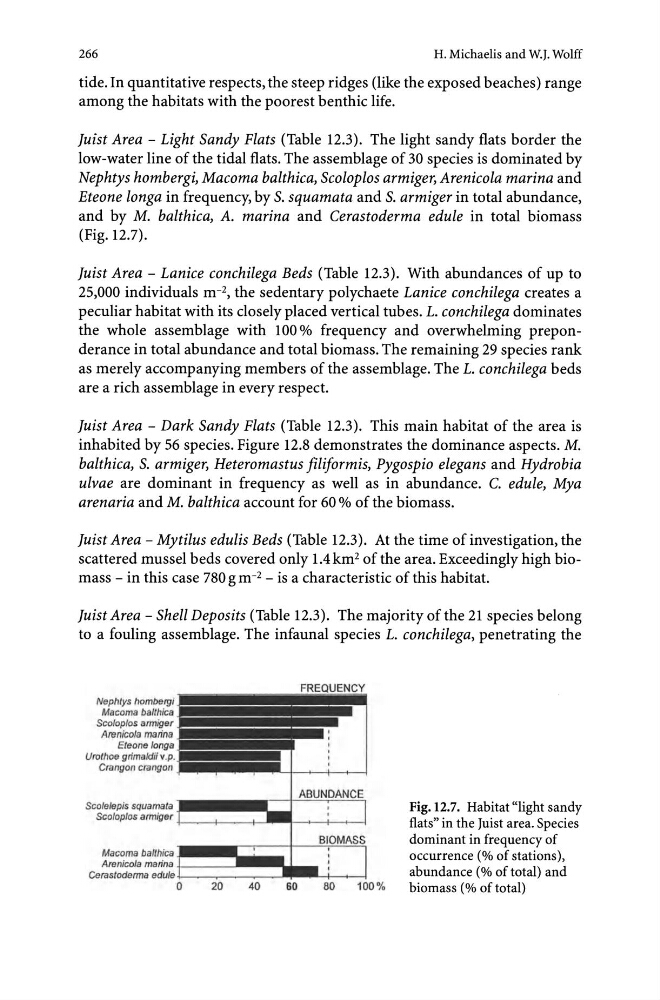
Juist Area - Light Sandy Flats (Table 12.3). The light sandy flats border the
low-water line of the tidal flats. The assemblage of 30 species is dominated by
Nephtys hombergi, Macoma balthica, Scoloplos armiger, Arenicola marina and
Eteone longa in frequency, by S. squamata and S. armiger in total abundance,
and by M. balthica, A. marina and Cerastoderma edule in total biomass
(Fig. 12.7).
Juist Area - Lanice conchilega Beds (Table 12.3). With abundances of up to
25,000 individuals m- 2 , the sedentary polychaete Lanice conchilega creates a
peculiar habitat with its closely placed vertical tubes. L. conchilega dominates
the whole assemblage with 100 % frequency and overwhelming preponderance in total abundance and total biomass. The remaining 29 species rank
as merely accompanying members of the assemblage. The L. conchilega beds
are a rich assemblage in every respect.
Juist Area - Dark Sandy Flats (Table 12.3). This main habitat of the area is
inhabited by 56 species. Figure 12.8 demonstrates the dominance aspects. M.
balthica, S. armiger, Heteromastus filiformis, Pygospio elegans and Hydrobia
ulvae are dominant in frequency as well as in abundance. C. edule, Mya
arenaria and M. balthica account for 60 % of the biomass.
Juist Area - Mytilus edulis Beds (Table 12.3). At the time of investigation, the
scattered mussel beds covered only 1.4 km 2 of the area. Exceedingly high biomass - in this case 780 g m- 2 - is a characteristic of this habitat.
Juist Area - Shell Deposits (Table 12.3). The majority of the 21 species belong
to a fouling assemblage. The infaunal species L. conchilega, penetrating the
Nephlys hambergi
Maeoma ballhica
Seoloplos armigar
Arenicola marina
Eleone longa
Urolhoe grimaldii v.
Crangon crangon
Scolelepis squamata JIll • • • •
Seoloplos armiger
-,,\---<--t--+---1
Fig. 12.7. Habitat "light sandy
flats" in the Juist area. Species
dominant in frequency of
Macoma ballhica JIll..
occurrence (% of stations),
Arenicola marina 1 - - - -
Cerasloderma edule-l--~~~~~"'_l.....+-_---1
abundance (% of total) and
o
20
40
60
80
100 %
biomass (% of total)
H. Michaelis and W.J. Wolff
tide. In quantitative respects, the steep ridges (like the exposed beaches) range
among the habitats with the poorest benthic life.
Juist Area - Light Sandy Flats (Table 12.3). The light sandy flats border the
low-water line of the tidal flats. The assemblage of 30 species is dominated by
Nephtys hombergi, Macoma balthica, Scoloplos armiger, Arenicola marina and
Eteone longa in frequency, by S. squamata and S. armiger in total abundance,
and by M. balthica, A. marina and Cerastoderma edule in total biomass
(Fig. 12.7).
Juist Area - Lanice conchilega Beds (Table 12.3). With abundances of up to
25,000 individuals m- 2 , the sedentary polychaete Lanice conchilega creates a
peculiar habitat with its closely placed vertical tubes. L. conchilega dominates
the whole assemblage with 100 % frequency and overwhelming preponderance in total abundance and total biomass. The remaining 29 species rank
as merely accompanying members of the assemblage. The L. conchilega beds
are a rich assemblage in every respect.
Juist Area - Dark Sandy Flats (Table 12.3). This main habitat of the area is
inhabited by 56 species. Figure 12.8 demonstrates the dominance aspects. M.
balthica, S. armiger, Heteromastus filiformis, Pygospio elegans and Hydrobia
ulvae are dominant in frequency as well as in abundance. C. edule, Mya
arenaria and M. balthica account for 60 % of the biomass.
Juist Area - Mytilus edulis Beds (Table 12.3). At the time of investigation, the
scattered mussel beds covered only 1.4 km 2 of the area. Exceedingly high biomass - in this case 780 g m- 2 - is a characteristic of this habitat.
Juist Area - Shell Deposits (Table 12.3). The majority of the 21 species belong
to a fouling assemblage. The infaunal species L. conchilega, penetrating the
Nephlys hambergi
Maeoma ballhica
Seoloplos armigar
Arenicola marina
Eleone longa
Urolhoe grimaldii v.
Crangon crangon
Scolelepis squamata JIll • • • •
Seoloplos armiger
-,,\---<--t--+---1
Fig. 12.7. Habitat "light sandy
flats" in the Juist area. Species
dominant in frequency of
Macoma ballhica JIll..
occurrence (% of stations),
Arenicola marina 1 - - - -
Cerasloderma edule-l--~~~~~"'_l.....+-_---1
abundance (% of total) and
o
20
40
60
80
100 %
biomass (% of total)