

Soft-Bottom Fauna of a Tropical and a Temperate Intertidal Area
265
In Table 12.1 the species occurring only in the seagrass beds are marked
with an asterisk, altogether 53 species. None of them plays a relevant role in
terms of number or weight. Their total number is only 176 individuals m- 2
compared with the 1375 individuals m- 2 of all species and their total biomass
of 1.31 g ADW m- 2 has only a modest share of the 8.44 g ADW m- 2 biomass of
all species (excluding Anadara senilis). A. senilis played a minor part in the
seagrass beds in 1988, because this bivalve added only 0.23 g ADW m- 2 to the
average biomass (Table 12.2). The most important phytal inhabitants are Polycirrus aurantiacus, Palaemon cf. elegans and Idotea chelipes.
Banc d'Arguin - ZosteralVaucheria (Table 12.2). None of the 12 species occurring in this habitat revealed a connection to Vaucheria.
Banc d'Arguin - Mangrove (Table 12.2). At only one sampling station 21 species were found. A. senilis included, the total biomass is higher than in any
other habitat (Table 12.2).
Banc d'Arguin - Sebkha (Table 12.2). The supralittoral sebkha is an extremely
poor benthic habitat. Two of the investigated stations did not contain any
macrofauna. At a third station, Abra tenuis, Capitella capitata and juvenile
Uca tangeri were encountered.
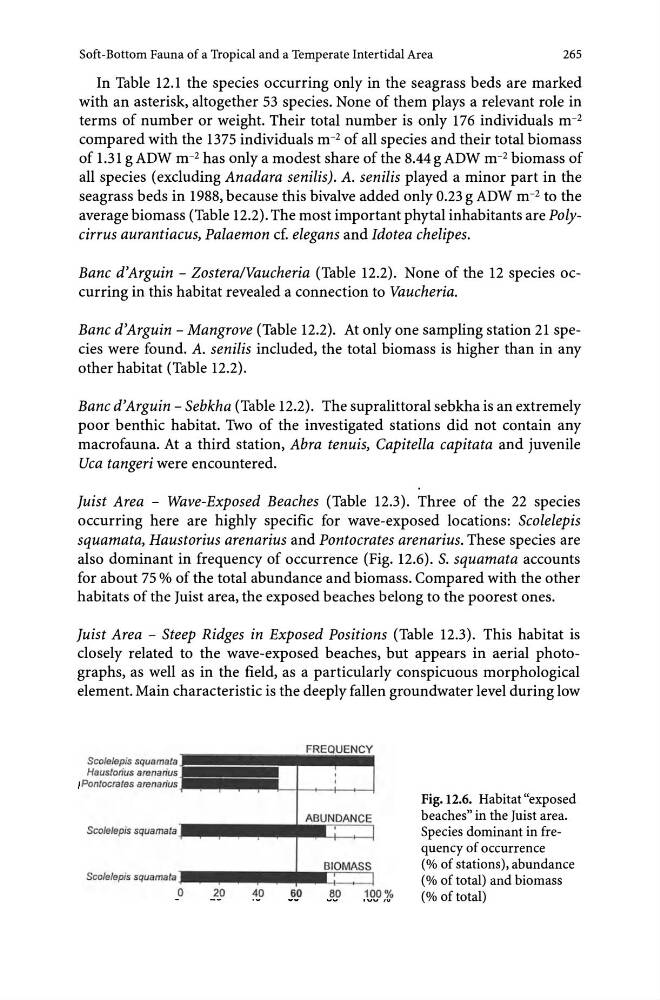
Juist Area - Wave-Exposed Beaches (Table 12.3). Three of the 22 species
occurring here are highly specific for wave-exposed locations: Scolelepis
squamata, Haustorius arenarius and Pontocrates arenarius. These species are
also dominant in frequency of occurrence (Fig. 12.6). S. squamata accounts
for about 75 % of the total abundance and biomass. Compared with the other
habitats of the Juist area, the exposed beaches belong to the poorest ones.
Juist Area - Steep Ridges in Exposed Positions (Table 12.3). This habitat is
closely related to the wave-exposed beaches, but appears in aerial photographs, as well as in the field, as a particularly conspicuous morphological
element. Main characteristic is the deeply fallen groundwater level during low
ABUNDANCE
Sco/elepis squamata • • • • • • • • ji~~5
Sco/e/epis SqUam11/al • • • • • • • • • F-~]
o
20
40
Fig. 12.6. Habitat "exposed
beaches" in the Juist area.
Species dominant in frequency of occurrence
(% of stations), abundance
(% of total) and biomass
(% of total)
265
In Table 12.1 the species occurring only in the seagrass beds are marked
with an asterisk, altogether 53 species. None of them plays a relevant role in
terms of number or weight. Their total number is only 176 individuals m- 2
compared with the 1375 individuals m- 2 of all species and their total biomass
of 1.31 g ADW m- 2 has only a modest share of the 8.44 g ADW m- 2 biomass of
all species (excluding Anadara senilis). A. senilis played a minor part in the
seagrass beds in 1988, because this bivalve added only 0.23 g ADW m- 2 to the
average biomass (Table 12.2). The most important phytal inhabitants are Polycirrus aurantiacus, Palaemon cf. elegans and Idotea chelipes.
Banc d'Arguin - ZosteralVaucheria (Table 12.2). None of the 12 species occurring in this habitat revealed a connection to Vaucheria.
Banc d'Arguin - Mangrove (Table 12.2). At only one sampling station 21 species were found. A. senilis included, the total biomass is higher than in any
other habitat (Table 12.2).
Banc d'Arguin - Sebkha (Table 12.2). The supralittoral sebkha is an extremely
poor benthic habitat. Two of the investigated stations did not contain any
macrofauna. At a third station, Abra tenuis, Capitella capitata and juvenile
Uca tangeri were encountered.
Juist Area - Wave-Exposed Beaches (Table 12.3). Three of the 22 species
occurring here are highly specific for wave-exposed locations: Scolelepis
squamata, Haustorius arenarius and Pontocrates arenarius. These species are
also dominant in frequency of occurrence (Fig. 12.6). S. squamata accounts
for about 75 % of the total abundance and biomass. Compared with the other
habitats of the Juist area, the exposed beaches belong to the poorest ones.
Juist Area - Steep Ridges in Exposed Positions (Table 12.3). This habitat is
closely related to the wave-exposed beaches, but appears in aerial photographs, as well as in the field, as a particularly conspicuous morphological
element. Main characteristic is the deeply fallen groundwater level during low
ABUNDANCE
Sco/elepis squamata • • • • • • • • ji~~5
Sco/e/epis SqUam11/al • • • • • • • • • F-~]
o
20
40
Fig. 12.6. Habitat "exposed
beaches" in the Juist area.
Species dominant in frequency of occurrence
(% of stations), abundance
(% of total) and biomass
(% of total)