

Soft-Bottom Fauna of a Tropical and a Temperate Intertidal Area
267
Macoma balthica
Arenicola marina
Se%plos armiger
Nephtys Ilomoolf/i
Nereis diversieolor
Uro/hoe gn'maldii v,p,
Heleromas/us filiformis
Pygospio elegans
Hydrobia ulvae
Hydrobia ulvae
Laniee conchilega
Pygospio elegans +-__
Macoma bal/hiea +-_ _ _ _
Seoloplos armiger +-____ _
He/eromas/us filiformis +-~-,-_~ __ ,!,, __ -+_-I
Ceras/oderma edule JIll • • •
Mya a",nana +-_ _ _
Macoma bal/hica +-_-,-_~_ .-..-_-+ . . . . . . . . . --1
o
20
40
60
80
100%
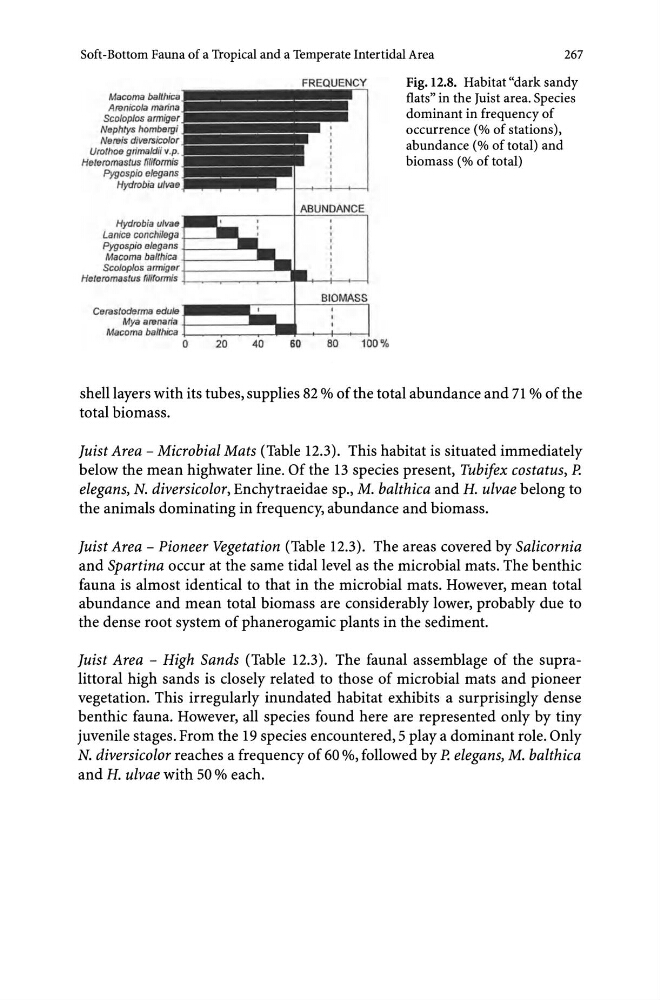
Fig. 12.8. Habitat "dark sandy
flats" in the Juist area. Species
dominant in frequency of
occurrence (% of stations),
abundance (% of total) and
biomass (% of total)
shell layers with its tubes, supplies 82 % of the total abundance and 71 % of the
total biomass.
]uist Area - Microbial Mats (Table 12.3). This habitat is situated immediately
below the mean highwater line. Of the 13 species present, Tubifex costatus, P.
elegans, N. diversicolor, Enchytraeidae sp., M. balthica and H. ulvae belong to
the animals dominating in frequency, abundance and biomass.
]uist Area - Pioneer Vegetation (Table 12.3). The areas covered by Salicornia
and Spartina occur at the same tidal level as the microbial mats. The benthic
fauna is almost identical to that in the microbial mats. However, mean total
abundance and mean total biomass are considerably lower, probably due to
the dense root system of phanerogamic plants in the sediment.
]uist Area - High Sands (Table 12.3). The faunal assemblage of the supralittoral high sands is closely related to those of microbial mats and pioneer
vegetation. This irregularly inundated habitat exhibits a surprisingly dense
benthic fauna. However, all species found here are represented only by tiny
juvenile stages. From the 19 species encountered,S playa dominant role. Only
N. diversicolor reaches a frequency of 60 %, followed by P. elegans, M. balthica
and H. ulvae with 50 % each.
267
Macoma balthica
Arenicola marina
Se%plos armiger
Nephtys Ilomoolf/i
Nereis diversieolor
Uro/hoe gn'maldii v,p,
Heleromas/us filiformis
Pygospio elegans
Hydrobia ulvae
Hydrobia ulvae
Laniee conchilega
Pygospio elegans +-__
Macoma bal/hiea +-_ _ _ _
Seoloplos armiger +-____ _
He/eromas/us filiformis +-~-,-_~ __ ,!,, __ -+_-I
Ceras/oderma edule JIll • • •
Mya a",nana +-_ _ _
Macoma bal/hica +-_-,-_~_ .-..-_-+ . . . . . . . . . --1
o
20
40
60
80
100%
Fig. 12.8. Habitat "dark sandy
flats" in the Juist area. Species
dominant in frequency of
occurrence (% of stations),
abundance (% of total) and
biomass (% of total)
shell layers with its tubes, supplies 82 % of the total abundance and 71 % of the
total biomass.
]uist Area - Microbial Mats (Table 12.3). This habitat is situated immediately
below the mean highwater line. Of the 13 species present, Tubifex costatus, P.
elegans, N. diversicolor, Enchytraeidae sp., M. balthica and H. ulvae belong to
the animals dominating in frequency, abundance and biomass.
]uist Area - Pioneer Vegetation (Table 12.3). The areas covered by Salicornia
and Spartina occur at the same tidal level as the microbial mats. The benthic
fauna is almost identical to that in the microbial mats. However, mean total
abundance and mean total biomass are considerably lower, probably due to
the dense root system of phanerogamic plants in the sediment.
]uist Area - High Sands (Table 12.3). The faunal assemblage of the supralittoral high sands is closely related to those of microbial mats and pioneer
vegetation. This irregularly inundated habitat exhibits a surprisingly dense
benthic fauna. However, all species found here are represented only by tiny
juvenile stages. From the 19 species encountered,S playa dominant role. Only
N. diversicolor reaches a frequency of 60 %, followed by P. elegans, M. balthica
and H. ulvae with 50 % each.