

246
M. Sprung et al.
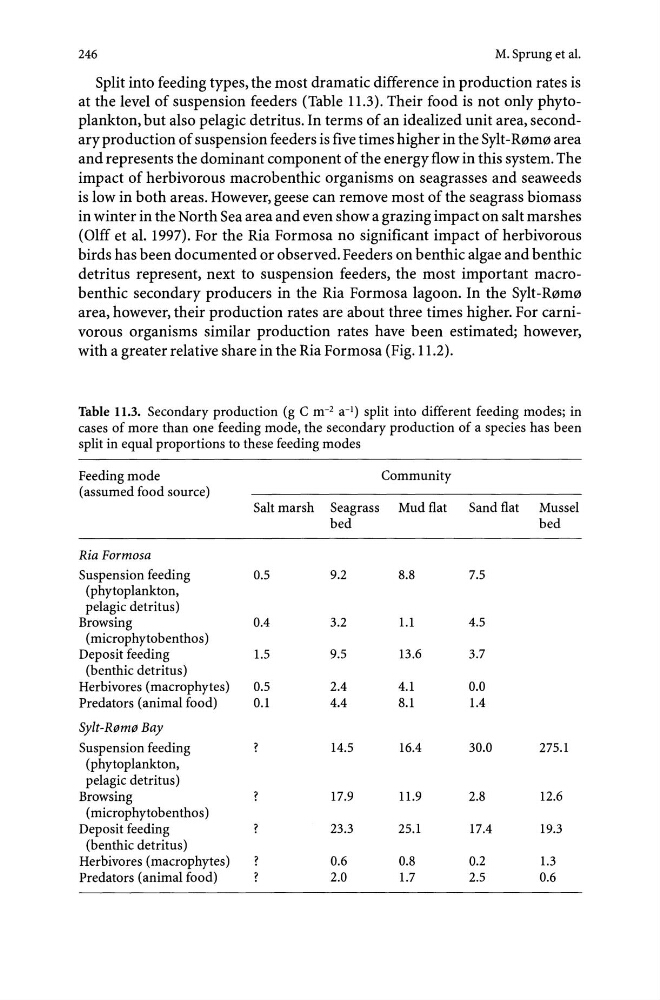
Split into feeding types, the most dramatic difference in production rates is
at the level of suspension feeders (Table 11.3). Their food is not only phytoplankton, but also pelagic detritus. In terms of an idealized unit area, secondary production of suspension feeders is five times higher in the Sylt -R0m0 area
and represents the dominant component of the energy flow in this system. The
impact of herbivorous macrobenthic organisms on seagrasses and seaweeds
is low in both areas. However, geese can remove most of the seagrass biomass
in winter in the North Sea area and even show a grazing impact on salt marshes
(Olff et al. 1997). For the Ria Formosa no significant impact of herbivorous
birds has been documented or observed. Feeders on benthic algae and benthic
detritus represent, next to suspension feeders, the most important macrobenthic secondary producers in the Ria Formosa lagoon. In the Sylt -R0m0
area, however, their production rates are about three times higher. For carnivorous organisms similar production rates have been estimated; however,
with a greater relative share in the Ria Formosa (Fig. 11.2).
Table 11.3. Secondary production (g C m- 2 a-l) split into different feeding modes; in
cases of more than one feeding mode, the secondary production of a species has been
split in equal proportions to these feeding modes
Feeding mode
Community
(assumed food source)
Salt marsh Seagrass Mud flat
Sand flat Mussel
bed
bed
Ria Formosa
Suspension feeding
0.5
9.2
8.8
7.5
(phytoplankton,
pelagic detritus)
Browsing
0.4
3.2
1.1
4.5
(microphytobenthos)
Deposit feeding
1.5
9.5
13.6
3.7
(benthic detritus)
Herbivores (macrophytes)
0.5
2.4
4.1
0.0
Predators (animal food)
0.1
4.4
8.1
1.4
Sylt-R!ilm!il Bay
Suspension feeding
14.5
16.4
30.0
275.1
(phytoplankton,
pelagic detritus)
Browsing
17.9
11.9
2.8
12.6
(microphytobenthos)
Deposit feeding
23.3
25.1
17.4
19.3
(benthic detritus)
Herbivores (macrophytes)
0.6
0.8
0.2
1.3
Predators (animal food)
2.0
1.7
2.5
0.6
M. Sprung et al.
Split into feeding types, the most dramatic difference in production rates is
at the level of suspension feeders (Table 11.3). Their food is not only phytoplankton, but also pelagic detritus. In terms of an idealized unit area, secondary production of suspension feeders is five times higher in the Sylt -R0m0 area
and represents the dominant component of the energy flow in this system. The
impact of herbivorous macrobenthic organisms on seagrasses and seaweeds
is low in both areas. However, geese can remove most of the seagrass biomass
in winter in the North Sea area and even show a grazing impact on salt marshes
(Olff et al. 1997). For the Ria Formosa no significant impact of herbivorous
birds has been documented or observed. Feeders on benthic algae and benthic
detritus represent, next to suspension feeders, the most important macrobenthic secondary producers in the Ria Formosa lagoon. In the Sylt -R0m0
area, however, their production rates are about three times higher. For carnivorous organisms similar production rates have been estimated; however,
with a greater relative share in the Ria Formosa (Fig. 11.2).
Table 11.3. Secondary production (g C m- 2 a-l) split into different feeding modes; in
cases of more than one feeding mode, the secondary production of a species has been
split in equal proportions to these feeding modes
Feeding mode
Community
(assumed food source)
Salt marsh Seagrass Mud flat
Sand flat Mussel
bed
bed
Ria Formosa
Suspension feeding
0.5
9.2
8.8
7.5
(phytoplankton,
pelagic detritus)
Browsing
0.4
3.2
1.1
4.5
(microphytobenthos)
Deposit feeding
1.5
9.5
13.6
3.7
(benthic detritus)
Herbivores (macrophytes)
0.5
2.4
4.1
0.0
Predators (animal food)
0.1
4.4
8.1
1.4
Sylt-R!ilm!il Bay
Suspension feeding
14.5
16.4
30.0
275.1
(phytoplankton,
pelagic detritus)
Browsing
17.9
11.9
2.8
12.6
(microphytobenthos)
Deposit feeding
23.3
25.1
17.4
19.3
(benthic detritus)
Herbivores (macrophytes)
0.6
0.8
0.2
1.3
Predators (animal food)
2.0
1.7
2.5
0.6