

Energy Flow in Benthic Assemblages: Portugal and North Sea Tidal Basins
245
In the Sylt-R0m0 Bay, phytoplankton is the main primary producer when
the subtidal part of the bay is also included, contributing 52 % to total primary
production. For the intertidal area the share of phytoplankton in total
primary production is about 10 % due to the short inundation time of most
tidal flats. This calculation is based on a mean annual production of
159 g C m- 2 for subtidal areas and 43 g C m- 2 for intertidal areas.
Detritus Input. This is not directly a source of primary production. However,
for the Sylt-R0m0 Bay, flume measurements imply a detritus input from subtidal sources, which constitutes an important element for the energy flow
through intertidal communities. On average an input of 226 g C m- 2 a-I has
been estimated (Asmus et al. 1998). In the Ria Formosa lagoon, published
estimates are still lacking.
11.4.2 Secondary Production
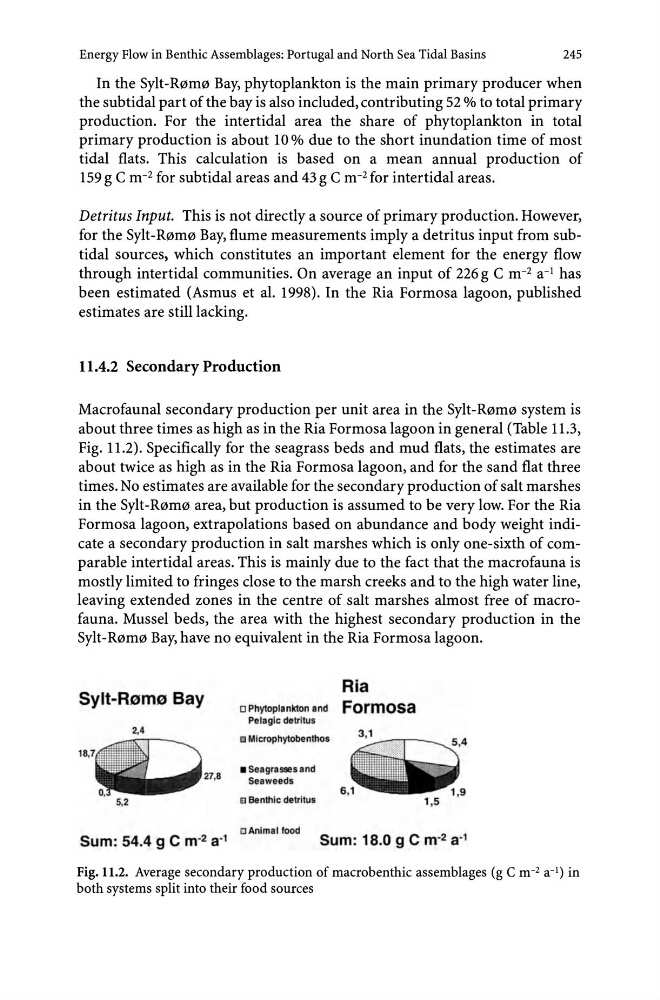
Macrofaunal secondary production per unit area in the Sylt-R0m0 system is
about three times as high as in the Ria Formosa lagoon in general (Table 11.3,
Fig. 11.2). Specifically for the seagrass beds and mud flats, the estimates are
about twice as high as in the Ria Formosa lagoon, and for the sand flat three
times. No estimates are available for the secondary production of salt marshes
in the Sylt -R0m0 area, but production is assumed to be very low. For the Ria
Formosa lagoon, extrapolations based on abundance and body weight indicate a secondary production in salt marshes which is only one-sixth of comparable intertidal areas. This is mainly due to the fact that the macrofauna is
mostly limited to fringes close to the marsh creeks and to the high water line,
leaving extended zones in the centre of salt marshes almost free of macrofauna. Mussel beds, the area with the highest secondary production in the
Sylt -R0m0 Bay, have no equivalent in the Ria Formosa lagoon.
Sylt-R0m0 Bay
2,4
~
.~
18,7
'
27,8
0,
5,2
Sum: 54.4 9 C m- 2 a- 1
Ria
D Phytoplankton and Formosa
Pe lagic detritus
[I Mlcrophytobenlhos
• Seagrasses and
Seaweeds
EI Benthic detritus
1,5
IJ Animal lood
Sum: 18.0 9 C m- 2 a- 1
Fig. 11.2. Average secondary production of macrobenthic assemblages (g C m- 2 a-I) in
both systems split into their food sources
245
In the Sylt-R0m0 Bay, phytoplankton is the main primary producer when
the subtidal part of the bay is also included, contributing 52 % to total primary
production. For the intertidal area the share of phytoplankton in total
primary production is about 10 % due to the short inundation time of most
tidal flats. This calculation is based on a mean annual production of
159 g C m- 2 for subtidal areas and 43 g C m- 2 for intertidal areas.
Detritus Input. This is not directly a source of primary production. However,
for the Sylt-R0m0 Bay, flume measurements imply a detritus input from subtidal sources, which constitutes an important element for the energy flow
through intertidal communities. On average an input of 226 g C m- 2 a-I has
been estimated (Asmus et al. 1998). In the Ria Formosa lagoon, published
estimates are still lacking.
11.4.2 Secondary Production
Macrofaunal secondary production per unit area in the Sylt-R0m0 system is
about three times as high as in the Ria Formosa lagoon in general (Table 11.3,
Fig. 11.2). Specifically for the seagrass beds and mud flats, the estimates are
about twice as high as in the Ria Formosa lagoon, and for the sand flat three
times. No estimates are available for the secondary production of salt marshes
in the Sylt -R0m0 area, but production is assumed to be very low. For the Ria
Formosa lagoon, extrapolations based on abundance and body weight indicate a secondary production in salt marshes which is only one-sixth of comparable intertidal areas. This is mainly due to the fact that the macrofauna is
mostly limited to fringes close to the marsh creeks and to the high water line,
leaving extended zones in the centre of salt marshes almost free of macrofauna. Mussel beds, the area with the highest secondary production in the
Sylt -R0m0 Bay, have no equivalent in the Ria Formosa lagoon.
Sylt-R0m0 Bay
2,4
~
.~
18,7
'
27,8
0,
5,2
Sum: 54.4 9 C m- 2 a- 1
Ria
D Phytoplankton and Formosa
Pe lagic detritus
[I Mlcrophytobenlhos
• Seagrasses and
Seaweeds
EI Benthic detritus
1,5
IJ Animal lood
Sum: 18.0 9 C m- 2 a- 1
Fig. 11.2. Average secondary production of macrobenthic assemblages (g C m- 2 a-I) in
both systems split into their food sources