

Processes That Affect Saltmarsh Erosion and Saltmarsh Restoration
175
SE England was from the pioneer zone (Fig. 8.1), a result that is contrary to the
effects of coastal squeeze. Houwing et al. (1999) concluded that the loss of
pioneer zone vegetation in the Netherlands from 1976-1983 was not primarily
due to increased tidal inundation. Although Burd (1992) attributed loss of
pioneer zone communities to increased wave action, much of the loss of this
(and other) vegetation has been from sheltered sites, particularly by lateral
erosion of creeks within the marsh, without any apparent connection to wave
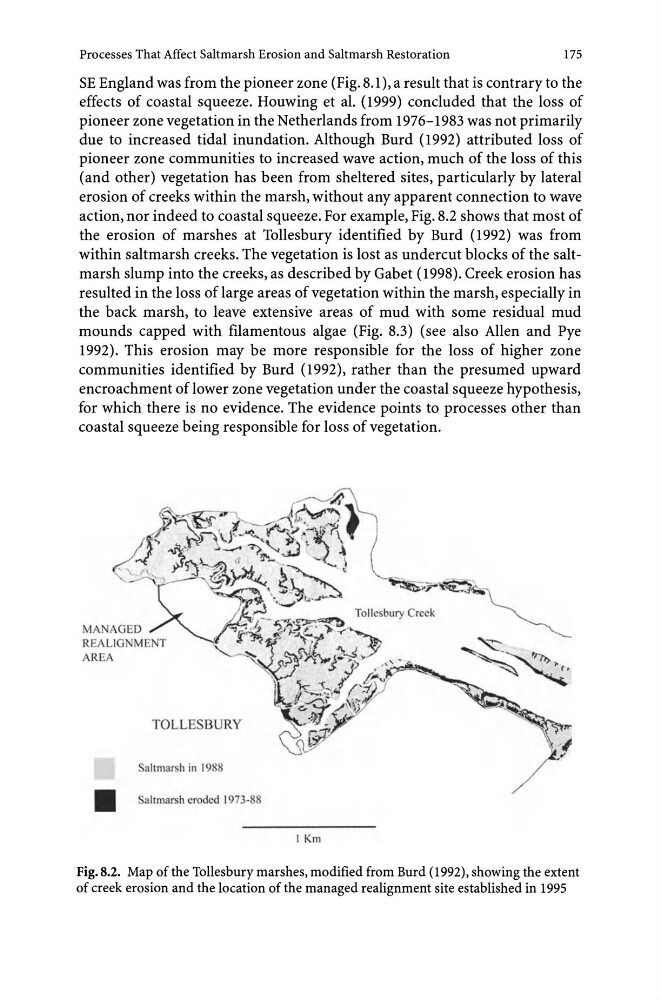
action, nor indeed to coastal squeeze. For example, Fig. 8.2 shows that most of
the erosion of marshes at Tollesbury identified by Burd (1992) was from
within saltmarsh creeks. The vegetation is lost as undercut blocks of the saltmarsh slump into the creeks, as described by Gabet (1998). Creek erosion has
resulted in the loss of large areas of vegetation within the marsh, especially in
the back marsh, to leave extensive areas of mud with some residual mud
mounds capped with filamentous algae (Fig. 8.3) (see also Allen and Pye
1992). This erosion may be more responsible for the loss of higher zone
communities identified by Burd (1992), rather than the presumed upward
encroachment of lower zone vegetation under the coastal squeeze hypothesis,
for which there is no evidence. The evidence points to processes other than
coastal squeeze being responsible for loss of vegetation.
MANAGED
REALIG ME
AREA
TOLLESBU RY
altma r h in 1988
•
Saltmarsh eroded 1 973-88
1 Km
Fig. S.2. Map of the Tollesbury marshes, modified from Burd (1992), showing the extent
of creek erosion and the location of the managed realignment site established in 1995
175
SE England was from the pioneer zone (Fig. 8.1), a result that is contrary to the
effects of coastal squeeze. Houwing et al. (1999) concluded that the loss of
pioneer zone vegetation in the Netherlands from 1976-1983 was not primarily
due to increased tidal inundation. Although Burd (1992) attributed loss of
pioneer zone communities to increased wave action, much of the loss of this
(and other) vegetation has been from sheltered sites, particularly by lateral
erosion of creeks within the marsh, without any apparent connection to wave
action, nor indeed to coastal squeeze. For example, Fig. 8.2 shows that most of
the erosion of marshes at Tollesbury identified by Burd (1992) was from
within saltmarsh creeks. The vegetation is lost as undercut blocks of the saltmarsh slump into the creeks, as described by Gabet (1998). Creek erosion has
resulted in the loss of large areas of vegetation within the marsh, especially in
the back marsh, to leave extensive areas of mud with some residual mud
mounds capped with filamentous algae (Fig. 8.3) (see also Allen and Pye
1992). This erosion may be more responsible for the loss of higher zone
communities identified by Burd (1992), rather than the presumed upward
encroachment of lower zone vegetation under the coastal squeeze hypothesis,
for which there is no evidence. The evidence points to processes other than
coastal squeeze being responsible for loss of vegetation.
MANAGED
REALIG ME
AREA
TOLLESBU RY
altma r h in 1988
•
Saltmarsh eroded 1 973-88
1 Km
Fig. S.2. Map of the Tollesbury marshes, modified from Burd (1992), showing the extent
of creek erosion and the location of the managed realignment site established in 1995