

174
R.G. Hughes
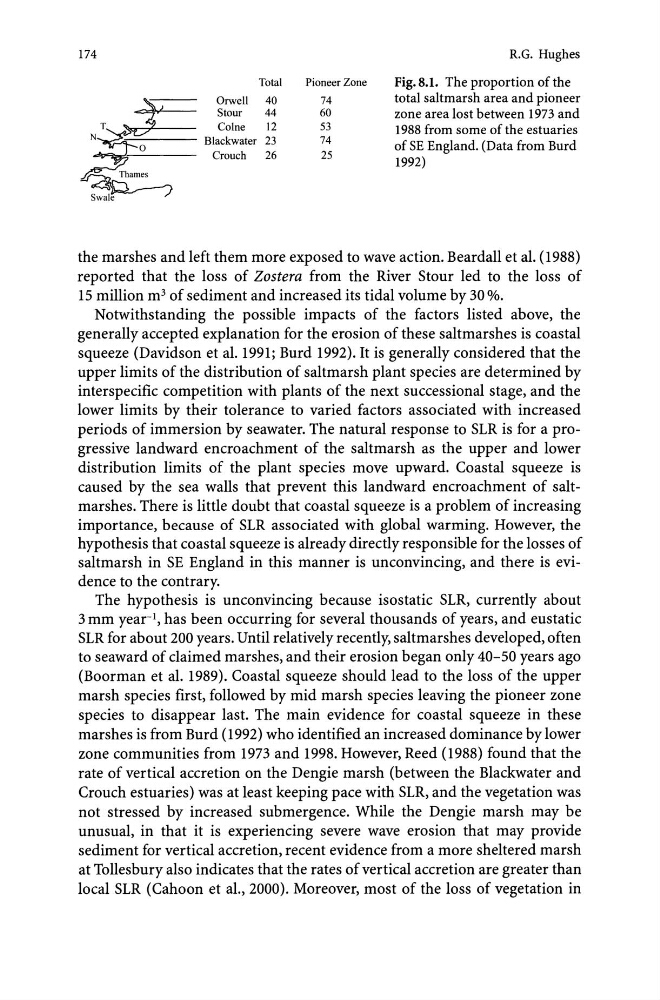
Total
Pioneer Zone
Fig.8.1. The proportion of the
Orwell
40
74
total saltmarsh area and pioneer
Stour
44
60
zone area lost between 1973 and
Colne
12
53
1988 from some of the estuaries
Blackwater 23
74
of SE England. (Data from Burd
Crouch
26
25
1992)
the marshes and left them more exposed to wave action. Beardall et aI. (1988)
reported that the loss of Zostera from the River Stour led to the loss of
15 million m 3 of sediment and increased its tidal volume by 30 %.
Notwithstanding the possible impacts of the factors listed above, the
generally accepted explanation for the erosion of these saltmarshes is coastal
squeeze (Davidson et aI. 1991; Burd 1992). It is generally considered that the
upper limits of the distribution of saltmarsh plant species are determined by
interspecific competition with plants of the next successional stage, and the
lower limits by their tolerance to varied factors associated with increased
periods of immersion by seawater. The natural response to SLR is for a progressive landward encroachment of the saltmarsh as the upper and lower
distribution limits of the plant species move upward. Coastal squeeze is
caused by the sea walls that prevent this landward encroachment of saltmarshes. There is little doubt that coastal squeeze is a problem of increasing
importance, because of SLR associated with global warming. However, the
hypothesis that coastal squeeze is already directly responsible for the losses of
saltmarsh in SE England in this manner is unconvincing, and there is evidence to the contrary.
The hypothesis is unconvincing because isostatic SLR, currently about
3 mm year-I, has been occurring for several thousands of years, and eustatic
SLR for about 200 years. Until relatively recently, saltmarshes developed, often
to seaward of claimed marshes, and their erosion began only 40-50 years ago
(Boorman et aI. 1989). Coastal squeeze should lead to the loss of the upper
marsh species first, followed by mid marsh species leaving the pioneer zone
species to disappear last. The main evidence for coastal squeeze in these
marshes is from Burd (1992) who identified an increased dominance by lower
zone communities from 1973 and 1998. However, Reed (1988) found that the
rate of vertical accretion on the Dengie marsh (between the Blackwater and
Crouch estuaries) was at least keeping pace with SLR, and the vegetation was
not stressed by increased submergence. While the Dengie marsh may be
unusual, in that it is experiencing severe wave erosion that may provide
sediment for vertical accretion, recent evidence from a more sheltered marsh
at Tollesbury also indicates that the rates of vertical accretion are greater than
local SLR (Cahoon et aI., 2000). Moreover, most of the loss of vegetation in
R.G. Hughes
Total
Pioneer Zone
Fig.8.1. The proportion of the
Orwell
40
74
total saltmarsh area and pioneer
Stour
44
60
zone area lost between 1973 and
Colne
12
53
1988 from some of the estuaries
Blackwater 23
74
of SE England. (Data from Burd
Crouch
26
25
1992)
the marshes and left them more exposed to wave action. Beardall et aI. (1988)
reported that the loss of Zostera from the River Stour led to the loss of
15 million m 3 of sediment and increased its tidal volume by 30 %.
Notwithstanding the possible impacts of the factors listed above, the
generally accepted explanation for the erosion of these saltmarshes is coastal
squeeze (Davidson et aI. 1991; Burd 1992). It is generally considered that the
upper limits of the distribution of saltmarsh plant species are determined by
interspecific competition with plants of the next successional stage, and the
lower limits by their tolerance to varied factors associated with increased
periods of immersion by seawater. The natural response to SLR is for a progressive landward encroachment of the saltmarsh as the upper and lower
distribution limits of the plant species move upward. Coastal squeeze is
caused by the sea walls that prevent this landward encroachment of saltmarshes. There is little doubt that coastal squeeze is a problem of increasing
importance, because of SLR associated with global warming. However, the
hypothesis that coastal squeeze is already directly responsible for the losses of
saltmarsh in SE England in this manner is unconvincing, and there is evidence to the contrary.
The hypothesis is unconvincing because isostatic SLR, currently about
3 mm year-I, has been occurring for several thousands of years, and eustatic
SLR for about 200 years. Until relatively recently, saltmarshes developed, often
to seaward of claimed marshes, and their erosion began only 40-50 years ago
(Boorman et aI. 1989). Coastal squeeze should lead to the loss of the upper
marsh species first, followed by mid marsh species leaving the pioneer zone
species to disappear last. The main evidence for coastal squeeze in these
marshes is from Burd (1992) who identified an increased dominance by lower
zone communities from 1973 and 1998. However, Reed (1988) found that the
rate of vertical accretion on the Dengie marsh (between the Blackwater and
Crouch estuaries) was at least keeping pace with SLR, and the vegetation was
not stressed by increased submergence. While the Dengie marsh may be
unusual, in that it is experiencing severe wave erosion that may provide
sediment for vertical accretion, recent evidence from a more sheltered marsh
at Tollesbury also indicates that the rates of vertical accretion are greater than
local SLR (Cahoon et aI., 2000). Moreover, most of the loss of vegetation in