

Icebergs in the North Atlantic . ..
Day 03600
" "
Day 08500
o
73
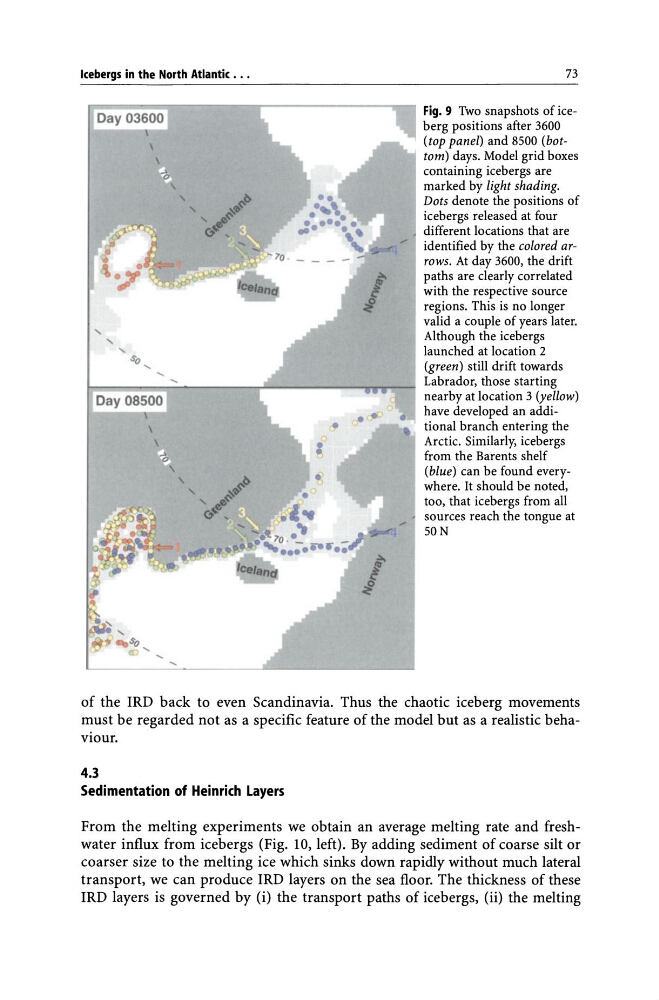
Fig. 9 Two snapshots of iceberg positions after 3600
(top panel) and 8500 (bottom) days. Model grid boxes
containing icebergs are
marked by light shading.
Dots denote the positions of
icebergs released at four
different locations that are
identified by the colored arrows. At day 3600, the drift
paths are clearly correlated
with the respective source
regions. This is no longer
valid a couple of years later.
Although the icebergs
launched at location 2
(green) still drift towards
Labrador, those starting
nearby at location 3 (yellow)
have developed an additional branch entering the
Arctic. Similarly, icebergs
from the Barents shelf
(blue) can be found everywhere. It should be noted,
too, that icebergs from all
sources reach the tongue at
SON
of the IRD back to even Scandinavia. Thus the chaotic iceberg movements
must be regarded not as a specific feature of the model but as a realistic behaVIOur.
4.3
Sedimentation of Heinrich Layers
From the melting experiments we obtain an average melting rate and freshwater influx from icebergs (Fig. 10, left). By adding sediment of coarse silt or
coarser size to the melting ice which sinks down rapidly without much lateral
transport, we can produce IRD layers on the sea floor. The thickness of these
IRD layers is governed by (i) the transport paths of icebergs, (ii) the melting
Day 03600
" "
Day 08500
o
73
Fig. 9 Two snapshots of iceberg positions after 3600
(top panel) and 8500 (bottom) days. Model grid boxes
containing icebergs are
marked by light shading.
Dots denote the positions of
icebergs released at four
different locations that are
identified by the colored arrows. At day 3600, the drift
paths are clearly correlated
with the respective source
regions. This is no longer
valid a couple of years later.
Although the icebergs
launched at location 2
(green) still drift towards
Labrador, those starting
nearby at location 3 (yellow)
have developed an additional branch entering the
Arctic. Similarly, icebergs
from the Barents shelf
(blue) can be found everywhere. It should be noted,
too, that icebergs from all
sources reach the tongue at
SON
of the IRD back to even Scandinavia. Thus the chaotic iceberg movements
must be regarded not as a specific feature of the model but as a realistic behaVIOur.
4.3
Sedimentation of Heinrich Layers
From the melting experiments we obtain an average melting rate and freshwater influx from icebergs (Fig. 10, left). By adding sediment of coarse silt or
coarser size to the melting ice which sinks down rapidly without much lateral
transport, we can produce IRD layers on the sea floor. The thickness of these
IRD layers is governed by (i) the transport paths of icebergs, (ii) the melting