

66
C. Schafer-Neth . K. Stattegger
If either height or radius shrink below a certain limit (25 m for the current
study), the assumption of an iceberg predominantly influenced by the surrounding waters is no longer met and the iceberg is completely removed from
the system.
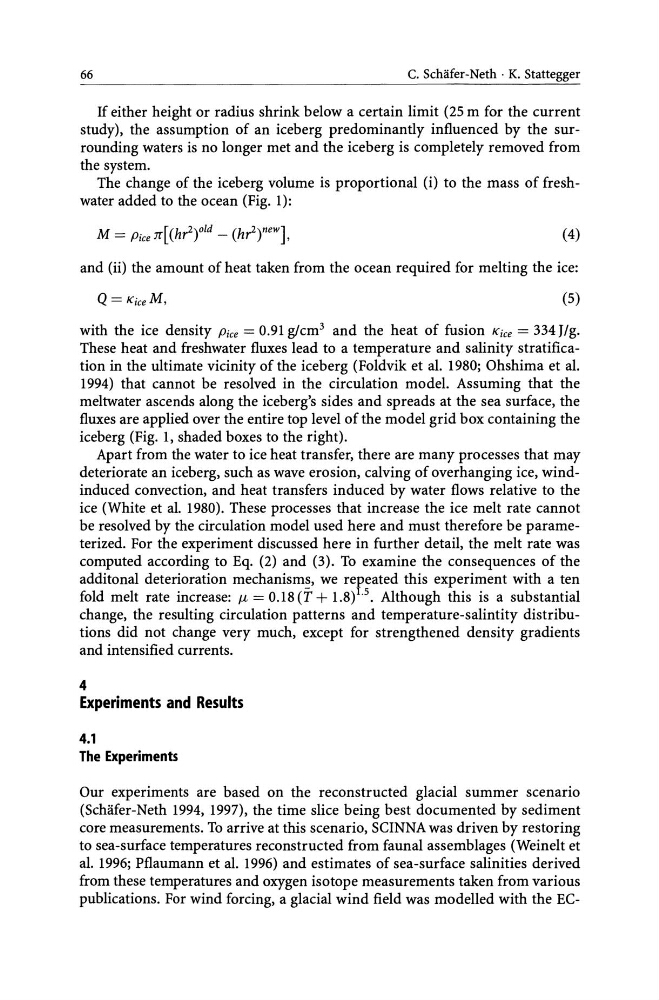
The change of the iceberg volume is proportional (i) to the mass of freshwater added to the ocean (Fig. 1):
(4)
and (ii) the amount of heat taken from the ocean required for melting the ice:
Q = Kice M ,
(5)
with the ice density Pice = 0.91 g/cm3 and the heat of fusion Kice = 334 JIg.
These heat and freshwater fluxes lead to a temperature and salinity stratification in the ultimate vicinity of the iceberg (Foldvik et al. 1980; Ohshima et al.
1994) that cannot be resolved in the circulation model. Assuming that the
meltwater ascends along the iceberg's sides and spreads at the sea surface, the
fluxes are applied over the entire top level of the model grid box containing the
iceberg (Fig. 1, shaded boxes to the right).
Apart from the water to ice heat transfer, there are many processes that may
deteriorate an iceberg, such as wave erosion, calving of overhanging ice, windinduced convection, and heat transfers induced by water flows relative to the
ice (White et al. 1980). These processes that increase the ice melt rate cannot
be resolved by the circulation model used here and must therefore be parameterized. For the experiment discussed here in further detail, the melt rate was
computed according to Eq. (2) and (3). To examine the consequences of the
additonal deterioration mechanism~, we repeated this experiment with a ten
fold melt rate increase: f1, = 0.18 (T + 1.8) .5. Although this is a substantial
change, the resulting circulation patterns and temperature-salintity distributions did not change very much, except for strengthened density gradients
and intensified currents.
4
Experiments and Results
4.1
The Experiments
Our experiments are based on the reconstructed glacial summer scenario
(Schafer-Neth 1994, 1997), the time slice being best documented by sediment
core measurements. To arrive at this scenario, SCINNA was driven by restoring
to sea-surface temperatures reconstructed from faunal assemblages (Weinelt et
al. 1996; pflaumann et al. 1996) and estimates of sea-surface salinities derived
from these temperatures and oxygen isotope measurements taken from various
publications. For wind forcing, a glacial wind field was modelled with the EC-
C. Schafer-Neth . K. Stattegger
If either height or radius shrink below a certain limit (25 m for the current
study), the assumption of an iceberg predominantly influenced by the surrounding waters is no longer met and the iceberg is completely removed from
the system.
The change of the iceberg volume is proportional (i) to the mass of freshwater added to the ocean (Fig. 1):
(4)
and (ii) the amount of heat taken from the ocean required for melting the ice:
Q = Kice M ,
(5)
with the ice density Pice = 0.91 g/cm3 and the heat of fusion Kice = 334 JIg.
These heat and freshwater fluxes lead to a temperature and salinity stratification in the ultimate vicinity of the iceberg (Foldvik et al. 1980; Ohshima et al.
1994) that cannot be resolved in the circulation model. Assuming that the
meltwater ascends along the iceberg's sides and spreads at the sea surface, the
fluxes are applied over the entire top level of the model grid box containing the
iceberg (Fig. 1, shaded boxes to the right).
Apart from the water to ice heat transfer, there are many processes that may
deteriorate an iceberg, such as wave erosion, calving of overhanging ice, windinduced convection, and heat transfers induced by water flows relative to the
ice (White et al. 1980). These processes that increase the ice melt rate cannot
be resolved by the circulation model used here and must therefore be parameterized. For the experiment discussed here in further detail, the melt rate was
computed according to Eq. (2) and (3). To examine the consequences of the
additonal deterioration mechanism~, we repeated this experiment with a ten
fold melt rate increase: f1, = 0.18 (T + 1.8) .5. Although this is a substantial
change, the resulting circulation patterns and temperature-salintity distributions did not change very much, except for strengthened density gradients
and intensified currents.
4
Experiments and Results
4.1
The Experiments
Our experiments are based on the reconstructed glacial summer scenario
(Schafer-Neth 1994, 1997), the time slice being best documented by sediment
core measurements. To arrive at this scenario, SCINNA was driven by restoring
to sea-surface temperatures reconstructed from faunal assemblages (Weinelt et
al. 1996; pflaumann et al. 1996) and estimates of sea-surface salinities derived
from these temperatures and oxygen isotope measurements taken from various
publications. For wind forcing, a glacial wind field was modelled with the EC-