

Icebergs in the North Atlantic . ..
67
III
~o<
' "
'\
'!J)~
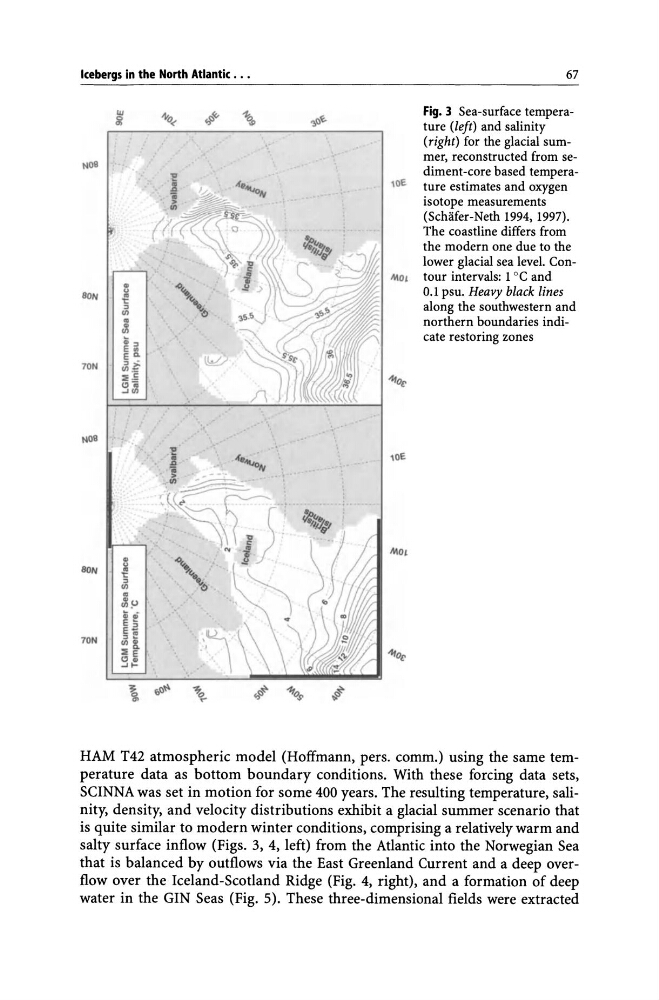
Fig. 3 Sea-surface temperai
ture (left) and salinity
(right) for the glacial sum1"09
mer, reconstructed from sediment-core based tempera10E
ture estimates and oxygen
isotope measurements
(Schafer-Neth 1994, 1997).
The coastline differs from
the modern one due to the
lower glacial sea level. Con1\\0,
tour intervals: 1 DC and
II
00"
0.1 psu. Heavy black lines
BON
..
",
'I:
along the southwestern and
"
en
~
northern boundaries indi..
Jl
cate restoring zones
" "
e ..
eo.
70N
J,i~.E
(!) ..
..Jen
410l'
H09
"'~"11
10E
0",
HAM T42 atmospheric model (Hoffmann, pers. comm.) using the same temperature data as bottom boundary conditions. With these forcing data sets,
SCINNA was set in motion for some 400 years. The resulting temperature, salinity, density, and velocity distributions exhibit a glacial summer scenario that
is quite similar to modern winter conditions, comprising a relatively warm and
salty surface inflow (Figs. 3, 4, left) from the Atlantic into the Norwegian Sea
that is balanced by outflows via the East Greenland Current and a deep overflow over the Iceland-Scotland Ridge (Fig. 4, right), and a formation of deep
water in the GIN Seas (Fig. 5). These three-dimensional fields were extracted
67
III
~o<
'\
'!J)~
Fig. 3 Sea-surface temperai
ture (left) and salinity
(right) for the glacial sum1"09
mer, reconstructed from sediment-core based tempera10E
ture estimates and oxygen
isotope measurements
(Schafer-Neth 1994, 1997).
The coastline differs from
the modern one due to the
lower glacial sea level. Con1\\0,
tour intervals: 1 DC and
II
00"
0.1 psu. Heavy black lines
BON
..
",
'I:
along the southwestern and
"
en
~
northern boundaries indi..
Jl
cate restoring zones
" "
e ..
eo.
70N
J,i~.E
(!) ..
..Jen
410l'
H09
"'~"11
10E
0",
HAM T42 atmospheric model (Hoffmann, pers. comm.) using the same temperature data as bottom boundary conditions. With these forcing data sets,
SCINNA was set in motion for some 400 years. The resulting temperature, salinity, density, and velocity distributions exhibit a glacial summer scenario that
is quite similar to modern winter conditions, comprising a relatively warm and
salty surface inflow (Figs. 3, 4, left) from the Atlantic into the Norwegian Sea
that is balanced by outflows via the East Greenland Current and a deep overflow over the Iceland-Scotland Ridge (Fig. 4, right), and a formation of deep
water in the GIN Seas (Fig. 5). These three-dimensional fields were extracted