

442
I. Lerche· S. Cao . S. Mallory· K. Petersen· A. Lowrie
4.1.4
Fluctuations in Mean Excess Pressure
Because both the lateral salt insertion speed and the salt sheet thickness are
quite variable, both the timing and emplaced thickness of salt at each location
carry some degree of uncertainty. As a consequence, the anticipated overpressure at breakout through a salt mass will also have some degree of uncertainty.
We have quantified this degree of uncertainty in terms of the volatility, v. In essence the code is run with a range of salt insertion speeds and salt thickness, to
record the excess pressure in each case below salt, and then to order (in terms of
increasing values of excess pressure) the histogram of results so that, by normalizing to unit area, one can then draw the cumulative probability of obtaining excess pressure values less than specific amounts. As the salt sheets move across
the section, at a given location site the volatility for excess pressure will itself
vary in concert with the mean excess pressure.
In addition, from the compendium of results for different salt speeds and different salt thickness, it is also possible to determine whether uncertainty of
speed or thickness is providing the largest contribution to the uncertainty in excess fluid pressure. Thus, for given ranges of uncertainty of salt speed, and given
ranges of uncertainty of salt thickness, one can determine the Relative Importance (RI) of each variation to the uncertainty in excess pressure.
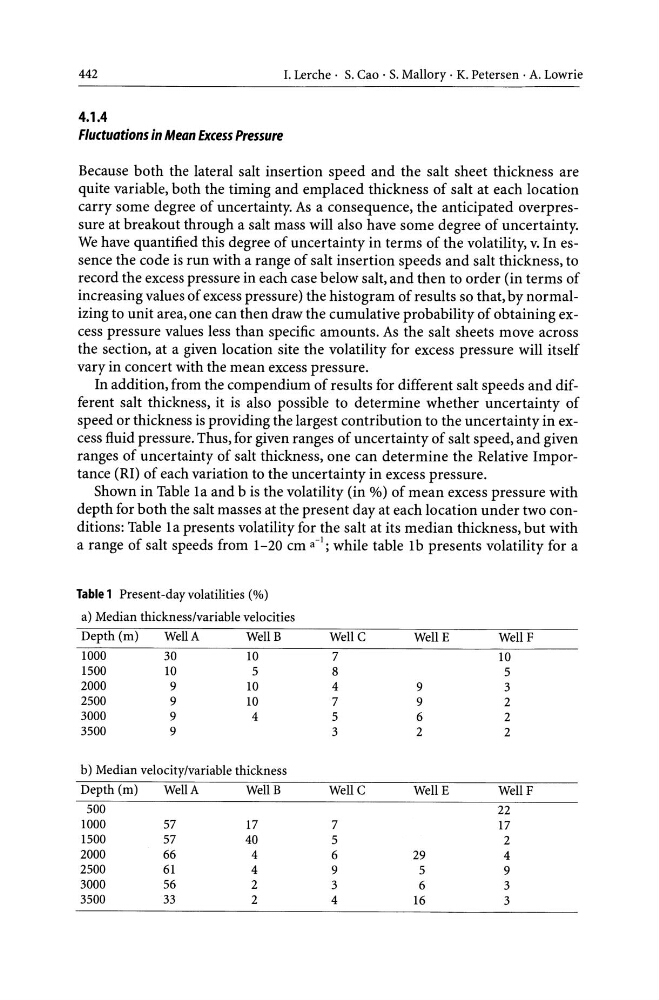
Shown in Table la and b is the volatility (in %) of mean excess pressure with
depth for both the salt masses at the present day at each location under two conditions: Table la presents volatility for the salt at its median thickness, but with
a range of salt speeds from 1-20 cm a-I; while table Ib presents volatility for a
Table 1 Present-day volatilities (%)
a) Median thickness/variable velocities
Depth (m)
Well A
WellB
1000
30
10
1500
10
5
2000
9
10
2500
9
10
3000
9
4
3500
9
b) Median velocity/variable thickness
Depth (m)
Well A
WellB
500
1000
57
17
1500
57
40
2000
66
4
2500
61
4
3000
56
2
3500
33
2
WellC
7
8
4
7
5
3
WellC
7
5
6
9
3
4
WellE
9
9
6
2
WellE
29
5
6
16
WellF
10
5
3
2
2
2
WellF
22
17
2
4
9
3
3
I. Lerche· S. Cao . S. Mallory· K. Petersen· A. Lowrie
4.1.4
Fluctuations in Mean Excess Pressure
Because both the lateral salt insertion speed and the salt sheet thickness are
quite variable, both the timing and emplaced thickness of salt at each location
carry some degree of uncertainty. As a consequence, the anticipated overpressure at breakout through a salt mass will also have some degree of uncertainty.
We have quantified this degree of uncertainty in terms of the volatility, v. In essence the code is run with a range of salt insertion speeds and salt thickness, to
record the excess pressure in each case below salt, and then to order (in terms of
increasing values of excess pressure) the histogram of results so that, by normalizing to unit area, one can then draw the cumulative probability of obtaining excess pressure values less than specific amounts. As the salt sheets move across
the section, at a given location site the volatility for excess pressure will itself
vary in concert with the mean excess pressure.
In addition, from the compendium of results for different salt speeds and different salt thickness, it is also possible to determine whether uncertainty of
speed or thickness is providing the largest contribution to the uncertainty in excess fluid pressure. Thus, for given ranges of uncertainty of salt speed, and given
ranges of uncertainty of salt thickness, one can determine the Relative Importance (RI) of each variation to the uncertainty in excess pressure.
Shown in Table la and b is the volatility (in %) of mean excess pressure with
depth for both the salt masses at the present day at each location under two conditions: Table la presents volatility for the salt at its median thickness, but with
a range of salt speeds from 1-20 cm a-I; while table Ib presents volatility for a
Table 1 Present-day volatilities (%)
a) Median thickness/variable velocities
Depth (m)
Well A
WellB
1000
30
10
1500
10
5
2000
9
10
2500
9
10
3000
9
4
3500
9
b) Median velocity/variable thickness
Depth (m)
Well A
WellB
500
1000
57
17
1500
57
40
2000
66
4
2500
61
4
3000
56
2
3500
33
2
WellC
7
8
4
7
5
3
WellC
7
5
6
9
3
4
WellE
9
9
6
2
WellE
29
5
6
16
WellF
10
5
3
2
2
2
WellF
22
17
2
4
9
3
3