

Risk, Uncertainty and Priorities - Quantitative Models
443
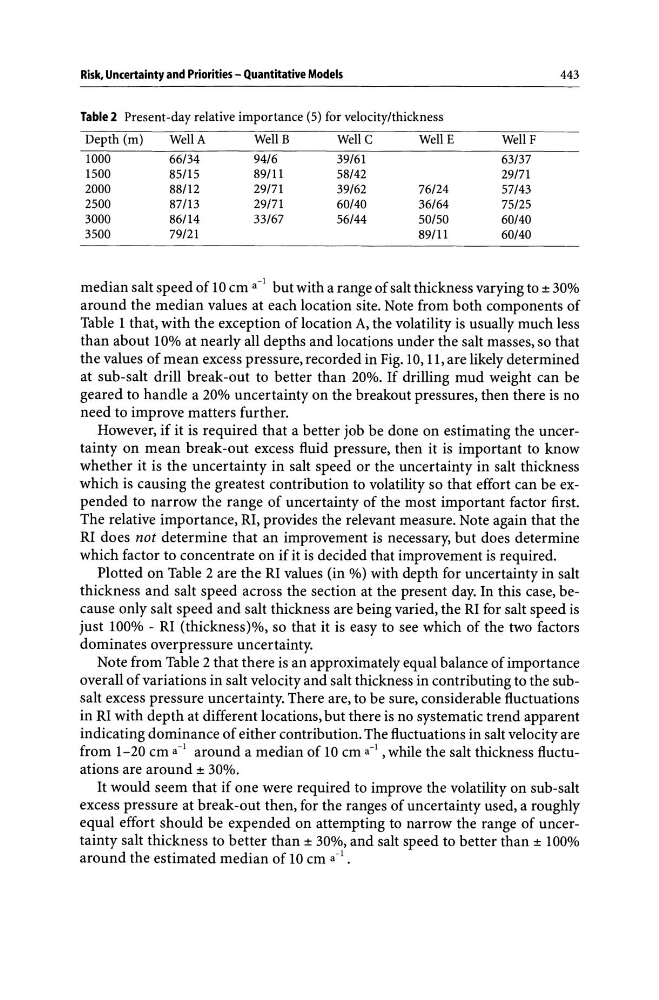
Table 2 Present-day relative importance (5) for velocitylthickness
Depth (m)
Well A
WeliB
Welle
WellE
Well F
1000
66/34
94/6
39/61
63/37
1500
85/15
89/11
58/42
29171
2000
88/12
29/71
39/62
76/24
57/43
2500
87/13
29/71
60/40
36/64
75/25
3000
86/14
33/67
56/44
50/50
60/40
3500
79121
89/11
60/40
median salt speed of 10 cm a -I but with a range of salt thickness varying to ± 30%
around the median values at each location site. Note from both components of
Table 1 that, with the exception of location A, the volatility is usually much less
than about 10% at nearly all depths and locations under the salt masses, so that
the values of mean excess pressure, recorded in Fig. 10, II, are likely determined
at sub-salt drill break-out to better than 20%. If drilling mud weight can be
geared to handle a 20% uncertainty on the breakout pressures, then there is no
need to improve matters further.
However, if it is required that a better job be done on estimating the uncertainty on mean break-out excess fluid pressure, then it is important to know
whether it is the uncertainty in salt speed or the uncertainty in salt thickness
which is causing the greatest contribution to volatility so that effort can be expended to narrow the range of uncertainty of the most important factor first.
The relative importance, RI, provides the relevant measure. Note again that the
RI does not determine that an improvement is necessary, but does determine
which factor to concentrate on if it is decided that improvement is required.
Plotted on Table 2 are the RI values (in %) with depth for uncertainty in salt
thickness and salt speed across the section at the present day. In this case, because only salt speed and salt thickness are being varied, the RI for salt speed is
just 100% - RI (thickness)%, so that it is easy to see which of the two factors
dominates overpressure uncertainty.
Note from Table 2 that there is an approximately equal balance of importance
overall of variations in salt velocity and salt thickness in contributing to the subsalt excess pressure uncertainty. There are, to be sure, considerable fluctuations
in RI with depth at different locations, but there is no systematic trend apparent
indicating dominance of either contribution. The fluctuations in salt velocity are
from 1-20 cm a-I around a median of 10 cm a-I, while the salt thickness fluctuations are around ± 30%.
It would seem that if one were required to improve the volatility on sub-salt
excess pressure at break-out then, for the ranges of uncertainty used, a roughly
equal effort should be expended on attempting to narrow the range of uncertainty salt thickness to better than ± 30%, and salt speed to better than ± 100%
around the estimated median of 10 cm a-I.
443
Table 2 Present-day relative importance (5) for velocitylthickness
Depth (m)
Well A
WeliB
Welle
WellE
Well F
1000
66/34
94/6
39/61
63/37
1500
85/15
89/11
58/42
29171
2000
88/12
29/71
39/62
76/24
57/43
2500
87/13
29/71
60/40
36/64
75/25
3000
86/14
33/67
56/44
50/50
60/40
3500
79121
89/11
60/40
median salt speed of 10 cm a -I but with a range of salt thickness varying to ± 30%
around the median values at each location site. Note from both components of
Table 1 that, with the exception of location A, the volatility is usually much less
than about 10% at nearly all depths and locations under the salt masses, so that
the values of mean excess pressure, recorded in Fig. 10, II, are likely determined
at sub-salt drill break-out to better than 20%. If drilling mud weight can be
geared to handle a 20% uncertainty on the breakout pressures, then there is no
need to improve matters further.
However, if it is required that a better job be done on estimating the uncertainty on mean break-out excess fluid pressure, then it is important to know
whether it is the uncertainty in salt speed or the uncertainty in salt thickness
which is causing the greatest contribution to volatility so that effort can be expended to narrow the range of uncertainty of the most important factor first.
The relative importance, RI, provides the relevant measure. Note again that the
RI does not determine that an improvement is necessary, but does determine
which factor to concentrate on if it is decided that improvement is required.
Plotted on Table 2 are the RI values (in %) with depth for uncertainty in salt
thickness and salt speed across the section at the present day. In this case, because only salt speed and salt thickness are being varied, the RI for salt speed is
just 100% - RI (thickness)%, so that it is easy to see which of the two factors
dominates overpressure uncertainty.
Note from Table 2 that there is an approximately equal balance of importance
overall of variations in salt velocity and salt thickness in contributing to the subsalt excess pressure uncertainty. There are, to be sure, considerable fluctuations
in RI with depth at different locations, but there is no systematic trend apparent
indicating dominance of either contribution. The fluctuations in salt velocity are
from 1-20 cm a-I around a median of 10 cm a-I, while the salt thickness fluctuations are around ± 30%.
It would seem that if one were required to improve the volatility on sub-salt
excess pressure at break-out then, for the ranges of uncertainty used, a roughly
equal effort should be expended on attempting to narrow the range of uncertainty salt thickness to better than ± 30%, and salt speed to better than ± 100%
around the estimated median of 10 cm a-I.