

Validation of Sediment Accumulation Regions in Kansas, USA
343
~
0.
:>
~
~
0;
(/)
u
~
c
. .
Cl
,. . .
e
U
. .
'" . .
,.,
:>
Z
0;
(/)
~ . .
<:
. .
Cl
'" . .
e
u
. .
u c
:>
::IE
OulYltaGSU
weaGSu
StafkGSU
Huo/1pYd
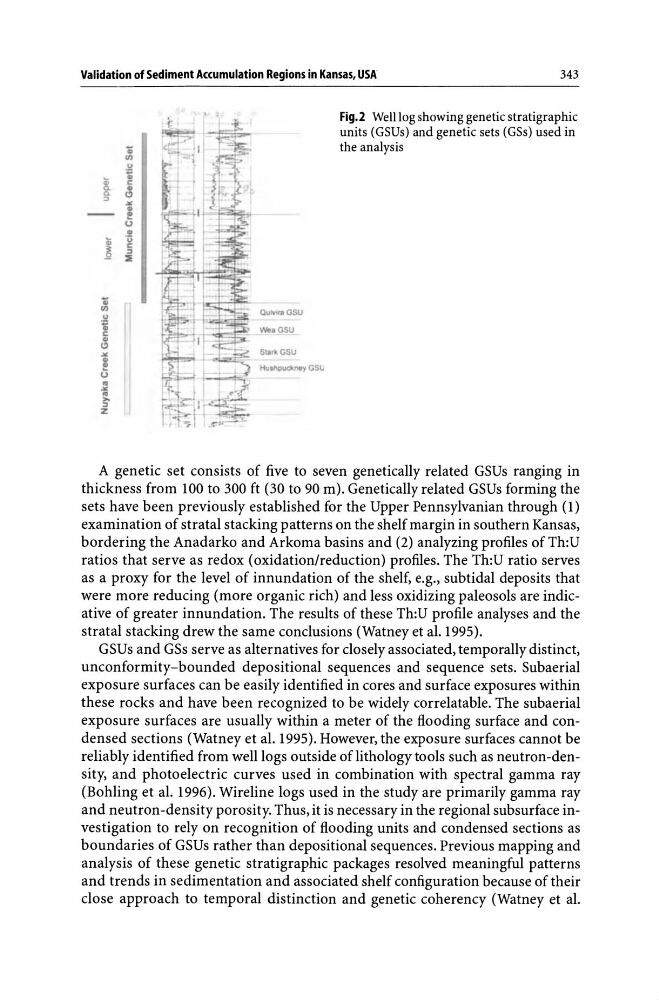
units (GSUs) and genetic sets (GSs) used in
the analysis
A genetic set consists of five to seven genetically related GSUs ranging in
thickness from 100 to 300 ft (30 to 90 m). Genetically related GSUs forming the
sets have been previously established for the Upper Pennsylvanian through (1)
examination of stratal stacking patterns on the shelf margin in southern Kansas,
bordering the Anadarko and Arkoma basins and (2) analyzing profiles of Th:U
ratios that serve as redox (oxidation/reduction) profiles. The Th:U ratio serves
as a proxy for the level of innundation of the shelf, e.g., subtidal deposits that
were more reducing (more organic rich) and less oxidizing paleosols are indicative of greater innundation. The results of these Th: U profile analyses and the
stratal stacking drew the same conclusions (Watney et al. 1995).
GSUs and GSs serve as alternatives for closely associated, temporally distinct,
unconformity-bounded depositional sequences and sequence sets. Subaerial
exposure surfaces can be easily identified in cores and surface exposures within
these rocks and have been recognized to be widely correlatable. The subaerial
exposure surfaces are usually within a meter of the flooding surface and condensed sections (Watney et al. 1995). However, the exposure surfaces cannot be
reliably identified from well logs outside of lithology tools such as neutron-density, and photoelectric curves used in combination with spectral gamma ray
(Bohling et al. 1996). Wireline logs used in the study are primarily gamma ray
and neutron-density porosity. Thus, it is necessary in the regional subsurface investigation to rely on recognition of flooding units and condensed sections as
boundaries of GSUs rather than depositional sequences. Previous mapping and
analysis of these genetic stratigraphic packages resolved meaningful patterns
and trends in sedimentation and associated shelf configuration because of their
close approach to temporal distinction and genetic coherency (Watney et al.
343
~
0.
:>
~
~
0;
(/)
u
~
c
. .
Cl
,. . .
e
U
. .
'" . .
,.,
:>
Z
0;
(/)
~ . .
<:
. .
Cl
'" . .
e
u
. .
u c
:>
::IE
OulYltaGSU
weaGSu
StafkGSU
Huo/1pYd
units (GSUs) and genetic sets (GSs) used in
the analysis
A genetic set consists of five to seven genetically related GSUs ranging in
thickness from 100 to 300 ft (30 to 90 m). Genetically related GSUs forming the
sets have been previously established for the Upper Pennsylvanian through (1)
examination of stratal stacking patterns on the shelf margin in southern Kansas,
bordering the Anadarko and Arkoma basins and (2) analyzing profiles of Th:U
ratios that serve as redox (oxidation/reduction) profiles. The Th:U ratio serves
as a proxy for the level of innundation of the shelf, e.g., subtidal deposits that
were more reducing (more organic rich) and less oxidizing paleosols are indicative of greater innundation. The results of these Th: U profile analyses and the
stratal stacking drew the same conclusions (Watney et al. 1995).
GSUs and GSs serve as alternatives for closely associated, temporally distinct,
unconformity-bounded depositional sequences and sequence sets. Subaerial
exposure surfaces can be easily identified in cores and surface exposures within
these rocks and have been recognized to be widely correlatable. The subaerial
exposure surfaces are usually within a meter of the flooding surface and condensed sections (Watney et al. 1995). However, the exposure surfaces cannot be
reliably identified from well logs outside of lithology tools such as neutron-density, and photoelectric curves used in combination with spectral gamma ray
(Bohling et al. 1996). Wireline logs used in the study are primarily gamma ray
and neutron-density porosity. Thus, it is necessary in the regional subsurface investigation to rely on recognition of flooding units and condensed sections as
boundaries of GSUs rather than depositional sequences. Previous mapping and
analysis of these genetic stratigraphic packages resolved meaningful patterns
and trends in sedimentation and associated shelf configuration because of their
close approach to temporal distinction and genetic coherency (Watney et al.