

Lagrangian Modelling Techniques Simulating Wave and Sediment Dynamics ...
19
of sediment being entrained in response to instantaneous currents, turbulence
and pressure gradients at the bed, and (ii) a "sink" associated with the settling of
previously entrained sediments In steady flows where bed availability is constant, these two components are equal, but they are often different in non-steady
environments (Black, 1994). Thus, it is physically important and notionally simpler to treat the two as independent.
In POL3DD, suspended sediment entrainment is calculated at multiple positions within each cell. The model selects random positions throughout the cells
because: (i) cell wall mid-point releases would put the sediment onto particular
streamlines and (ii) random releases on the cell walls only (as for bedload) are
insufficient because SSC can travel larger distances than the bedload, thereby
connecting the walls to the internal domain of the cells.
In the model, entrained particles are released at bed level, each carrying a
concentration equal to the local suspended sediment concentration calculated
after interpolating for local current strength, bed conditions, bed roughness,
grain fall velocity and grain size. The mass carried by each entrained particle is
an equal fraction of the total mass suspended during the time step. Knowing
concentration and mass, the particle "volume" is calculated.
Specifically, a sediment flux boundary condition is applied (Black, 1994). The
mass suspended is,
My =CzAwsLlt,
where A is bed area and C z is a near-bed concentration. Thus, the total mass entrained in a time step over a cell with dimensions L\x,Lly is
MT = COWs (mM) AxLly ,
where Co is the near-bed concentration calculated using one of the empirical
sediment suspension formulae (e.g. Nielsen, 1986) and m provides a time splitting option and is the number of time steps between simulated entrainment
events. If NR is the number of particles entrained within each model cell, the
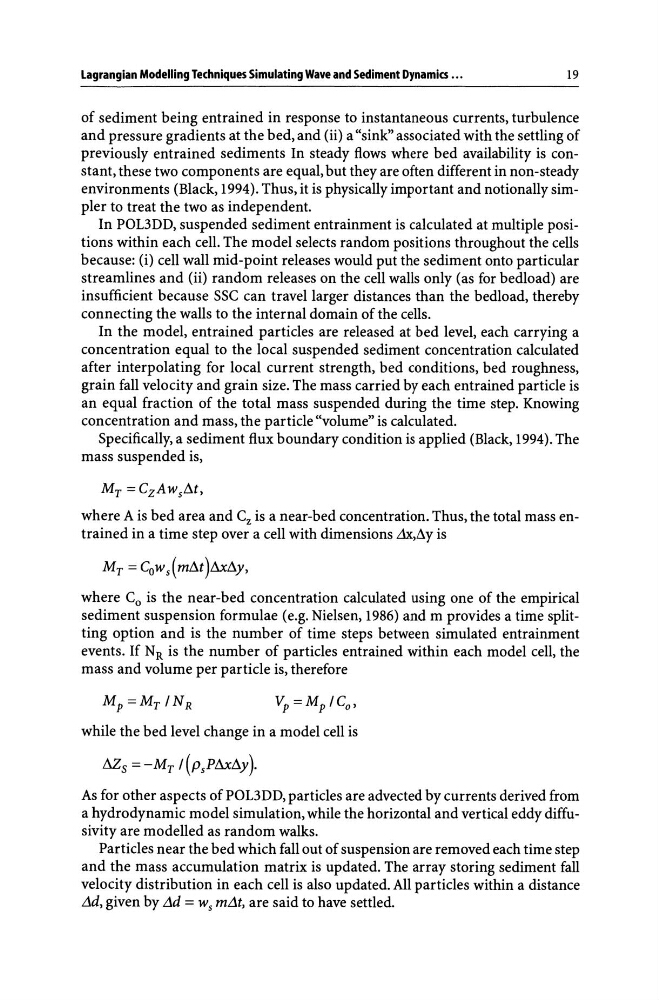
mass and volume per particle is, therefore
while the bed level change in a model cell is
As for other aspects of POL3DD, particles are advected by currents derived from
a hydrodynamic model simulation, while the horizontal and vertical eddy diffusivity are modelled as random walks.
Particles near the bed which fall out of suspension are removed each time step
and the mass accumulation matrix is updated. The array storing sediment fall
velocity distribution in each cell is also updated. All particles within a distance
L1d, given by L1d = W 5 mL1t, are said to have settled.
19
of sediment being entrained in response to instantaneous currents, turbulence
and pressure gradients at the bed, and (ii) a "sink" associated with the settling of
previously entrained sediments In steady flows where bed availability is constant, these two components are equal, but they are often different in non-steady
environments (Black, 1994). Thus, it is physically important and notionally simpler to treat the two as independent.
In POL3DD, suspended sediment entrainment is calculated at multiple positions within each cell. The model selects random positions throughout the cells
because: (i) cell wall mid-point releases would put the sediment onto particular
streamlines and (ii) random releases on the cell walls only (as for bedload) are
insufficient because SSC can travel larger distances than the bedload, thereby
connecting the walls to the internal domain of the cells.
In the model, entrained particles are released at bed level, each carrying a
concentration equal to the local suspended sediment concentration calculated
after interpolating for local current strength, bed conditions, bed roughness,
grain fall velocity and grain size. The mass carried by each entrained particle is
an equal fraction of the total mass suspended during the time step. Knowing
concentration and mass, the particle "volume" is calculated.
Specifically, a sediment flux boundary condition is applied (Black, 1994). The
mass suspended is,
My =CzAwsLlt,
where A is bed area and C z is a near-bed concentration. Thus, the total mass entrained in a time step over a cell with dimensions L\x,Lly is
MT = COWs (mM) AxLly ,
where Co is the near-bed concentration calculated using one of the empirical
sediment suspension formulae (e.g. Nielsen, 1986) and m provides a time splitting option and is the number of time steps between simulated entrainment
events. If NR is the number of particles entrained within each model cell, the
mass and volume per particle is, therefore
while the bed level change in a model cell is
As for other aspects of POL3DD, particles are advected by currents derived from
a hydrodynamic model simulation, while the horizontal and vertical eddy diffusivity are modelled as random walks.
Particles near the bed which fall out of suspension are removed each time step
and the mass accumulation matrix is updated. The array storing sediment fall
velocity distribution in each cell is also updated. All particles within a distance
L1d, given by L1d = W 5 mL1t, are said to have settled.