

20
K. Black· M. Green· T. Healy· R. Bell· J. Oldman· T. Hume
To fulfil the sediment flux boundary condition, diffusive random -walk excursions downwards which would carry a particle to the bed are disallowed by setting jump length to zero. This has implications for the entrainment simulation.
During the entrainment phase, particles are placed at bed level with a calculated
mass M p ' as described above. In disallowing downward jumps, a fraction of
these particles remain at the bed level after the diffusion stage and will therefore
fall out of suspension when their vertical advection is calculated next. Such deposition is a numerical artefact as the particles should be remaining in the water
column with the newly-entrained component. Numerically, the problem can be
treated by adding more particles or making a mass adjustment. The following
approach was adopted in POL3DD.
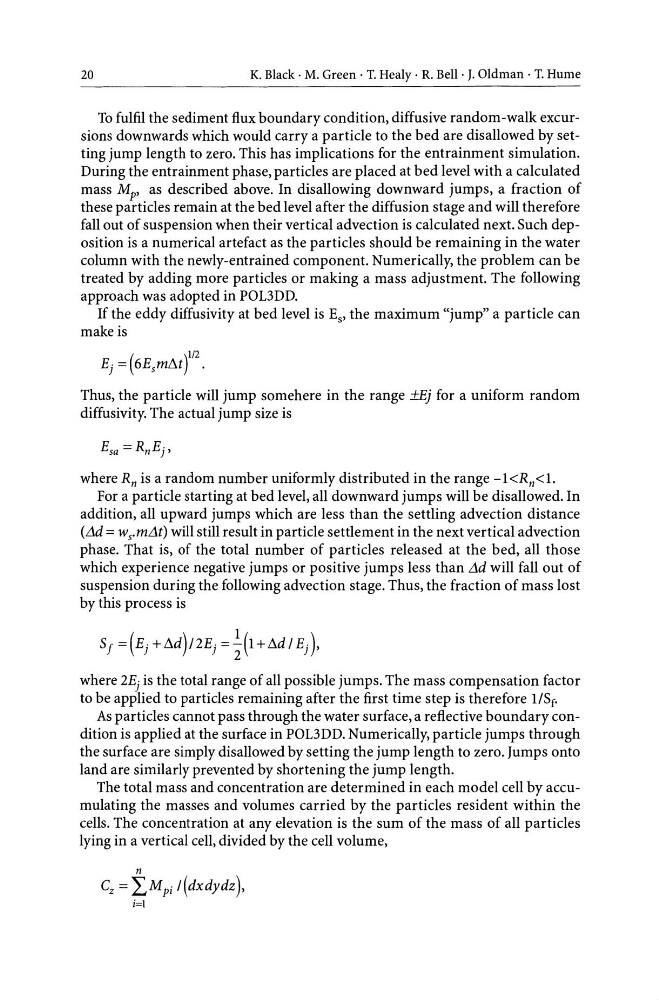
If the eddy diffusivity at bed level is E s ' the maximum "jump" a particle can
make is
(
)
112
E j = 6Esmi1t .
Thus, the particle will jump somehere in the range ±Ej for a uniform random
diffusivity. The actual jump size is
where Rn is a random number uniformly distributed in the range -1
addition, all upward jumps which are less than the settling advection distance
(Lld = ws.mLlt) will still result in particle settlement in the next vertical advection
phase. That is, of the total number of particles released at the bed, all those
which experience negative jumps or positive jumps less than Lld will fall out of
suspension during the following advection stage. Thus, the fraction of mass lost
by this process is
where 2E j is the total range of all possible jumps. The mass compensation factor
to be applied to particles remaining after the first time step is therefore 1IS[.
As particles cannot pass through the water surface, a reflective boundary condition is applied at the surface in POL3DD. Numerically, particle jumps through
the surface are simply disallowed by setting the jump length to zero. Jumps onto
land are similarly prevented by shortening the jump length.
The total mass and concentration are determined in each model cell by accumulating the masses and volumes carried by the particles resident within the
cells. The concentration at any elevation is the sum of the mass of all particles
lying in a vertical cell, divided by the cell volume,
n
Cz = I,MPi I(dxdydz),
i=1
K. Black· M. Green· T. Healy· R. Bell· J. Oldman· T. Hume
To fulfil the sediment flux boundary condition, diffusive random -walk excursions downwards which would carry a particle to the bed are disallowed by setting jump length to zero. This has implications for the entrainment simulation.
During the entrainment phase, particles are placed at bed level with a calculated
mass M p ' as described above. In disallowing downward jumps, a fraction of
these particles remain at the bed level after the diffusion stage and will therefore
fall out of suspension when their vertical advection is calculated next. Such deposition is a numerical artefact as the particles should be remaining in the water
column with the newly-entrained component. Numerically, the problem can be
treated by adding more particles or making a mass adjustment. The following
approach was adopted in POL3DD.
If the eddy diffusivity at bed level is E s ' the maximum "jump" a particle can
make is
(
)
112
E j = 6Esmi1t .
Thus, the particle will jump somehere in the range ±Ej for a uniform random
diffusivity. The actual jump size is
where Rn is a random number uniformly distributed in the range -1
addition, all upward jumps which are less than the settling advection distance
(Lld = ws.mLlt) will still result in particle settlement in the next vertical advection
phase. That is, of the total number of particles released at the bed, all those
which experience negative jumps or positive jumps less than Lld will fall out of
suspension during the following advection stage. Thus, the fraction of mass lost
by this process is
where 2E j is the total range of all possible jumps. The mass compensation factor
to be applied to particles remaining after the first time step is therefore 1IS[.
As particles cannot pass through the water surface, a reflective boundary condition is applied at the surface in POL3DD. Numerically, particle jumps through
the surface are simply disallowed by setting the jump length to zero. Jumps onto
land are similarly prevented by shortening the jump length.
The total mass and concentration are determined in each model cell by accumulating the masses and volumes carried by the particles resident within the
cells. The concentration at any elevation is the sum of the mass of all particles
lying in a vertical cell, divided by the cell volume,
n
Cz = I,MPi I(dxdydz),
i=1