

18
K. Black· M. Green· T. Healy· R. Bell· J. Oldman· T. Hume
ordinate in a sigma transformed coordinate system, it is possible to apply chosen vertical velocity profiles around the mean (vertically-averaged) current for
those cases when a 2-dimensional hydrodynamic model is used to generate the
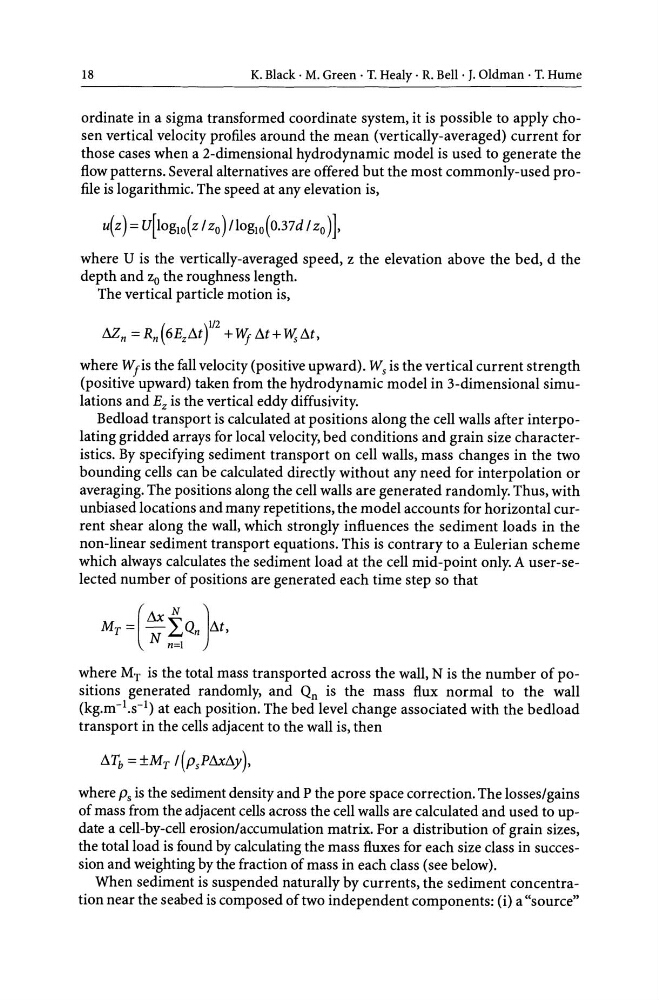
flow patterns. Several alternatives are offered but the most commonly-used profile is logarithmic. The speed at any elevation is,
U(Z) = U[loglO(Z / zo) /lOglO( 0.37d / zo)],
where U is the vertically-averaged speed, z the elevation above the bed, d the
depth and Zo the roughness length.
The vertical particle motion is,
(
)
112
t1Zn =Rn 6EzM
+V\fM+~M,
where Wfis the fall velocity (positive upward). Ws is the vertical current strength
(positive upward) taken from the hydrodynamic model in 3-dimensional simulations and E z is the vertical eddy diffusivity.
Bedload transport is calculated at positions along the cell walls after interpolating gridded arrays for local velocity, bed conditions and grain size characteristics. By specifying sediment transport on cell walls, mass changes in the two
bounding cells can be calculated directly without any need for interpolation or
averaging. The positions along the cell walls are generated randomly. Thus, with
unbiased locations and many repetitions, the model accounts for horizontal current shear along the wall, which strongly influences the sediment loads in the
non-linear sediment transport equations. This is contrary to a Eulerian scheme
which always calculates the sediment load at the cell mid-point only. A user-selected number of positions are generated each time step so that
Mr =(~fQnlM' N n=l
where MT is the total mass transported across the wall, N is the number of positions generated randomly, and Q n is the mass flux normal to the wall
(kg.m-1.s- 1 ) at each position. The bed level change associated with the bedload
transport in the cells adjacent to the wall is, then
where Ps is the sediment density and p the pore space correction. The losses/gains
of mass from the adjacent cells across the cell walls are calculated and used to update a cell-by-cell erosion/accumulation matrix. For a distribution of grain sizes,
the total load is found by calculating the mass fluxes for each size class in succession and weighting by the fraction of mass in each class (see below).
When sediment is suspended naturally by currents, the sediment concentration near the seabed is composed of two independent components: (i) a "source"
K. Black· M. Green· T. Healy· R. Bell· J. Oldman· T. Hume
ordinate in a sigma transformed coordinate system, it is possible to apply chosen vertical velocity profiles around the mean (vertically-averaged) current for
those cases when a 2-dimensional hydrodynamic model is used to generate the
flow patterns. Several alternatives are offered but the most commonly-used profile is logarithmic. The speed at any elevation is,
U(Z) = U[loglO(Z / zo) /lOglO( 0.37d / zo)],
where U is the vertically-averaged speed, z the elevation above the bed, d the
depth and Zo the roughness length.
The vertical particle motion is,
(
)
112
t1Zn =Rn 6EzM
+V\fM+~M,
where Wfis the fall velocity (positive upward). Ws is the vertical current strength
(positive upward) taken from the hydrodynamic model in 3-dimensional simulations and E z is the vertical eddy diffusivity.
Bedload transport is calculated at positions along the cell walls after interpolating gridded arrays for local velocity, bed conditions and grain size characteristics. By specifying sediment transport on cell walls, mass changes in the two
bounding cells can be calculated directly without any need for interpolation or
averaging. The positions along the cell walls are generated randomly. Thus, with
unbiased locations and many repetitions, the model accounts for horizontal current shear along the wall, which strongly influences the sediment loads in the
non-linear sediment transport equations. This is contrary to a Eulerian scheme
which always calculates the sediment load at the cell mid-point only. A user-selected number of positions are generated each time step so that
Mr =(~fQnlM' N n=l
where MT is the total mass transported across the wall, N is the number of positions generated randomly, and Q n is the mass flux normal to the wall
(kg.m-1.s- 1 ) at each position. The bed level change associated with the bedload
transport in the cells adjacent to the wall is, then
where Ps is the sediment density and p the pore space correction. The losses/gains
of mass from the adjacent cells across the cell walls are calculated and used to update a cell-by-cell erosion/accumulation matrix. For a distribution of grain sizes,
the total load is found by calculating the mass fluxes for each size class in succession and weighting by the fraction of mass in each class (see below).
When sediment is suspended naturally by currents, the sediment concentration near the seabed is composed of two independent components: (i) a "source"