

Quantitative Stratigraphy of Sedimentary Sequences
283
Processing 1
Processing 2
Processing 3
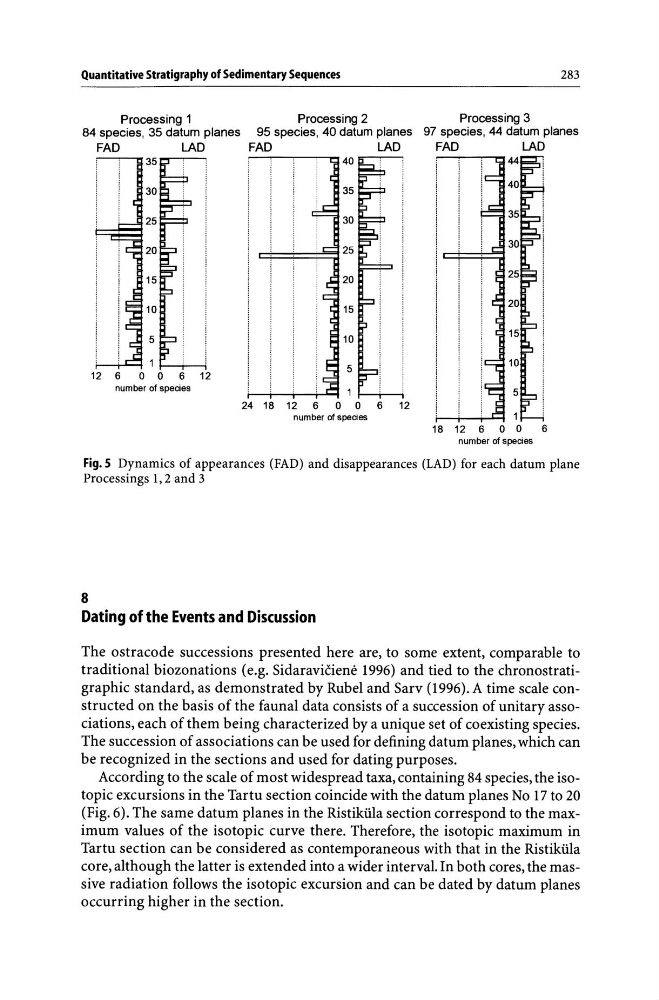
84 species, 35 datum planes 95 species, 40 datum planes 97 species, 44 datum planes
FAD
LAD
FAD
LAD
FAD
LAD
12 6
0 0
6 12
number of species
24 18 12
6
0 0
6
12
number of species
18 12 6
0 0
6
number of species
Fig.S Dynamics of appearances (FAD) and disappearances (LAD) for each datum plane
Processings 1, 2 and 3
8
Dating of the Events and Discussion
The ostracode successions presented here are, to some extent, comparable to
traditional biozonations (e.g. SidaraviCiene 1996) and tied to the chronostratigraphic standard, as demonstrated by Rubel and Sarv (1996). A time scale constructed on the basis of the faunal data consists of a succession of unitary associations, each of them being characterized by a unique set of coexisting species.
The succession of associations can be used for defining datum planes, which can
be recognized in the sections and used for dating purposes.
According to the scale of most widespread taxa, containing 84 species, the isotopic excursions in the Tartu section coincide with the datum planes No 17 to 20
(Fig. 6). The same datum planes in the Ristikiila section correspond to the maximum values of the isotopic curve there. Therefore, the isotopic maximum in
Tartu section can be considered as contemporaneous with that in the Ristikiila
core, although the latter is extended into a wider interval. In both cores, the massive radiation follows the isotopic excursion and can be dated by datum planes
occurring higher in the section.
283
Processing 1
Processing 2
Processing 3
84 species, 35 datum planes 95 species, 40 datum planes 97 species, 44 datum planes
FAD
LAD
FAD
LAD
FAD
LAD
12 6
0 0
6 12
number of species
24 18 12
6
0 0
6
12
number of species
18 12 6
0 0
6
number of species
Fig.S Dynamics of appearances (FAD) and disappearances (LAD) for each datum plane
Processings 1, 2 and 3
8
Dating of the Events and Discussion
The ostracode successions presented here are, to some extent, comparable to
traditional biozonations (e.g. SidaraviCiene 1996) and tied to the chronostratigraphic standard, as demonstrated by Rubel and Sarv (1996). A time scale constructed on the basis of the faunal data consists of a succession of unitary associations, each of them being characterized by a unique set of coexisting species.
The succession of associations can be used for defining datum planes, which can
be recognized in the sections and used for dating purposes.
According to the scale of most widespread taxa, containing 84 species, the isotopic excursions in the Tartu section coincide with the datum planes No 17 to 20
(Fig. 6). The same datum planes in the Ristikiila section correspond to the maximum values of the isotopic curve there. Therefore, the isotopic maximum in
Tartu section can be considered as contemporaneous with that in the Ristikiila
core, although the latter is extended into a wider interval. In both cores, the massive radiation follows the isotopic excursion and can be dated by datum planes
occurring higher in the section.