

284
L. Ainsaar, T. Martma, T. Meidla, M. Rubel and N. SidaraviCiene
Tartu
Stage. m.
VORMSI
--282.6
NABALA
--2853
RAKVERE
-
-
-
-
-
-
I I I 1 - , • • • • • • • • •
"11
-li-I-IOANDU
~.';'.';
--295.7
299.1
KEILA
--3137
HALJALA
I I I I I
I I I I
L-I-I"'·'
• • • • • • • • •
Ristiklila
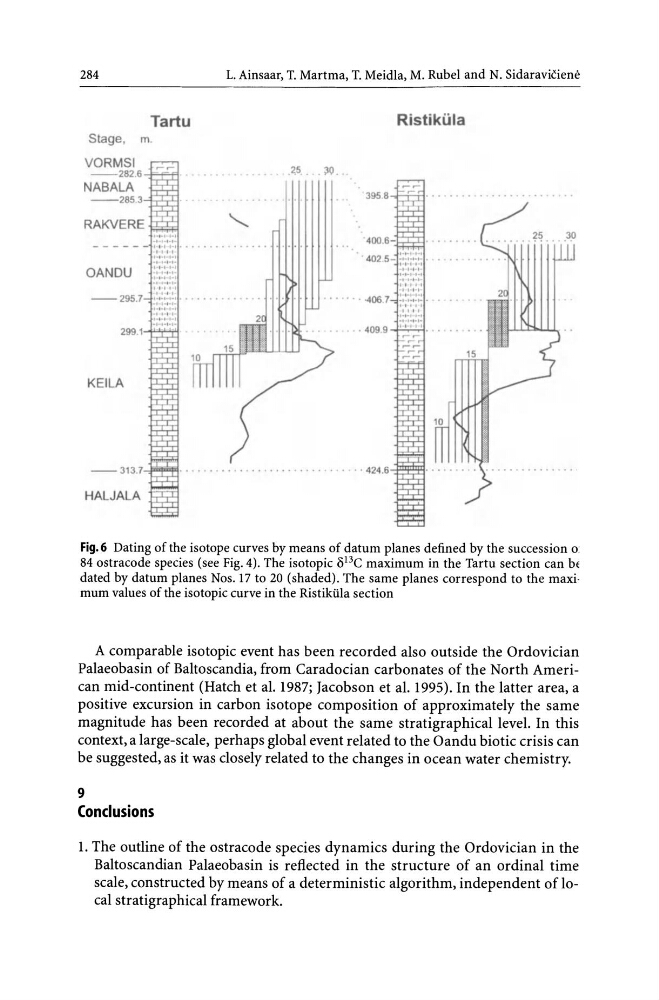
Fig.6 Dating of the isotope curves by means of datum planes defined by the succession 0
84 ostracode species (see Fig. 4). The isotopic 813e maximum in the Tartu section can b(
dated by datum planes Nos. 17 to 20 (shaded). The same planes correspond to the maximum values of the isotopic curve in the Ristikiila section
A comparable isotopic event has been recorded also outside the Ordovician
Palaeobasin of Baltoscandia, from Caradocian carbonates of the North American mid-continent (Hatch et al. 1987; Jacobson et al. 1995). In the latter area, a
positive excursion in carbon isotope composition of approximately the same
magnitude has been recorded at about the same stratigraphical level. In this
context, a large-scale, perhaps global event related to the Oandu biotic crisis can
be suggested, as it was closely related to the changes in ocean water chemistry.
9
Conclusions
1. The outline of the ostracode species dynamics during the Ordovician in the
Baltoscandian Palaeo basin is reflected in the structure of an ordinal time
scale, constructed by means of a deterministic algorithm, independent of local stratigraphical framework.
L. Ainsaar, T. Martma, T. Meidla, M. Rubel and N. SidaraviCiene
Tartu
Stage. m.
VORMSI
--282.6
NABALA
--2853
RAKVERE
-
-
-
-
-
-
I I I 1 - , • • • • • • • • •
"11
-li-I-IOANDU
~.';'.';
--295.7
299.1
KEILA
--3137
HALJALA
I I I I I
I I I I
L-I-I"'·'
• • • • • • • • •
Ristiklila
Fig.6 Dating of the isotope curves by means of datum planes defined by the succession 0
84 ostracode species (see Fig. 4). The isotopic 813e maximum in the Tartu section can b(
dated by datum planes Nos. 17 to 20 (shaded). The same planes correspond to the maximum values of the isotopic curve in the Ristikiila section
A comparable isotopic event has been recorded also outside the Ordovician
Palaeobasin of Baltoscandia, from Caradocian carbonates of the North American mid-continent (Hatch et al. 1987; Jacobson et al. 1995). In the latter area, a
positive excursion in carbon isotope composition of approximately the same
magnitude has been recorded at about the same stratigraphical level. In this
context, a large-scale, perhaps global event related to the Oandu biotic crisis can
be suggested, as it was closely related to the changes in ocean water chemistry.
9
Conclusions
1. The outline of the ostracode species dynamics during the Ordovician in the
Baltoscandian Palaeo basin is reflected in the structure of an ordinal time
scale, constructed by means of a deterministic algorithm, independent of local stratigraphical framework.