

Milankovitch Cycles and Sequences: Two Different Stratigraphic Tools
-2.0
0'·0
-1.5
- 1 . 0 + - ' ' - - - - - - - - - - ' - - , - - - - - - - - - ,
-2.0
-1.5
0'·0
-1.0
251
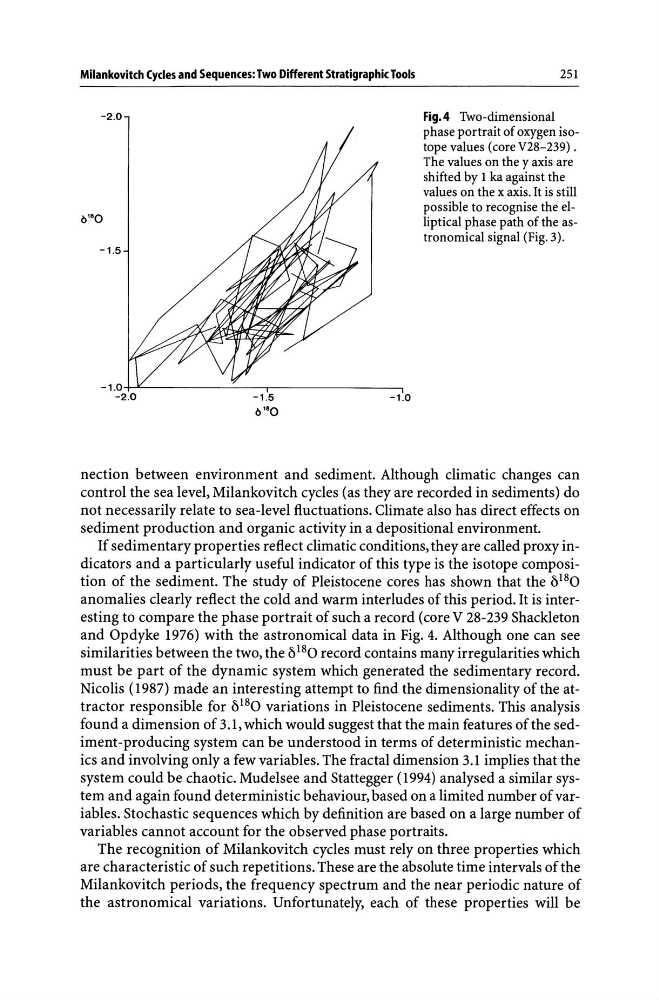
Fig.4 Two-dimensional
phase portrait of oxygen isotope values (core V2S-239) .
The values on the y axis are
shifted by 1 ka against the
values on the x axis. It is still
possible to recognise the elliptical phase path of the astronomical signal (Fig. 3).
nection between environment and sediment. Although climatic changes can
control the sea level, Milankovitch cycles (as they are recorded in sediments) do
not necessarily relate to sea-level fluctuations. Climate also has direct effects on
sediment production and organic activity in a depositional environment.
If sedimentary properties reflect climatic conditions, they are called proxy indicators and a particularly useful indicator of this type is the isotope composition of the sediment. The study of Pleistocene cores has shown that the elBo
anomalies clearly reflect the cold and warm interludes of this period. It is interesting to compare the phase portrait of such a record (core V 28-239 Shackleton
and Opdyke 1976) with the astronomical data in Fig. 4. Although one can see
similarities between the two, the elBo record contains many irregularities which
must be part of the dynamic system which generated the sedimentary record.
Nicolis (1987) made an interesting attempt to find the dimensionality of the attractor responsible for elBo variations in Pleistocene sediments. This analysis
found a dimension of 3.1, which would suggest that the main features of the sediment-producing system can be understood in terms of deterministic mechanics and involving only a few variables. The fractal dimension 3.1 implies that the
system could be chaotic. Mudelsee and Stattegger (1994) analysed a similar system and again found deterministic behaviour, based on a limited number of variables. Stochastic sequences which by definition are based on a large number of
variables cannot account for the observed phase portraits.
The recognition of Milankovitch cycles must rely on three properties which
are characteristic of such repetitions. These are the absolute time intervals of the
Milankovitch periods, the frequency spectrum and the near periodic nature of
the astronomical variations. Unfortunately, each of these properties will be
-2.0
0'·0
-1.5
- 1 . 0 + - ' ' - - - - - - - - - - ' - - , - - - - - - - - - ,
-2.0
-1.5
0'·0
-1.0
251
Fig.4 Two-dimensional
phase portrait of oxygen isotope values (core V2S-239) .
The values on the y axis are
shifted by 1 ka against the
values on the x axis. It is still
possible to recognise the elliptical phase path of the astronomical signal (Fig. 3).
nection between environment and sediment. Although climatic changes can
control the sea level, Milankovitch cycles (as they are recorded in sediments) do
not necessarily relate to sea-level fluctuations. Climate also has direct effects on
sediment production and organic activity in a depositional environment.
If sedimentary properties reflect climatic conditions, they are called proxy indicators and a particularly useful indicator of this type is the isotope composition of the sediment. The study of Pleistocene cores has shown that the elBo
anomalies clearly reflect the cold and warm interludes of this period. It is interesting to compare the phase portrait of such a record (core V 28-239 Shackleton
and Opdyke 1976) with the astronomical data in Fig. 4. Although one can see
similarities between the two, the elBo record contains many irregularities which
must be part of the dynamic system which generated the sedimentary record.
Nicolis (1987) made an interesting attempt to find the dimensionality of the attractor responsible for elBo variations in Pleistocene sediments. This analysis
found a dimension of 3.1, which would suggest that the main features of the sediment-producing system can be understood in terms of deterministic mechanics and involving only a few variables. The fractal dimension 3.1 implies that the
system could be chaotic. Mudelsee and Stattegger (1994) analysed a similar system and again found deterministic behaviour, based on a limited number of variables. Stochastic sequences which by definition are based on a large number of
variables cannot account for the observed phase portraits.
The recognition of Milankovitch cycles must rely on three properties which
are characteristic of such repetitions. These are the absolute time intervals of the
Milankovitch periods, the frequency spectrum and the near periodic nature of
the astronomical variations. Unfortunately, each of these properties will be