

252
VV. Sch¥varzacher
changed by sedimentation and therefore each is difficult to recognise in the
stratigraphic record.
4
The Milankovitch Spectrum
The astronomical system which is responsible for climate and sediment developments contains three main elements, eccentricity, obliquity and precession.
Each of these consists of a complex frequency spectrum but as a first approximation, one can assume an average period of 21 ka for the precession, a period of
40 ka for the obliquity and periods of 100,400 and 2000 ka for the eccentricity.
Theoretically, insolation in low latitudes is largely determined by the precession
signal, and in higher latitudes, the obliquity signal becomes more important.
The eccentricity modulates both signals.
As already stressed, the relationship between theoretical insolation and climate is not linear but both the climatic and the stratigraphic records show similar periodicities to the astronomical record and preserve the frequency ratios of
the various periods. In other words, the stratigraphic record, depending on its
completeness, should have ratios between observed frequencies similar to those
found in the Milankovitch spectrum. The ratios therefore can be used as criteria
for recognising Milankovitch cycles.
The most commonly quoted ratio of Milankovitch cycles is the ratio of eccentricity to precession (which is approximately 1:5). This is indeed approximate
and will fluctuate. For example, using insolation values for a latitude of 30 0 N
calculated by Berger and Loutre (1991) for the interval of 2 Ma to 6 Ma before
present, at l-ka intervals, one finds 125 maxima. The amplitudes of the maxima
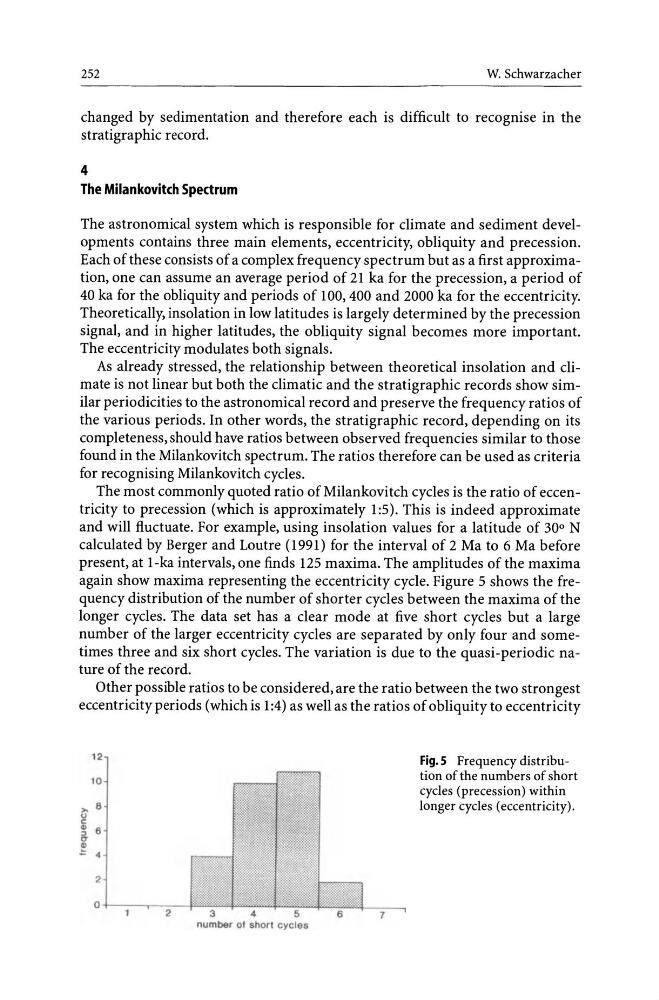
again show maxima representing the eccentricity cycle. Figure 5 shows the frequency distribution of the number of shorter cycles between the maxima of the
longer cycles. The data set has a clear mode at five short cycles but a large
number of the larger eccentricity cycles are separated by only four and sometimes three and six short cycles. The variation is due to the quasi-periodic nature of the record.
Other possible ratios to be considered, are the ratio between the two strongest
eccentricity periods (which is 1 :4) as well as the ratios of obliquity to eccentricity
12
10
'" 8
" c
~ 8
0..
-= 4
2
0+----.-.,..-2
3
4
number 01 shorl cycles
Fig.5 Frequency distribution of the numbers of short
cycles (precession) ¥vithin
longer cycles (eccentricity).
VV. Sch¥varzacher
changed by sedimentation and therefore each is difficult to recognise in the
stratigraphic record.
4
The Milankovitch Spectrum
The astronomical system which is responsible for climate and sediment developments contains three main elements, eccentricity, obliquity and precession.
Each of these consists of a complex frequency spectrum but as a first approximation, one can assume an average period of 21 ka for the precession, a period of
40 ka for the obliquity and periods of 100,400 and 2000 ka for the eccentricity.
Theoretically, insolation in low latitudes is largely determined by the precession
signal, and in higher latitudes, the obliquity signal becomes more important.
The eccentricity modulates both signals.
As already stressed, the relationship between theoretical insolation and climate is not linear but both the climatic and the stratigraphic records show similar periodicities to the astronomical record and preserve the frequency ratios of
the various periods. In other words, the stratigraphic record, depending on its
completeness, should have ratios between observed frequencies similar to those
found in the Milankovitch spectrum. The ratios therefore can be used as criteria
for recognising Milankovitch cycles.
The most commonly quoted ratio of Milankovitch cycles is the ratio of eccentricity to precession (which is approximately 1:5). This is indeed approximate
and will fluctuate. For example, using insolation values for a latitude of 30 0 N
calculated by Berger and Loutre (1991) for the interval of 2 Ma to 6 Ma before
present, at l-ka intervals, one finds 125 maxima. The amplitudes of the maxima
again show maxima representing the eccentricity cycle. Figure 5 shows the frequency distribution of the number of shorter cycles between the maxima of the
longer cycles. The data set has a clear mode at five short cycles but a large
number of the larger eccentricity cycles are separated by only four and sometimes three and six short cycles. The variation is due to the quasi-periodic nature of the record.
Other possible ratios to be considered, are the ratio between the two strongest
eccentricity periods (which is 1 :4) as well as the ratios of obliquity to eccentricity
12
10
'" 8
" c
~ 8
0..
-= 4
2
0+----.-.,..-2
3
4
number 01 shorl cycles
Fig.5 Frequency distribution of the numbers of short
cycles (precession) ¥vithin
longer cycles (eccentricity).